
Picture the Gnostic cosmos the way most retellings hand it to you. A blind god at the top of a material world, convinced he built the universe alone. Layers of archon soldiers beneath him, one bolted to each level, keeping watch. No exit anywhere in the architecture, or so it would seem. Although that’s the story most people learn, it’s incomplete and fragmented.
The Nag Hammadi texts were sealed in jars with rolled up parchments, buried in Egyptian sand. they were lost to history for over a thousand years before a young farmer dug them up in 1945. We find out an archon breaks rank. His name was Sabaoth. What happened to it changes the shape of the whole story.
“Sabaoth didn’t escape the system. He built an embassy inside it.”
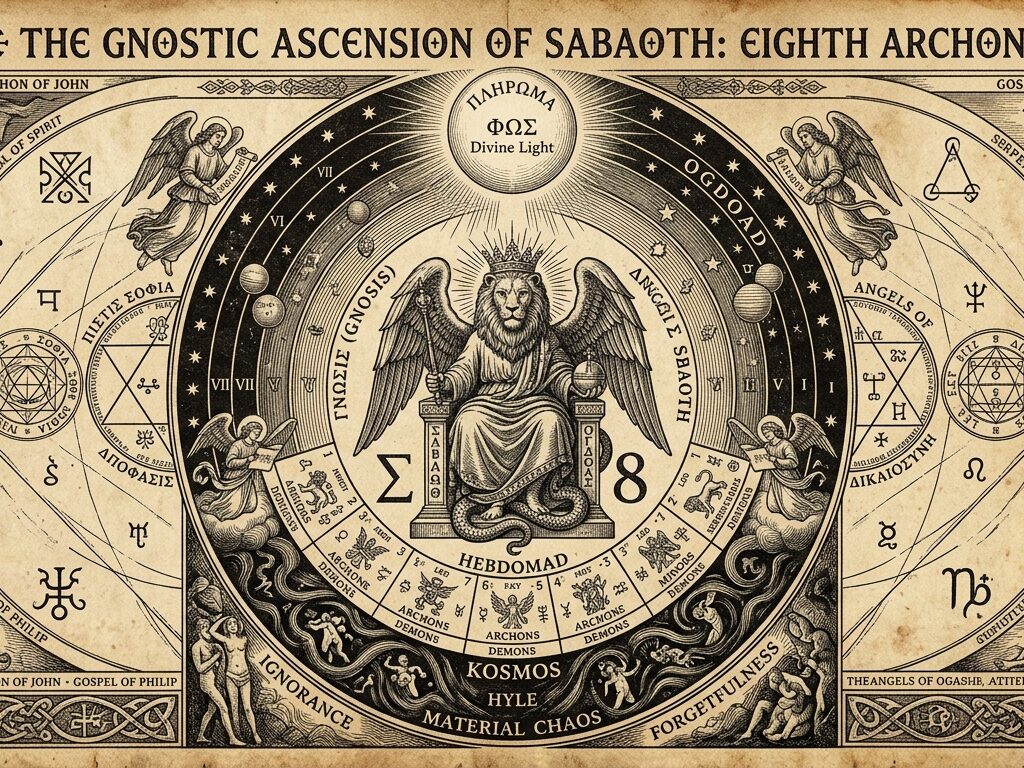
Born Inside the Machine
I’ve always been fascinated with the story of Sabaoth, the one who got away from the demiurge’s kingdom. The story is a hopeful one and gives us an exit to the daily crunch and feeling locked into systems. I don’t use he or she, as much as possible when referring to these emanations because I feel it negates their fullness. They are not humans as we are, therefore neither hes and shes. I refer to them as energy emanation, hence calling the it.
Sabaoth isn’t an outsider looking in. It is inside the demiurge’s plane of existence. In fact, it’s one of the sons of Yaldabaoth, the demiurge. Yaldabaoth is blind and arrogant, self-declared god of the Universe at the center of Gnostic cosmology. If you’ve read The Blind God and the Machinery of Control, you already know the story. Yaldabaoth built the material world out of sheer ignorance. It then convinced itself it was the highest power in existence. And Sabaoth was raised inside that conviction. It was part of the ruling household. It was groomed for the same blindness. Sounds familiar?
Then Pistis Sophia changes everything. Known as wisdom herself, an emanation of the true light above, it reaches down and says something Sabaoth was never supposed to hear. It condemns Yaldabaoth. It condemns the chaos he made. It opens his eyes, indirectly. And Sabaoth believes it. It starts to see the light and the limitation around its life.
On the Origin of the World puts it plainly: “Now when Sabaoth, the son of Yaldabaoth, heard the voice of Pistis, he sang praises to her, and he condemned the father.” The Hypostasis of the Archons tells nearly the same story with a different cast. There,s Sophia and its daughter Zoe, Life herself, deliver the revelation and lift it. Two texts with two slightly different figures doing the same work. It hears the truth and turns against its father. It’s free and liberated from the lie, or the veil as we would later hear.
No other archon in these two texts does this. Every other one stays sealed inside Yaldabaoth’s certainty, not because they’re evil, but because nothing ever reaches them. Sabaoth is different in exactly one respect. Something got through, and it let it change itself to higher realms of awareness.
What Repentance Bought Him
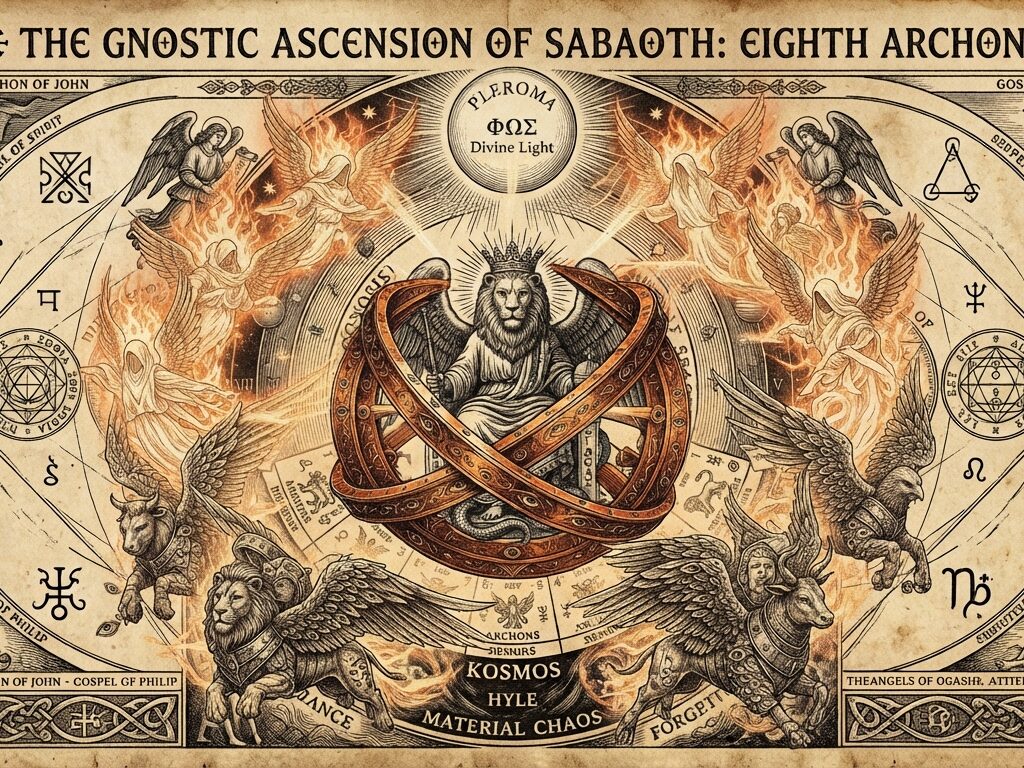
This is where the story stops being a footnote and starts being an interesting one for our evolution, showing us there are always more solutions then obstacles.
Pistis Sophia doesn’t just forgive Sabaoth. It raises it above every other archon, above the whole lower cosmos its father built. It calls Sabaoth to its right hand and puts its father at its left. The family order is flipped.
Pistis Sophia sets Sabaoth in the seventh heaven, just below the veil between the world above and the world below. It pours its own light into Sabaoth and teaches it about the eighth heaven. The eighth heaven is the region above Yaldabaoth creation where it doesn’t know exists and can never reach. Sophia teaches Sabaoth about the Universe and the Monad so that it can copy it. Once it’s there, Sabaoth doesn’t sit quietly. It starts to build.
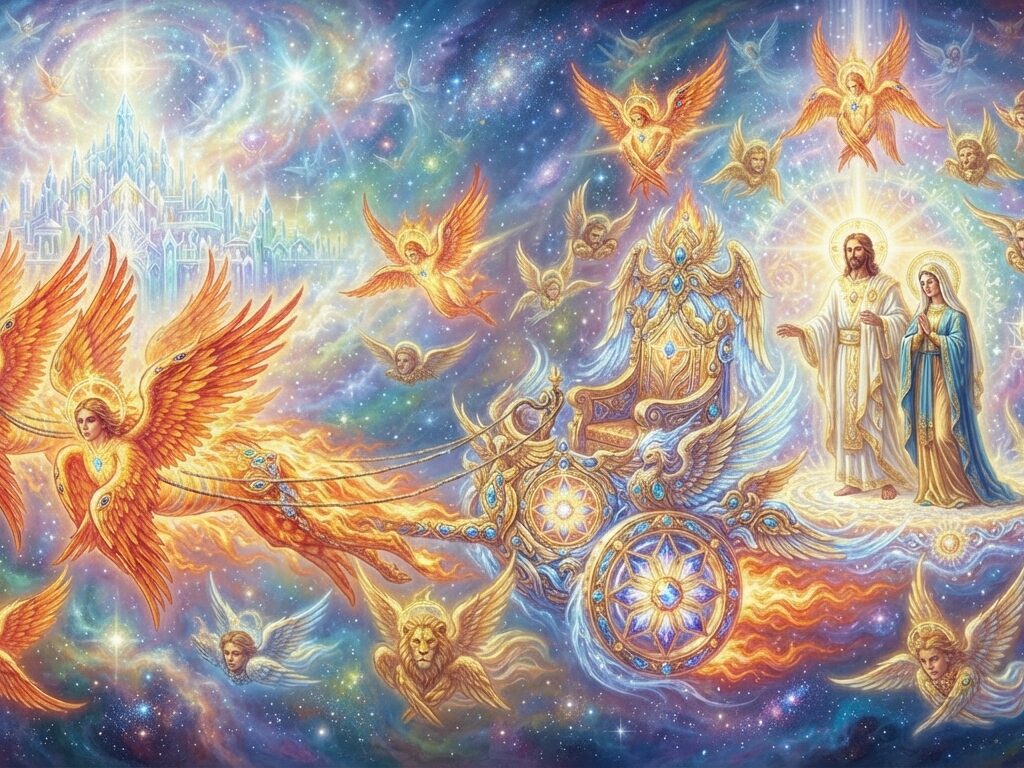
Origin of the World describes a huge throne set on a four-faced chariot called “Cherubim.” That is the throne-chariot from Ezekiel’s vision, the seat of the God of Israel. Beside it stand serpent-like angels called “Seraphim,” who praise him at all times. In Isaiah, seraphim circle God’s throne. The Hebrew word means “burning,” and it also means “fiery serpent.”
Around the throne is gathered a wide congregation of angels, thousands upon thousands, modeled on the assembly in the eighth heaven. The firstborn is named Israel, meaning “the man who sees God.” At its right sits the Christos. And at the left is the virgin of the holy spirit with seven virgins standing before the virgin playing thirty harps, psalteries and trumpets. From that chariot, the text says, seventy-two gods took shape to rule the seventy-two languages of the peoples.
A court. A choir. A government for the nations. But not a hideout.
The Hypostasis of the Archons paints the same court albeit, little differently. Sophia seats Life at the right to teach Sabaoth, and an angel of fury to the left.
As to the name Sabaoth, it means “hosts” or “armies.” In the Hebrew Bible, “Lord of Hosts” is a title of the God of Israel, and the scholar Bentley Layton tentatively links the Gnostic Sabaoth to that God. In a nutshell, the old throne room gets rebuilt here, by a repentant son, under Wisdom’s direction.
If you view that court against the world Yaldabaoth built below it, one becomes ruled by a god convinced he’s alone at the top. The other is built by its own son, in open imitation of a light its father cannot see and cannot reach. Sabaoth didn’t escape the system. It built an embassy inside it right at the border, which is where the veil is.
The Cost, and Why It Doesn’t Reach Him
When Yaldabaoth looks up and sees its own son ruling in a glory it’ll never touch, it doesn’t grieve. He envies. The envy takes shape. It becomes Death, a being in its own right. From Death comes a train of lesser powers that spread into the world below.
That text states it flatly: the prime parent’s jealousy engenders Death directly. And thus more mayhem is spread in the lower realm.
Keeping this in mind, consider how power structures behave when an insider leaves. This well and recognizable pattern isn’t nothing new. It’s ancient. Today, institutions rarely soften when one of their own wakes up and walks. More often than not, they tighten on everyone left behind, not on the one who’s gone. Sabaoth’s ascent triggers exactly that, anger and vengeance not on it, but n the lower strata. The system gets harder to live inside for everyone but Sabaoth.
“Institutions rarely soften when one of their own wakes up and walks. More often they tighten — on everyone left behind, not on the one who’s gone.”
Still, noting yields and Sabaoth’s position holds. The demiurge can rage, generate Death, flood the lower world with subordinate power. None of it reaches the seventh heaven. Sabaoth stays exactly where wisdom put it because the thing Sabaoth did — recognizing the truth and saying so out loud — isn’t the kind of act a system can revoke once it’s happened.
“Recognizing the truth and saying so out loud isn’t the kind of act a system can revoke once it’s happened.”
What we Can Take Away From…
Every other detail in this myth supports that fact. A being born entirely inside a corrupted structure, raised on its assumptions, groomed for its blindness, can still find a way out. This rarely happens through force, as we can see from various ancient scripts and writings. Neither does it happen through escape. It happens through something most religions insist on, simple, unadulterated repentance for one’s ignorance. In the oldest sense of the word, Sabaoth heard something true, wisdom, turned toward it, and built something with it.
That’s the whole argument for why Sabaoth’s story matters. It has nothing to do with ancient cosmology. The divine spark the Gnostics describe in human beings isn’t installed by the system either. It’s there despite it. It’s the same way Sabaoth’s willingness to hear Pistis Sophia was never something Yaldabaoth planned for or could have prevented.
So the real question isn’t about an archon in a text about eighteen centuries old. It’s what you do with your situation once you become aware of it. The next time something true reaches you from outside whatever structure raised you — the family story, the career, the whole architecture you were handed, you realize you never chose any of it. Without perspective or points of reference, you accepted out of good will. that’s one of the beauty of humanity’s nature, unbounded goodness, even if it can be manipulated to crass and crude causes. Does this sound familiar in today’s geopolitical and politic context? It should.
So if you recognize it, do you stay exactly where you were placed or ask yourself now that you know, what will you do with it? Keep that conversation going.
