
PART 7 OF 7 • HERMETIC WISDOM SERIES
We have traveled a long way in this series: from the late antique streets of Alexandria to Ficino‘s Florence, from the cryptic lines of the Emerald Tablet to a New York bookshop in the early 2000s. We’ve examined what Hermeticism actually is historically, what its most important texts actually teach, how it was reinvented in the Renaissance, and how it was repackaged for 20th-century self-help audiences.
Now the question that has been implicit all along is what does this tradition actually offer us? Not as historical curiosity. Not as esoteric branding. But as living wisdom for a wholistic life in 2026?
My answer, after years of studying this material, is, well, quite a lot. But not everything that flies its flag. Let me try to separate the genuine gifts from the pitfalls.
The Genuine Gifts of Hermetic Philosophy
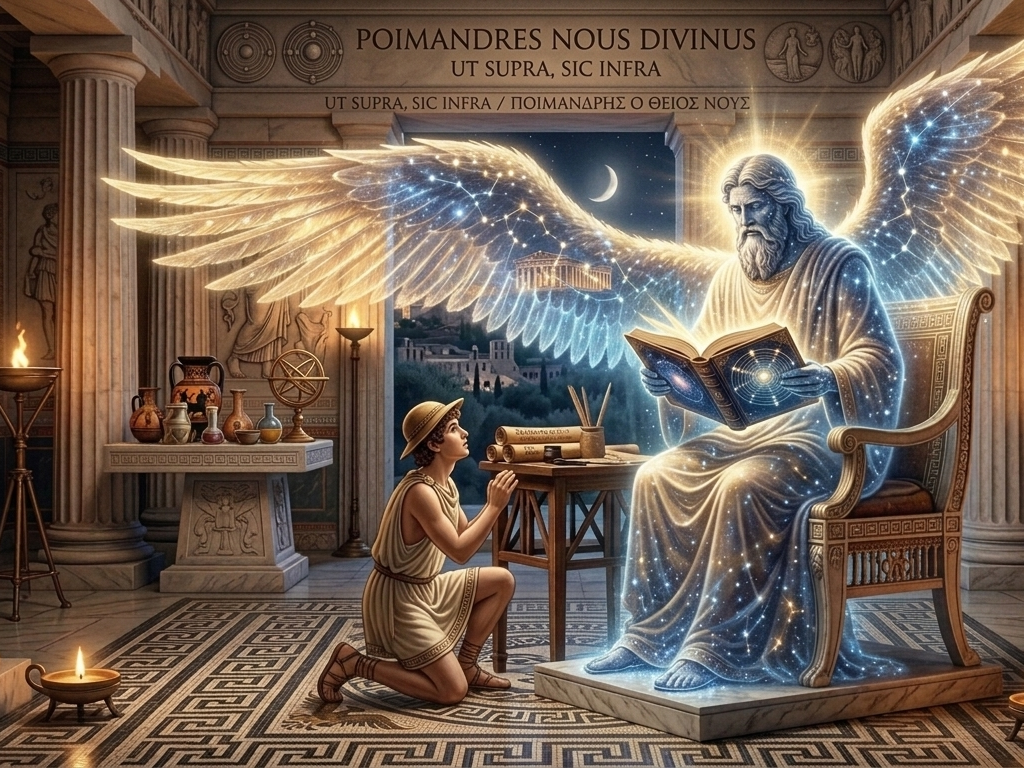
The first and deepest gift is the vision of a living cosmos. The Hermetic tradition insists, across all its texts and all its centuries, that the universe is not a dead mechanism we happen to inhabit. It is a living, ensouled, purposeful whole, and we are not outside it but woven into it as microcosms. In an age that simultaneously over-values the human (as the only subject that matters) and under-values it (as an accidental product of blind evolutionary forces), this vision offers something rare: a framework in which human existence is both genuinely significant and genuinely humble.
The second gift is the centrality of ethics. The classical Hermetica are unambiguous: genuine knowledge of the divine — what they call gnosis — requires moral preparation. Not as a prerequisite imposed by a divine bureaucrat, but as a description of how consciousness actually works. A mind preoccupied with greed, reactivity, envy, or deceit cannot perceive the deeper patterns of reality. The ethical life is not the price of admission to the spiritual path. It is the spiritual path. This integration of inner and outer transformation, of contemplative depth and relational responsibility, is exactly what a genuine wholistic approach requires.
The third gift is the principle of correspondence — not as a magical formula, but as a lens. The same patterns repeat across scales. The structures of balance, rhythm, interdependence, and feedback that govern ecosystems also govern relationships, organizations, and inner psychological life. Attending to one level teaches you about the others. This is why Hermetic philosophy has always been at home at the intersection of science and spirituality: it notices pattern rather than privileging any single domain.
“Hermetic philosophy doesn’t ask you to choose between reason and revelation, between science and spirit, between the individual and the cosmos. It asks you to hold them all together, in the recognition that reality is bigger than any single framework for understanding it.”
Where Hermeticism Meets the Wholistic Middle Path
The tradition I find most resonant with Hermetic philosophy is not any single one but the convergence point between several. Taoism‘s insistence on the unity underlying apparent opposites, and on the path of intelligent non-forcing (wu wei), maps onto the Hermetic teaching about alignment with cosmic order. The Sufi tradition’s emphasis on polishing the heart as a mirror for the divine, on the spiritual path as the refinement of the capacity for love and perception, resonates with Hermetic gnosis and ethical purification. Dzogchen‘s teaching about recognizing the nature of awareness itself — the rigpa that is neither arising nor ceasing, neither this nor that — echoes the Hermetic Nous that transcends the planetary conditioning of ordinary mind. Ramakrishna‘s rebirth of the Vedas and Vedenta is also a testament of this. Live it, don’t just read about it and or preach it.
What all of these traditions share, and what Hermeticism shares with them, is the commitment to the middle path in its deepest sense. Not a middle path compromised or moderated. The middle path as the recognition that apparent opposites — form and formlessness, the individual and the universal, the material and the spiritual, science and wisdom — are not actually in conflict. They are aspects of a single reality, perceived from different angles and at different scales. This is a great tool to avoid thought and desire manipulation enforced today with our rich online media universe.
This is what wholistic means, at its root. Not a slightly more complete version of what was already on offer. A genuinely different orientation: one that begins from wholeness rather than working toward it, that recognizes the connections first and the divisions second. This is what the Wholistic Center is based upon, the wholistic center within all of us.
What to Avoid: The Pitfalls of Modern Hermeticism
Not everything that calls itself Hermetic serves the genuine tradition. Three pitfalls appear most often.
Magical thinking is the first. Classical Hermeticism emphasizes contemplation, ethical transformation, and the patient cultivation of inner clarity. When the tradition gets reduced to formulas for manifesting desired outcomes through mental focus, something essential has been lost. The Hermetic path is demanding. It requires genuine work. Shortcuts that promise cosmic alignment without inner transformation are selling something the tradition never offered. It also calls for observation and plenty of rest.
Solipsism is the second. The Kybalion’s strong Mentalism — “All is Mind” — can slide into the belief that external reality is simply a projection of inner states, that suffering is primarily a matter of perspective, that our thoughts literally create our circumstances. This mistakes a useful metaphor for a complete description of reality. The world is real. A slap on the face is still a slap on the face. Or better put, an illusion hurting another illusion still hurts. Other people are real. Try double-crossing someone and see the results. Their suffering is not a projection of our inner state. Hermeticism at its best deepens engagement with reality; it does not dissolve it.
Ahistorical claiming is the third. When The Kybalion presents itself as an ancient Egyptian document, when practitioners claim that Hermetic philosophy is the hidden source of all world religions, when the tradition is used to lend authority to modern inventions by connecting them to imagined antiquity — something manipulative is happening. The genuine tradition doesn’t need false credentials. It has real ones.
The over-emphasized on the messenger neglects the importance of the message. It’s an old Zen teaching, but Bruce Lee made it famous in Enter the Dragon: a master points at the moon to teach his disciple. The student stares at the finger in adoration. Lee snaps: not the finger — the moon.“.
Finally, over the decades of studying hermetics and other thought forms, Ive met a great deal of well-learned people. They were imposing in their understanding and commendable in their wealth of knowledge. However, and not always, a great many of them suffered mental breakdowns and hallucinations. One of my closest friend mentally collapsed. Another one was convinced I was the great devil his secret group had warned about. And no amount of knowledge could reach them. Beware studying and learning without giving the human being within plenty of room to digest and space to process.
A Hermetic Practice for Daily Life
If you want to bring something genuinely Hermetic into your daily practice, here is a simple structure grounded in the classical texts rather than in modern reimaginings.
In the morning, before the day gets hold of you, take five minutes in stillness. Ask yourself:
What is the nature of this mind that is aware right now?
You don’t need to answer it. Just let it open. Then set an intention for one specific expression of the ethical life — one act of mercy, one moment of truthfulness, one choice for simplicity over excess — that you will bring into the day.
This is the Hermetic practice of invoking Nous: turning the attention toward the deeper intelligence within, and linking it to concrete ethical action.
At midday, pause for sixty seconds. Notice where you have been automatic — reactive, habitual, driven by the equivalent of what Poimandres calls the planetary governors. Notice where you have had a moment of genuine choice, of perceiving clearly rather than just responding. Don’t judge either. Just notice. This is the practice of correspondence: reading the macrocosm of your day in the microcosm of a single moment.
In the evening, take three minutes for the Hermetic equivalent of the Stoic’s daily review.
Three questions:
Where did I act in alignment with what I know to be true?
Where did I drift into disorder — reactivity, excess, untruth?
What is the single adjustment I want to carry into tomorrow?
Release the answers without judgment. The practice is not about perfection. It is about the patient, ongoing process of separating the subtle from the gross — dissolving what is crusted over, coagulating what is genuinely refined.
The Enduring Invitation
Hermetic philosophy has survived for over two thousand years not because it has a powerful institution behind it, but because it keeps naming something true. The universe is alive with intelligence. The human being is a microcosm of that intelligence, both subject to its rhythms and capable of aligning with its deeper order. The path to that alignment is through gnosis and ethical transformation — through genuine knowing, genuine responsibility, genuine care for the living world.
These claims are not scientific in the modern sense. They cannot be tested in a laboratory. But they can be tested in a life — in the quality of attention you bring to your experience, in the integrity of your relationships, in the coherence between what you believe and how you actually live. That is the kind of testing the Hermetic tradition has always invited.
We started this series with a hand trailing along a bookshelf in New York. We end it here: with an invitation to take Hermetic wisdom seriously enough to test it — not as doctrine to be believed, but as a lens to be used, a practice to be inhabited, a vision of the whole that might make the parts more coherent.
As above, so below. As within, so without. The middle path is not the absence of conviction. It is the presence of a wisdom large enough to hold all the pieces together. It is the wholistic way.

← Previous: Part 6: The Kybalion and New Thought