
PART 3 OF 7 • HERMETIC WISDOM SERIES,
By Nicolas Zart for The Wholistic Center
As Above, So Below
The Hermetic Cosmos and the Human Being
The most famous line in the Hermetic tradition — “That which is above is like that which is below, and that which is below is like that which is above” — appears in the Emerald Tablet, which we’ll examine closely in Part 4. But the principle it expresses runs through the entire Hermetic tradition like a spine. To understand what it really means, we need to understand the Hermetic picture of the universe.
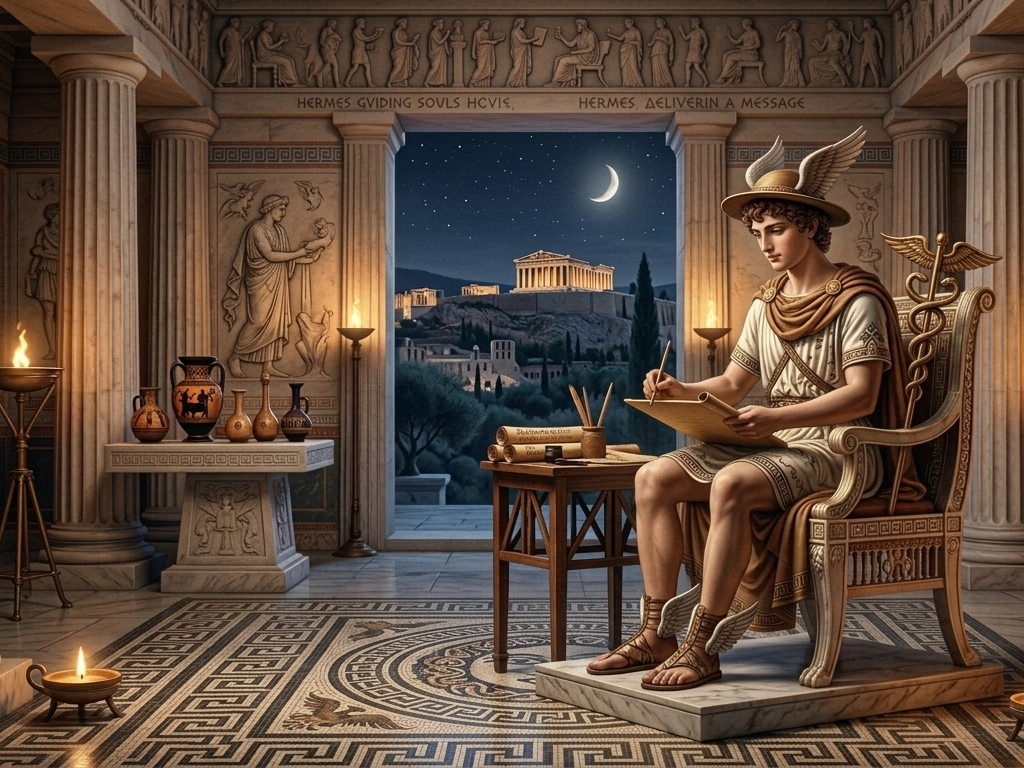
And that picture is not the universe of modern materialism, a vast collection of dead matter obeying mechanical laws. Nor is it the universe of escapist spirituality, an illusion to be seen through and abandoned. It is something more wholistic than either: a living cosmos, ensouled and ordered, with humanity at its pivotal center.
The Hermetic God: Light, Mind, and the Source of All
The Hermetic tradition describes God with a kind of controlled ecstasy — the writers know they are pointing at something language cannot hold, and they say so, repeatedly, while trying anyway. They use words such as The All, The source of All, etc. Either way, God is pure Light. God is Life. God is Goodness. God is Mind (Nous) beyond all forms and names. And crucially: God contains all potential within. Everything that exists is an expression of this overflowing source, not a creation separate from it.
This is closer to what philosophers call panentheism than to conventional theism. God is not a being among other beings, not a craftsman standing outside the universe shaping it. God is the living ground of everything, present within creation as its sustaining intelligence while remaining beyond it. The cosmos emanates from God not as a product from a factory, but as light from a lamp — continuously, necessarily, without division. This is a theme we rediscover later with early Gnosticism that God is omnipresent, Omniscient, and omnipowerful. What can It not be? Even the question is absurd to ask.

This matters for how we relate to the world. In a Hermetic universe, reverence for the natural world is not sentimental environmentalism. It is a consequence of the deepest metaphysical commitment and gnosis: the recognition that the world is not raw material for human projects, but the living body of the divine.
The Seven Spheres: Fate, Order, and the Possibility of Freedom
Between the divine source and the material world, the Hermetic cosmos places seven planetary spheres, each governed by an intelligence — the Sun, Moon, Mercury, Venus, Mars, Jupiter, Saturn. These governors administer Fate: the cycles and patterns that shape embodied existence, the tendencies and passions that accompany incarnation, the rhythms of biology and circumstance that we inherit simply by being born into a body.
Most human beings live entirely within this system of Fate, following its rhythms without awareness, driven by the passions that the planetary spheres activate. This is the prison most of us are stuck with. The Hermetic tradition does not condemn this. Fate is not evil. The spheres are not malevolent. They are a training ground — the structures that shape soul development in the material world. It’s up to us to wake up, snap out, and chose to go forward with awareness.

But the human being is not only subject to Fate. Within us is also Nous — the divine spark, the element that is not planetary but cosmic, not conditioned but free. And through the cultivation of that inner intelligence — through gnosis, ethical living, and contemplative practice — the soul can begin to perceive the larger pattern, to act from understanding rather than compulsion, to transcend the blind repetition of fate-driven existence.
The Human as Microcosm: A Pivotal Being
The Hermetic understanding of the human being is one of the most striking ideas in the tradition. We are not accidents of evolution. We are not fallen angels trapped in matter. We are microcosms — small-scale images of the whole universe, containing within our own nature everything that exists at the cosmic scale.
Body: formed from the elements, subject to their rhythms and laws. Soul: animated by the planetary powers, carrying their tendencies and energies. Nous: the immortal divine spark, capable of knowing God, capable of stepping outside the automatic repetition of fate.

This triple constitution — body, soul, spirit — appears across traditions, from the Vedantic framework of gross, subtle, and causal bodies, to the Platonic tripartite soul, to the Kabbalistic mapping of Nefesh, Ruach, and Neshamah. Hermetic thought is part of a convergent recognition: the human being occupies a unique position in the hierarchy of existence, neither purely divine nor purely animal, but the hinge between them.
“We are the universe become conscious of itself, trying to remember what it is. Hermeticism names this the awakening of Nous. Contemporary physics calls it the anthropic principle. They are looking at the same thing from different angles.”The Ethics of the Microcosm
If the human being is a microcosm of the cosmos, then our inner states are not private affairs. They ripple outward. A soul in harmony contributes to cosmic harmony. A soul in disorder — driven by greed, reactivity, cruelty, or deceit — contributes to cosmic disorder. This gives Hermetic ethics an urgency that is more than moral convention.
The Hermetic texts are specific about what the path of alignment looks like: mercy and reverence, freedom from envy and greed, truthfulness, simplicity, compassion for all living beings. These are not rules imposed by an external authority. They are the description of a soul in resonance with the divine order — a soul that has recognized its own nature as a microcosm and is living accordingly.
In our own time, this framework has immediate ecological implications. If the material world is the living body of the divine, and if we are microcosms of that world, then the way we treat the planet is the way we treat ourselves. Environmental ethics, in Hermetic terms, is a consequence of self-knowledge.
What This Means for How We Live
The Hermetic vision challenges two of the most common dysfunctions in contemporary spiritual life. It challenges the materialist reduction that says only matter is real and the inner life is epiphenomenal. And it challenges the spiritual bypass that says only the inner life is real and the material world can be ignored or transcended. Another way to look at this is the Arhaman and Lucifer myth where the former appeals to the materials sense and the latter to the spiritual escape of our human life. If traditionally the East was very spiritual and the West caught in materialism, it’s easy to see how these two spheres one dominated by one or the other are merging slowly into a new realm.
Hermeticism insists on both being neither good or bad, just what it is in a very stoic view. The cosmos is alive with meaning, and we are participants in it. Our inner work is real and consequential — and it connects outward into relationships, communities, and the natural world.
As above, so below. As within, so without isn’t a slogan, but as a description of how things actually are.
In Part 4, we examine the Emerald Tablet — the cryptic text that gave us “as above, so below” and became the most famous and most misquoted line in Western esotericism.
← Previous: Part 2: Poimandres Next: Part 4: The Emerald Tablet →