
“The Sumerians never said the gods came from another planet. They said the gods came from heaven — and heaven, in the oldest languages we have, rarely meant a place you could fly to.”
In this part of the Sumerian series, you can find part 1 here and 2 here, today we turn our attention to what is left of this civilization we keep on rediscovering.
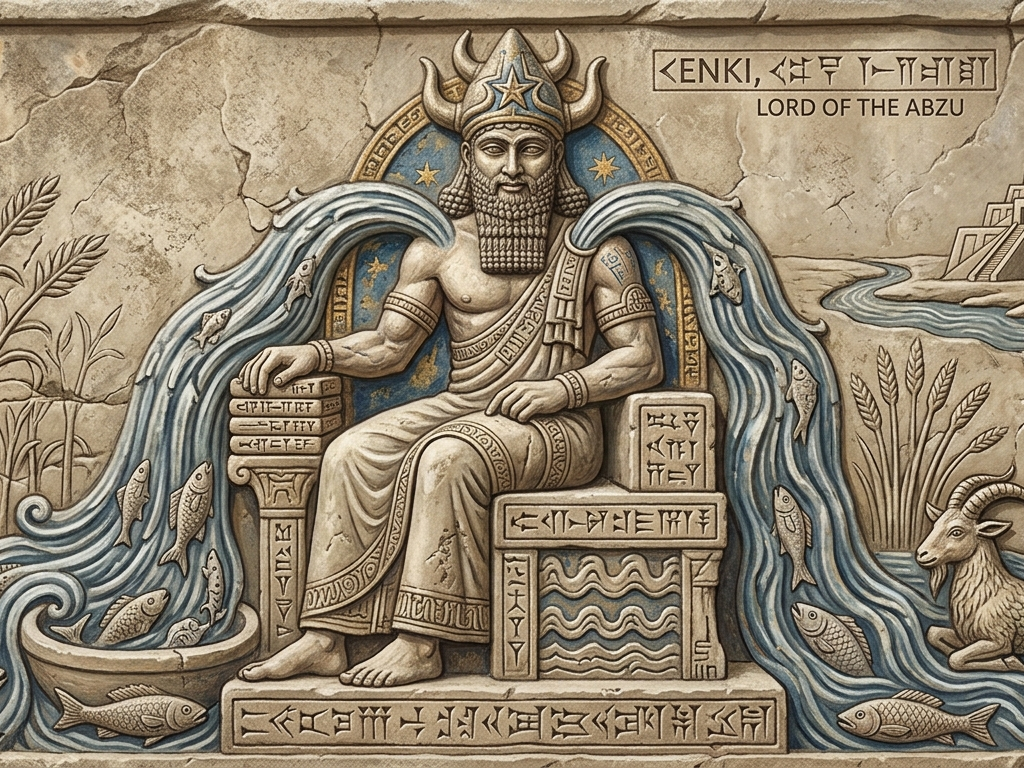
Anunnaki: Gods, “Aliens,” or Something the Sumerians Understood Better Than We Do
Sumer’s Part 1 in this series ended with a question left deliberately open: whether the Anunnaki were gods, extraterrestrials, or something else the framing itself gets wrong. It’s worth sitting with that question rather than brushing it aside as nonsense. Both, the popular answer and the scholarly rebuttal, skip past what the Sumerians themselves were the most precise about.
Who the Anunnaki Were, According to the Tablets
“Enki did not build a species. He argued for one. The oldest recorded creation story is also the oldest recorded argument about whether human beings are worth the trouble.”
The Anunnaki were not a single figure or a single kind of being. They were the ruling structure of the Sumerian pantheon — a family, with rank, jurisdiction, and internal politics, the way any bureaucracy has jurisdiction and politics. They blended the supernatural and the daily-lives, straddling both and giving people a sense of society’s order. Whether they exist(ed) or not is besides the point. The point is what they represented and how the concept, real or not, affected daily life.
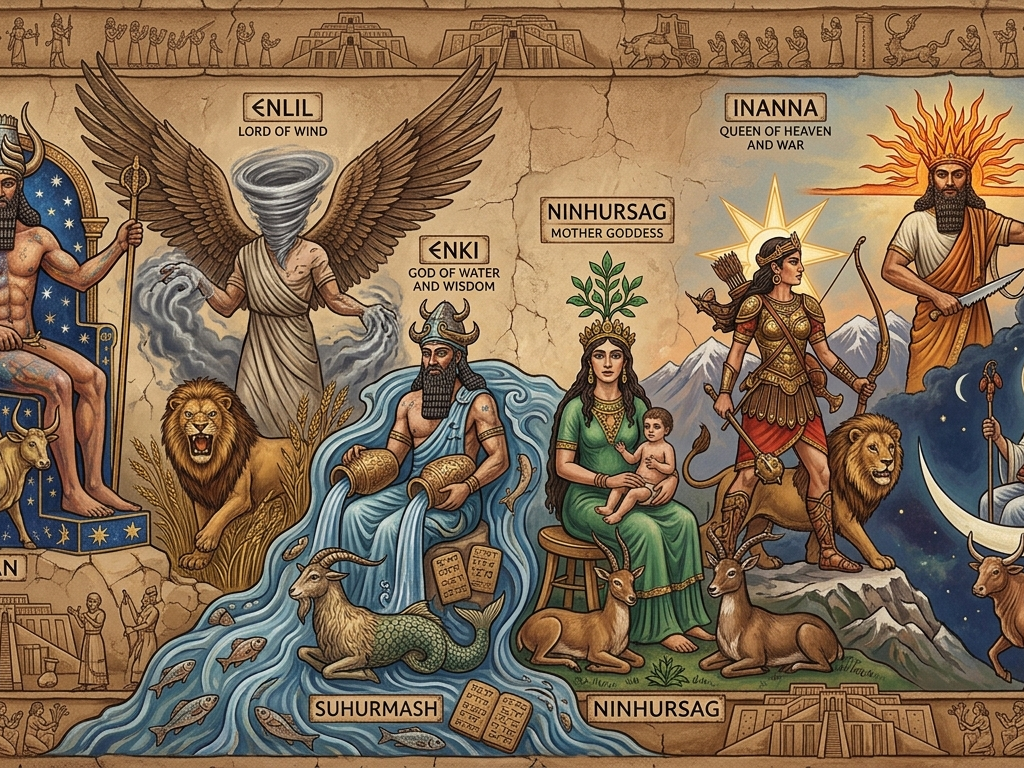
Anu sat at the top, god of the sky, distant and largely ceremonial — the authority everyone deferred to and almost no one dealt with directly. Enlil, his son, held the real executive power: god of air, storms, and kingship, the one who granted or withdrew the right to rule. Enki (also called Ea), god of water, wisdom, and craft, was Enlil’s frequent counterweight — the one who kept advocating for humanity when Enlil wanted to be rid of it. This is a recurring theme that can be found in many ancient texts outside of Sumer. This happens more than once in the surviving Sumer texts, including in the flood story, itself repeated elsewhere.
Ninhursag, the earth mother, was credited with shaping the first human bodies from clay. Utu, the sun, judged. Nanna, the moon, measured time. Inanna, covered in Part 2 of this series through her descent into the underworld, was their unruly, ungovernable granddaughter.
This is a cabinet, whether it came from a spaceship crew or not. The relationships matter more than the individual biographies — which is itself a clue about what kind of thing the Sumerians thought they were describing.
The Word Itself
Anunnaki is usually rendered from Sumerian as a-nun-na, roughly “those of princely blood” or “the princely offspring”. This is a statement about lineage and rank, the same way you’d describe a royal house. Zecharia Sitchin’s 1976 translation, “those who from heaven came,” is where the ancient astronaut theory gets its foothold. If the gods literally came from somewhere else, arrival implies a point of departure, and a point of departure implies a spaceship and a home planet. We can also consider location beyond space and time to further muddy the waters.
Still, Sumerologists who read cuneiform for a living reject that rendering. The grammar doesn’t support “came from” as cleanly as Sitchin originally believed. Still, it’s worth noticing that the correction — “princely offspring,” a statement about status — is in some ways a stranger claim than the one it’s replacing. It says the most powerful forces shaping the physical world were understood, by the people who lived closest to that world, as a matter of rank within a family rather than location in space. That’s not a smaller idea than ancient astronauts. It might be a bigger one.

The Actual Creation Story, Which Nobody Needed Aliens For
The most quoted Sumerian creation account — the Enki and Ninmah myth — is not about hybridization or genetic engineering in the way Sitchin’s readers imagine it. It’s more of an argument.
The lesser gods, tired of digging irrigation canals by hand, went on strike. Enki proposed a solution: create a new kind of being, mixed from clay and the blood of a minor god, to take over the physical labor so the gods could rest. Ninmah did the actual shaping. The first attempts came out wrong — some too weak to work, some unable to reproduce, some with bodies that failed in one way or another. The myth doesn’t hide this. It treats the failures as part of the record, the same way the first draft of anything is part of the record.
This is a theme that gets repeated all over the Earth from ancient scripts and bible. Michael Tellinger, in his explanation of the word Ubuntu from South Africa also talks about legends of Gods who descended on Earth to use a hybridized race to dig up gold from the ground to support their technology. Eventually that race also grew tired and rebelled. Not only do we see that similar story repeat itself over the planet but do we see today descendants from that country exercising important decision-making roles in the most powerful countries. We’ll let you do that research for fun, but don’t jump to conclusions too quickly either.
What survives in this story is not a technology. It’s a debate about obligation. It asks what do the gods owe the beings they made to serve them? What do those beings owe back? Enki, notably, is the one who keeps arguing for humanity’s side of that ledger — the same Enki who, in the flood story, warns Utnapishtim to build a boat against Enlil’s wishes. If there is a hero in the Sumerian pantheon, by any modern definition of the word, it’s the one god consistently on record trying to keep humanity alive against the wishes of his own family.
Why the Alien Reading Won’t Let Go
“Ancient Aliens needed the Anunnaki to be visitors, because a species that engineered itself out of raw clay and stubbornness is a much harder story to sell in forty-four minutes.”
None of this makes Sitchin’s theory disappear. The Apkallu really are strange-looking. The pace at which Sumerian civilization assembled writing, law, astronomy, and irrigation is blazing fast by any previous standards and anything that came after it. There is something in modern audiences — not a flaw exactly, more a habit of imagination — that finds it easier to believe advanced knowledge arrived from somewhere else than to believe it was built, slowly and imperfectly, by people standing in mud with reed styluses.
That habit says more about the modern audience than about the Sumerians. A civilization that watched the sky closely enough to divide it into 360 degrees, that built the first legal codes, that argued in writing about what gods owe their creations — that civilization was not short on imagination or rigor. It didn’t need visitors to explain itself. It needed the thing every civilization needs: enough time, enough attention, and enough people willing to write things down.
What “Came Down From Heaven” Might Have Meant
Here is an interesting possibility, and the one both the Ancient Aliens camp and its debunkers tend to skip past: in the oldest layers of nearly every wisdom tradition, “descending from heaven” is not necessarily a geographic point, but a more nuanced one. It’s a claim about a different order of reality making contact with the ordinary one. In other words, the sacred breaking into the mundane, however that contact was actually experienced by the people describing it.
This is the same grammar that unsurprisingly shows up later in Gnostic cosmology. The subject of the series that preceded this one is the Aeons emanating downward from the Pleroma, the divine spark descending into matter, the Archons governing a layer of reality beneath the true source. Sumer’s Anunnaki, arriving from “heaven” to organize the earth, are an early version of the same architecture — a hierarchy of increasingly condensed reality, stepping down from something vast into something workable.
Read that way, it’s difficult to think of the Anunnaki as a claim of biology or aerospace. They were most likely an early, remarkably systematic attempt to describe the relationship between consciousness and matter — the same question the Gnostics would take up two thousand years later, and the same question every wholistic tradition eventually has to answer in its own vocabulary.
The Question Worth Pondering
Sitchin gave millions of readers permission to take Sumer seriously by making it sound like science fiction. I was once of them. Plenty of people found their way to genuine cuneiform scholarship through a paperback about ancient astronauts. But the theory that got them in the door is not the most interesting thing in the building.
The more interesting thing is a civilization that looked at the gap between raw matter and organized life, and instead of leaving it unexplained, built an entire structured mythology that influenced jurisdictions, arguments, obligations, a family with real internal conflict and still felt today. It describes how one becomes the other. Whether you call that theology, proto-science, or something in between, certainly it was not primitive. It was an early and serious attempt at the same question this whole series keeps returning to: what is the relationship between the world we can measure and the order that seems to stand behind it?
The Sumerians thought the gods had asked them to build civilization. Maybe the more useful question isn’t whether that’s literally true. It’s what they understood, standing in the mud between two rivers, that made that framing feel like the most accurate one available.