
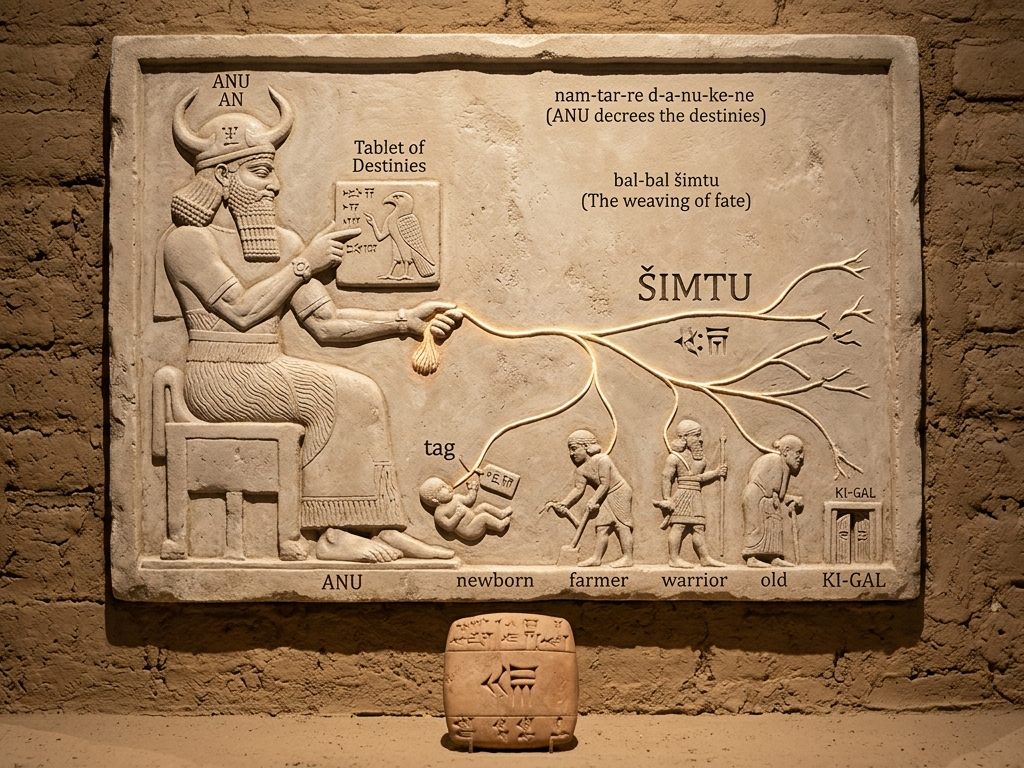
In this follow up to our original Sumerian article, we look at the ancient Sumerian word — šimtu — that translates roughly as “fate” or “destiny.” But in practice, it meant something closer to the thing that has already been decided. When a Sumerian scribe wanted to say that someone had died, they didn’t write that the person perished or passed. They wrote that the person had gone to their šimtu. In other words, they had gone to what was always going to happen.
Don’t mistake this for resignation. It comes from a civilization that, over the course of three thousand years, thought harder about death than most other before or since. It wasn’t a word used to make peace with death. It was to understand its exact structure. What they found was not heaven. It was not hell. It was something far stranger, and in many ways far wiser.
A World Beneath the World
The Sumerians called the underworld Kur — also translated as Irkalla after its queen. It existed below the earth, separated from the living by a great river, accessible only through a series of seven gates. It was not a place of punishment. It was not a place of reward. It was simply the place where everyone eventually went. It also explains why tradition Christian representations of hell was thought to be below the Earth. This dates back to the Sumerians.
Rich or poor, righteous or cruel, king or shepherd — the destination was the same. What differed was not your moral record but your circumstances of death and burial. A soldier who died in battle and was left unburied wandered restlessly. A person whose family brought proper offerings ate and drank well in the underworld. A king arrived with the social hierarchy intact. A slave arrived a slave.
The Sumerians did not build a moral afterlife. They built a mirror.
What you carried into death was the structure of the life you had lived — not its goodness, but its shape. This is either deeply unsettling or deeply liberating, depending on where you stand when you read it. The question it forces is not was I good enough? but did I build something that will hold when the light goes out?
The Seven Who Wait
And then there are the Gallu.
They are described across multiple texts — in the Descent of Inanna, in the myths of Dumuzid, in the incantation tablets that scribes produced to protect the living from their reach. They appear always in groups of seven. They serve Ereshkigal, the queen of the underworld, and her consort Nergal. Their purpose is singular: to escort the dead to Kur, and to ensure that no one who belongs below remains above.
They do not eat. They do not drink. They accept no offerings of grain or beer. They do not know the pleasure of white flour or cool water. They do not recognize human joy. And mostly, they do not recognize cruelty. That is the important part.
The Gallu are not monsters in the way we mean the word nor are they torturers. They are not sadists taking satisfaction in the work. In the texts they are described as merciless not because they enjoy causing pain, but because mercy is simply not a function they perform. They are šimtu made flesh — the inevitable given a face and seven pairs of feet. They are who they are in all of their impassive neutrality. They can’t be swayed.
This is, in its way, a more honest description of death than the one most of us were given.
Death does not hate you. It does not single you out. It is not punishment for what you did or did not do. It arrives the way the Gallu arrive in the myths — walking steadily, neither hurrying nor delaying, unable to be reasoned with, impossible to bribe.
The Descent
The most famous encounter with the Gallu comes in one of the oldest stories ever recorded: the Descent of Inanna.
Inanna, goddess of love and war, decides to descend into the underworld to attend the funeral rites of her sister’s dead husband. What follows is a systematic dismantling of everything she is.
At the first gate, she is stripped of her crown. At the second, her lapis lazuli necklace. At the third, her robe. Gate by gate, earrings, breastplate, golden ring, royal garments — all of it surrendered until she arrives at the throne of Ereshkigal naked and on her knees.
Ereshkigal kills her.
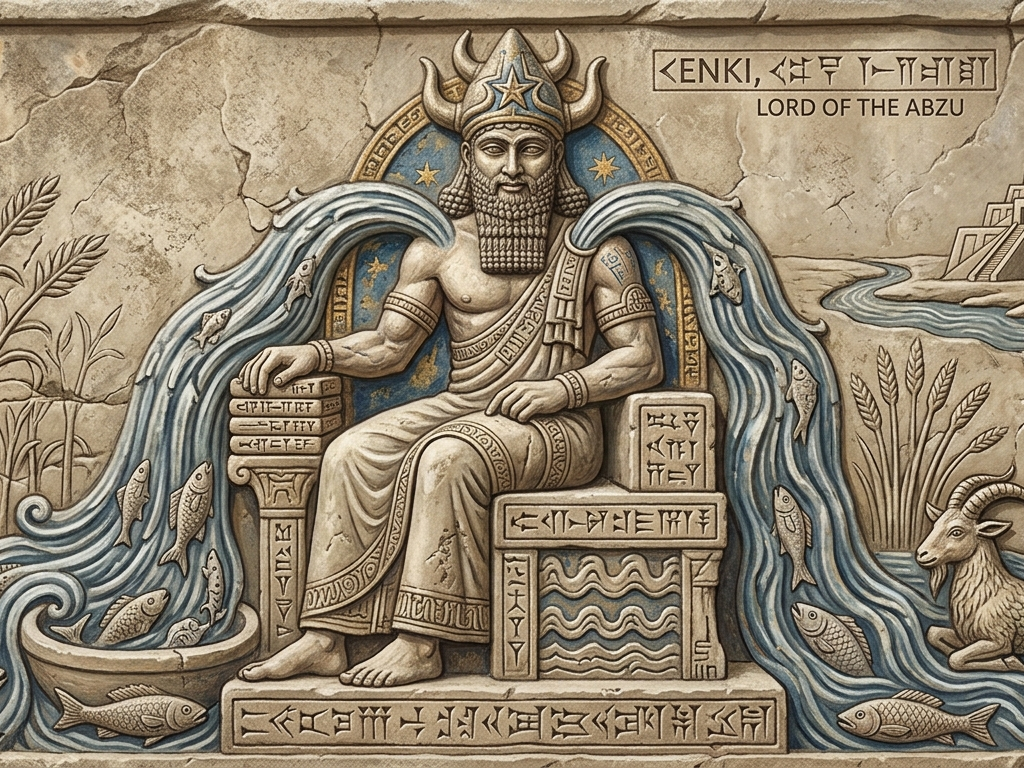
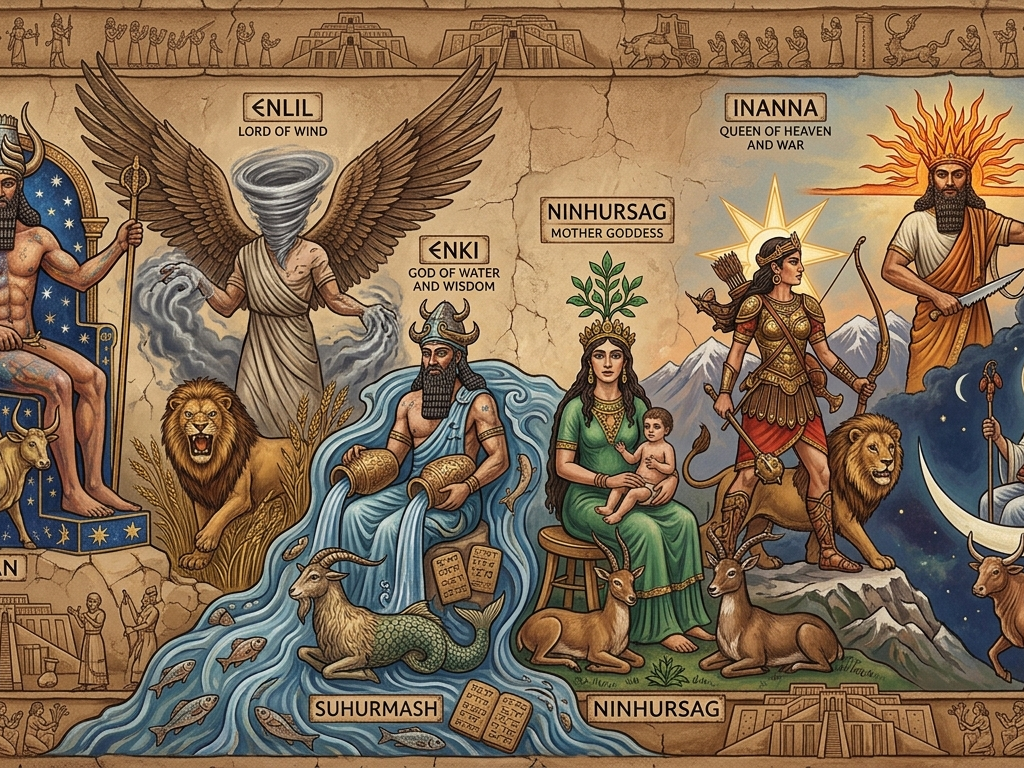
She is hung on a hook. Three days pass. Only through the intervention of the god Enki, who sends creatures to soothe the grieving Ereshkigal, is Inanna eventually revived and allowed to return to the living world — and only by sending a substitute in her place.
The Gallu escort her back out, gate by gate, through the same ritual reversal: each piece of clothing returned, each piece of identity restored.
But the descent has already happened. The stripping was real. Whatever Inanna was when she entered, the Inanna who returned was someone who had stood naked before the queen of the dead.
The Sumerians understood something that would take the rest of civilization another two thousand years to name: death asks you to hand everything back. The question is whether you wait for the gates to take it from you, or whether you begin to examine — now, while you still can — what you are actually holding.
Something else I’ve come to feel, now that I’ve crossed the threshold into my sixties, is that path already at work on me — readying me for those gates. There’s a quiet letting go beginning: of earthly social norms, of duties and rights I once assumed were fixed despite being man-made. The older I get, the more I recognize I’ve already passed through a few of these gates, and that each one has been preparing me for what nearly every human eventually faces — the body ceasing to function. When I arrive there, I know I will go naked, carrying only what I’ve made of myself along the way: the lessons learned, and, I hope, actually kept.
The Debt Between Worlds
There is one more piece of this map that modern culture has almost entirely forgotten.
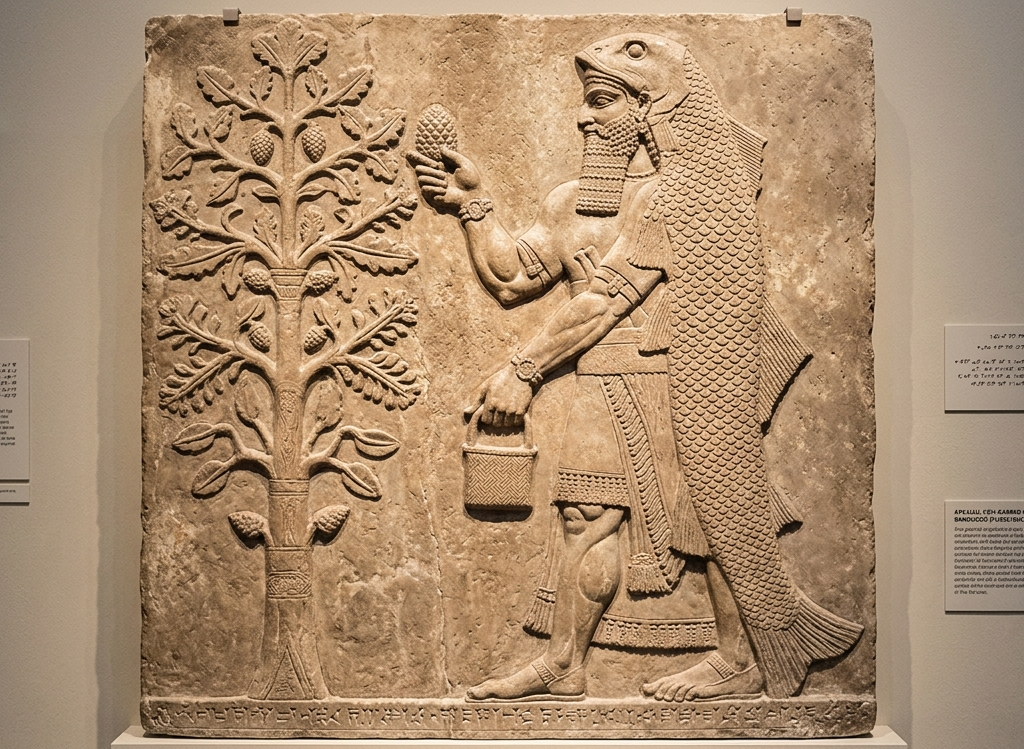
In the Sumerian worldview, the relationship between the living and the dead was not concluded at the moment of burial. It was ongoing. The dead depended on the living to bring libations — poured water and offerings of food — to sustain them in Kur. Without this, the dead existed in misery, their conditions in the underworld deteriorating the longer they were neglected.
In return, the well-tended dead were understood to provide something back: protection, guidance, the anchoring of family memory across generations.
This was not superstition in the modern dismissive sense. It was a social contract extended across the boundary of death. You feed those who came before you. They remain with you. The transaction continues. It strengthened the bond of the community, both here and those past.
We have largely severed this contract in modern life with a linear time concept. We bury our dead and move on, often quickly, because grief has been quietly reclassified as a problem to be managed rather than a relationship to be maintained. We even park older folks into death homes we call retirement homes. What the Sumerians offer is not a theology but a practice that strengthen communities and bonds us into a common human experience on Earth: the dead are not gone from the ledger. They remain on it, under a different column. They still live in memory reminding us we stand on the shoulders of those who came before.
How different would your relationship to your own mortality be if you understood yourself as someone who would be remembered into — and would in some sense continue to provide for — the people you leave behind?
What Was Never Mysterious
Seven unknown beings. Secrets hidden in clay tablets. Ancient revelations finally decoded. That’s Sumer for you. And the truth is quieter and, I would argue, more useful upon further study.
The Gallu were never secret. Scholars have known about them for over a century. They appear in some of the most studied texts in ancient literature. What has been lost is not the scholarship but the application — the sitting with these ideas long enough to let them ask their questions of you.
The Sumerians looked at death directly and built a cosmology around what they saw: that it comes without moral drama, that it strips everything, that what remains is the shape of the life that preceded it, and that the relationship between living and dead is not a one-way departure but an ongoing conversation. Essentially you come in bare and leave the same, save for what you learned and those experiences.
They pressed all of this into wet clay. It dried. It survived.
Šimtu. The thing that has already been decided.
The only real question is what you are doing with the time before the Gallu arrive.