
In 1462, a monk arrived in Florence carrying a manuscript. It had been acquired in Macedonia by agents of Cosimo de Medici — the wealthiest man in Europe and an obsessive collector of ancient texts. Cosimo was in his seventies, dying, and he had been waiting a long time for something like this. He instructed his court philosopher, Marsilio Ficino, to set aside his translation of Plato‘s complete works and begin on this manuscript immediately.
The manuscript was the Corpus Hermeticum — the foundational texts of the Hermetic tradition, attributed to Hermes Trismegistus and thought at the time to be older than Moses. Cosimo never finished reading Plato. He died before Ficino completed the translation. But the translation changed Europe.
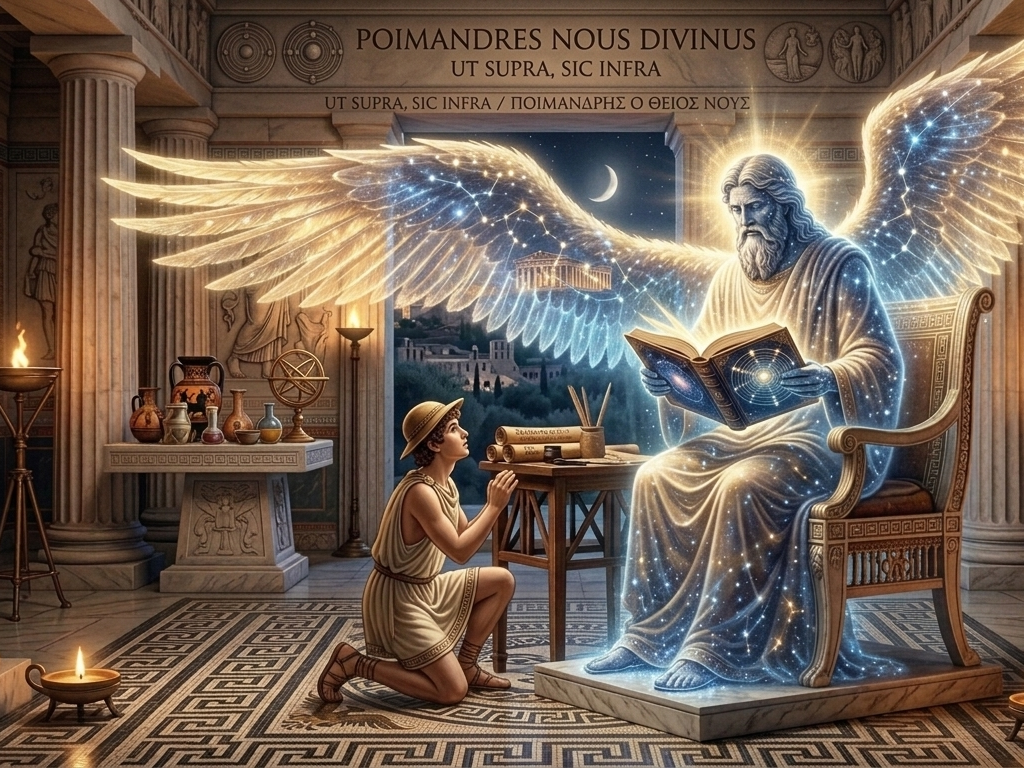
Understanding what happened in Florence in the late 15th century — and why it matters — requires understanding a particular hunger. The Renaissance was not simply a revival of classical learning. It was a search for something deeper than Scholastic theology had provided: a unified vision of the cosmos, the human soul, and the divine that made room for beauty, magic, and direct experience. The Hermetica seemed to offer exactly that.
A Philosopher and a Patron
Marsilio Ficino was thirty years old when Cosimo handed him the Corpus Hermeticum. He was already the leading Platonic scholar in Italy, director of the Florentine Academy, and a man of extraordinary intellectual range. He was also deeply religious — a priest who understood his work with ancient texts not as secular scholarship but as spiritual practice.
Ficino believed he had found in Hermeticism what he called the prisca theologia: an original, primordial theology that had been given to humanity at the beginning of time and then transmitted through a chain of ancient sages — Hermes Trismegistus, Zoroaster, Orpheus, Pythagoras, Plato — down to the present. These were not competing traditions but variations on a single ancient wisdom. The Hermetica were the oldest surviving expression of that wisdom.
This was a powerful idea. It meant that the pagan philosophers had not been in darkness before Christianity — they had been illuminated by the same divine light, seen through a different lens. It meant that ancient wisdom and Christian theology were not adversaries but complementary voices in a long conversation. And it meant that the human soul, in Ficino’s reading of Hermes, was not a fallen creature awaiting redemption but a spark of the divine fire capable of ascending through the planetary spheres to union with the One.
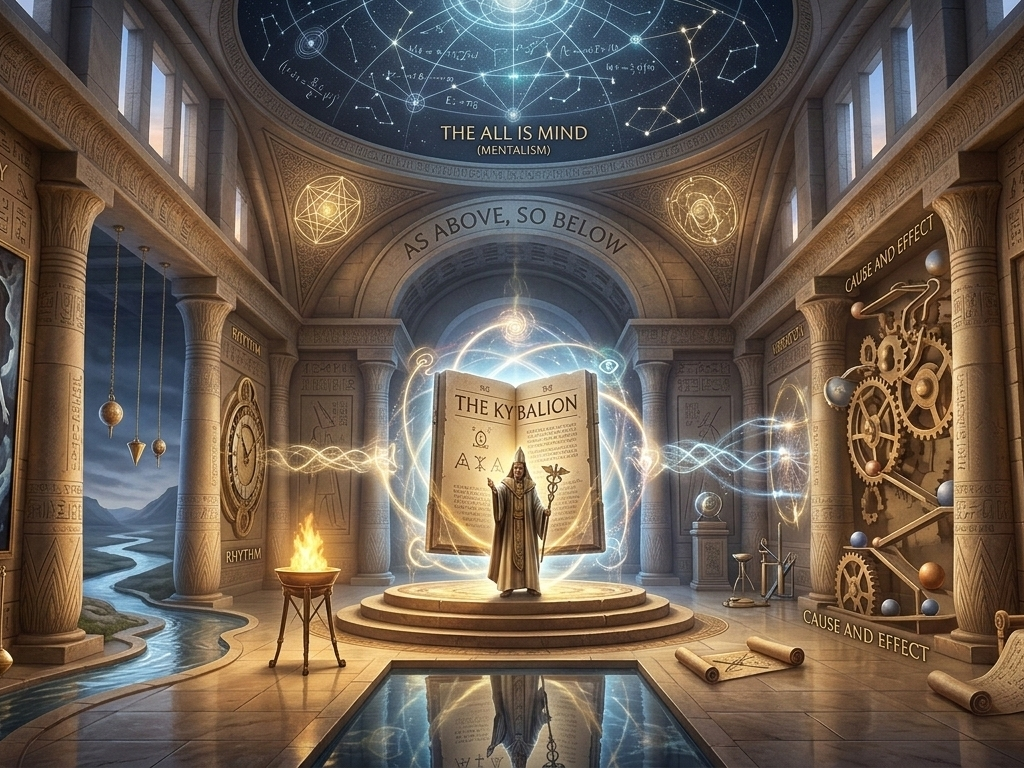
Ficino’s translation of the Corpus Hermeticum — completed in 1463, just before Cosimo died — spread rapidly across Europe. Within decades, it was one of the most widely read and influential texts in the Western world. Pico della Mirandola combined it with Kabbalah and Neoplatonism to create a synthesis he called “Hermetic Cabalism.” Lodovico Lazzarelli, a poet and mystic, pursued it further than anyone at the time dared. The Hermetica became foundational to what we now call Renaissance magic: the idea that the human being, as a microcosm of the universe, could work with the forces of the macrocosm to produce effects in the world.
The Firebrand: Giordano Bruno
If Ficino represents the contemplative, conciliatory side of Renaissance Hermeticism, Giordano Bruno represents its radical, explosive edge.
Bruno was a Dominican friar from Naples who abandoned his order, wandered Europe for twenty years, and was eventually burned at the stake in Rome in 1600 — not, as is commonly assumed, primarily for astronomy, but for a complex of theological and cosmological views rooted in his Hermetic commitments.
Bruno believed, following Hermes, that the universe was infinite, that the divine was immanent in all things, and that the sun was a living symbol of the One rather than merely a celestial body. He embraced Copernicus not because he was a proto-scientist but because a heliocentric, infinite universe fit his Hermetic cosmology: a universe without center, or with infinite centers, in which every point is equally divine.
Scholar Frances Yates, whose 1964 work Giordano Bruno and the Hermetic Tradition transformed how historians understand this period, argued that Bruno’s Hermeticism was not an eccentric addition to his thought but its core. The Hermetic magus — the human being who understands the patterns of the cosmos deeply enough to work with them — was Bruno’s model for what a philosopher could be.
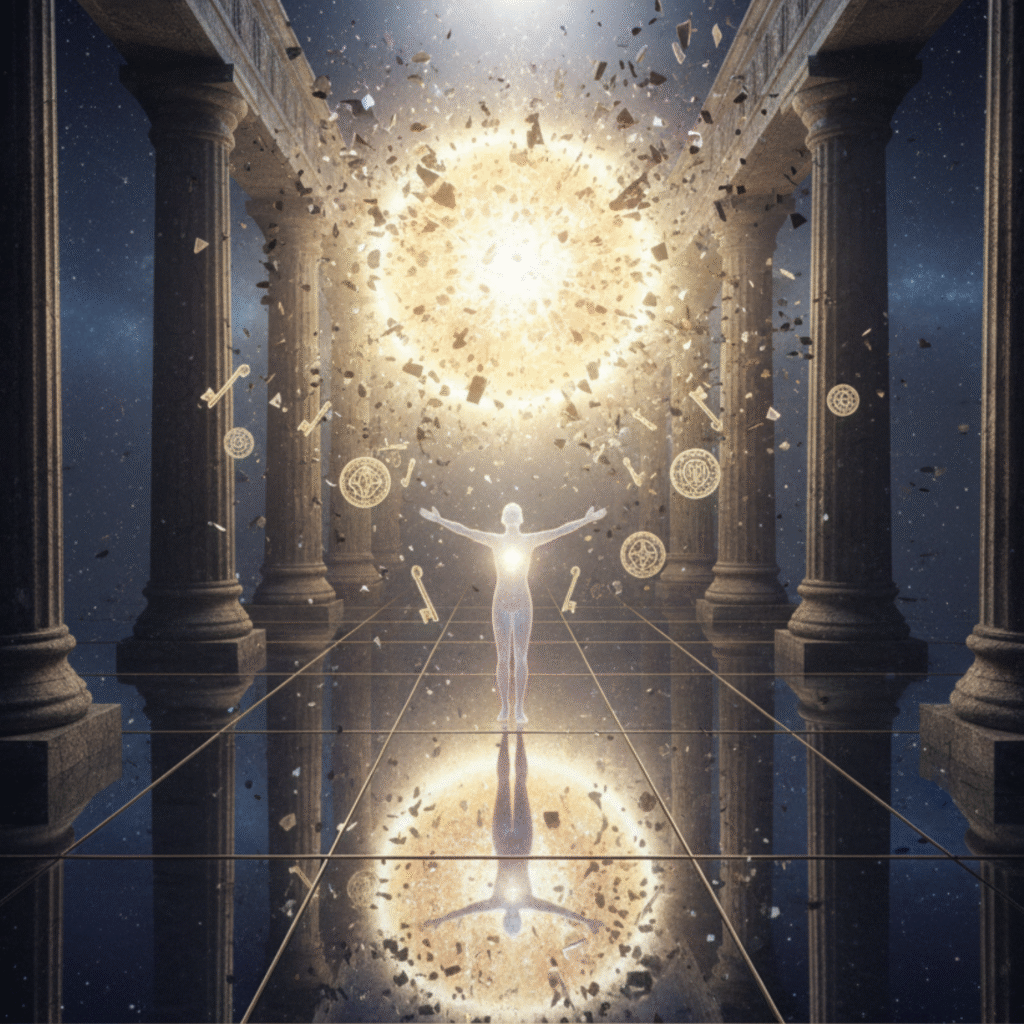
Bruno was also a practitioner. He developed elaborate memory systems based on Hermetic principles — ways of organizing the mind to mirror the structure of the cosmos, on the theory that what is above is structured like what is below. His art of memory was not simply a mnemonic technique but a magical practice: to organize your inner world according to cosmic patterns was, in Hermetic terms, to align yourself with the forces that govern the outer world.
His execution was a warning. The Church understood, correctly, that a fully developed Hermeticism was not compatible with institutional Christianity’s claims to unique authority. The idea that divine wisdom had been available to pagans, that the universe was infinite and alive, that the human soul could ascend to the divine through philosophical practice rather than through the sacraments — these were not minor heresies. Bruno refused to recant, and paid with his life.
What the Renaissance Got Wrong — and Right
There is an important caveat to this story, one that changes its meaning without diminishing its significance.
When Isaac Casaubon, a Swiss philologist, demonstrated in 1614 that the Corpus Hermeticum was not ancient Egyptian wisdom but a product of late antiquity — written between the 1st and 4th centuries CE — the prisca theologia thesis collapsed. The texts were not older than Moses. They were not even older than Christianity. They were philosophical and theological writings from the Greco-Roman world that had absorbed Platonism, Stoicism, Jewish thought, and early Gnostic ideas. Venerable, sophisticated, and genuinely profound — but not primordial revelation.
The Renaissance Hermeticists were wrong about the history. But they were not wrong about the philosophy. This goes back to the over-importance attached to the messenger should not negate the weight of the meaning of the message. The texts contain real wisdom. The principle of correspondence — that the same patterns repeat across scales — remains one of the most productive ideas in both science and contemplative practice. The emphasis on the human being as a microcosm, capable of aligning with larger patterns through disciplined inner work, is as relevant now as it was in Florence in 1463. The integration of ancient philosophical traditions into a coherent vision of human possibility — what Ficino called “learned piety” — is a project that still has work left in it.
Wouter Hanegraaff, the Dutch scholar of Western esotericism, has argued that the Hermetic tradition represents something important in the Western intellectual genealogy: a persistent alternative to both dogmatic theology and reductive materialism, a tradition that holds open the question of the relationship between mind, cosmos, and the sacred. Whether we call that tradition Hermeticism, perennial philosophy, or simply serious inquiry into the nature of things, the Renaissance gave it a form that we are still working with.
Three Currents That Reach Us Today
The Renaissance Hermeticists left three legacies that flow directly into contemporary wholistic practice.
The first is the legitimacy of multiple wisdom traditions. Ficino’s prisca theologia was historically wrong but philosophically generative: it opened the door to taking seriously the idea that different cultures and eras have accessed genuine wisdom, and that comparison across traditions is more productive than competition between them. This is now a foundational assumption of serious comparative philosophy, depth psychology, and wholistic medicine.
The second is the dignity of the human being as a participant in the cosmos rather than merely a subject of it. Pico della Mirandola’s famous “Oration on the Dignity of Man” — directly influenced by Hermeticism — articulated the idea that the human being is uniquely capable of becoming what it contemplates. This is not the same as modern individualism. It is something older and more demanding: the idea that self-cultivation and cosmic alignment are the same project, pursued at different scales.
The third is the relationship between inner work and outer effect. Bruno’s memory systems, Ficino’s astrological medicine, the broader project of Renaissance natural magic — all rest on the same premise: that a sufficiently refined understanding of the patterns of the cosmos, integrated into practice, produces real effects. This is the ancestor of every contemporary discipline that works at the intersection of inner development and practical transformation, from contemplative neuroscience to systemic design.
The Renaissance did not produce the Hermetic tradition. It received it, transformed it, and sent it forward into the modern world carrying new questions and new possibilities. In Part 6, we follow that transmission into its strange afterlives: Rosicrucianism, Freemasonry, and the long underground river that surfaces, in changed form, in our own time.
← Previous: Part 4: Decoding the Emerald Tablet Next: Part 6: The Underground River →