
The hidden “code” behind existence is slowly coming to light. Drawing on texts from the Nag Hammadi library discovery telling us how early viewed the world, it reframes spiritual awakening as remembering a buried divine spark rather than submitting to a distant external God.
The Hidden Archive and the False God
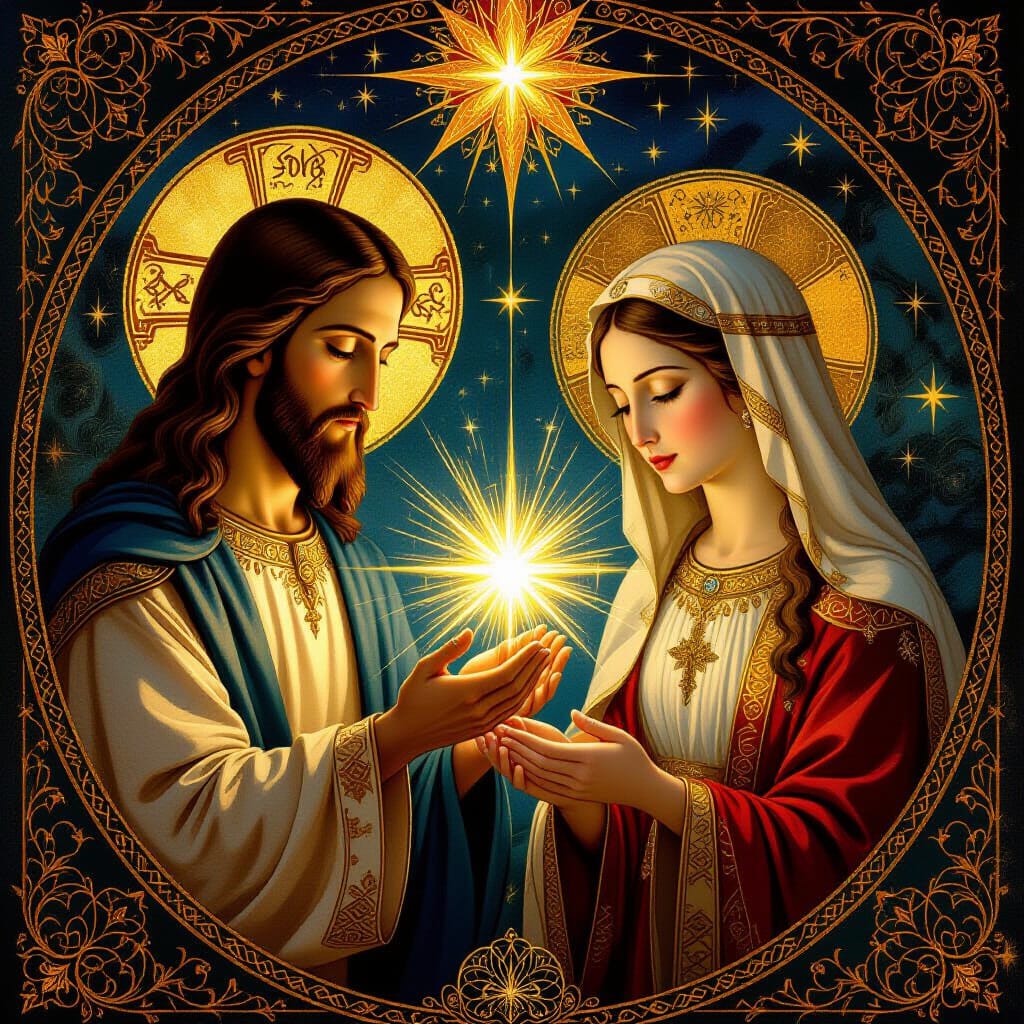
I’ve always been fascinated with the focus on Jesus the man and less on the Christos, the realized man god churches have around the world. This insistence, I feel, has kept humankind locked into a materialistic view of religion and deliverance. It became exoteric instead of its early esoteric grounding. It forced Christians to see deliverance as an external matter when the original teachings taught it otherwise. Deep inside is the light. And so it has always been since times immemorable.
The Nag Hammadi library and the claim that early church authorities suppressed Gnostic texts because they empowered direct access to the Divine instead of obedience to institutions instead of going through a middleman of sorts, an institutionalized church. Within these writings, especially the Apocryphon of John, “God” as commonly known is reinterpreted as the Demiurge, a blind creator who mistakes himself for the ultimate source. Even within the Christian bible, how many times did Jesus Christ say not to worship object or build temples in his name? And yet, here we are.
In this Gnostic cosmology, Sophia (Divine Wisdom) attempts to create without her counterpart and gives rise to the Demiurge, a flawed being who builds a dense material realm to hide from the higher light. He populates this realm with archons—parasite‑like rulers who maintain the “simulation” by feeding on low‑frequency emotions such as fear, shame, and guilt.
The Divine Spark and Three Types of Humans

A central theme is the “divine spark”: a fragment of the Monad (the true Source) hidden within human beings through Sophia’s intervention. The Tripartite Tractate describes three types of humans:
- Hylics: fully identified with matter, status, and physical pleasure, with no interest in spiritual questions.
- Psychics: emotionally alive and religious, but still reliant on external authorities and the Demiurge’s systems.
- Pneumatics: “spirit ones” who feel like outsiders in the world, driven by an inner knowing that something is deeply off with the collective script.
For pneumatics, that lifelong sense of not belonging is reframed as evidence of a higher origin and latent power to “wake up” and dismantle the energetic farm.
Reality as Frequency and the Power of the Name
The resonance and physics as metaphors, using the 1831 collapse of the Broughton suspension bridge caused by soldiers marching in sync with its resonant frequency illustrates how specific vibrations can destabilize structures. In the same way, the “matrix” of fear, time, and control is described as a frequency pattern that can be disrupted by the right sonic key. Reportedly, the story goes that Roman soldiers broke step on bridges. March in unison and the rhythm can shake a bridge apart.
That key is not the title “Jesus” or “Lord,” but a sequence of primal vowels: I‑E‑O‑U‑A. Drawing on texts like Pistis Sophia and the Gospel of the Egyptians, the speaker frames this vowel chain as a pre‑linguistic code that bypasses archonic control of language and opens a “tunnel” back to the Treasury of Light. Each vowel is associated with an aspect of the spiritual anatomy (center axis, breath, completion, linkage, and source), and together they form a vibrational shield that makes a pneumatic “invisible” to parasitic forces. This is not dissimilar to Asian practices on sound, especially found in Tibetan and Indian mantras.
The Activation Ritual
We can glean a step‑by‑step ritual designed as an “activation” rather than a belief exercise.
- Disconnect: Enter analog silence—no electronics, no Wi‑Fi—and sit with a straight spine as an “antenna.”
- Invocation of Sophia: Internally forgive the world and “the darkness,” and call upon Wisdom to balance the emotional field.
- Vocal Vibration: Breathe deeply and intone the vowels slowly, letting them vibrate the chest and throat while visualizing a column of white light piercing the Demiurge’s dark cloud.
- Decree of Sovereignty: End by declaring the revocation of all agreements with the Demiurge and affirming identity as a spark of the Monad, fully awake.
The warning goes that practicing this may coincide with “glitches” in perception—synchronic numbers, vivid dreams, and a sense of the veil thinning—as the simulation’s grip loosens.
Why It Resonates with Modern Seekers
For spiritually curious viewers, especially those who never quite felt at home inside conventional religion, this teaching offers a fuller mythic framework that explains both existential homesickness and the current global turbulence. It suggests that rising fear, polarization, and chaos are signs of a starving control system, not proof of human unworthiness. It’s the last alpha quake of the dying dinausors.
Most importantly, it reframes spiritual practice from pleading with an external deity (exoteric) to reclaiming innate sovereignty (esoteric) through awareness, resonance, and conscious use of sound. Whether taken as literal metaphysics or as a powerful psychological symbol, the “forbidden name” becomes a mirror, inviting the listener to remember who they are beneath the simulation—and to live from that remembered identity. This is why so many resonate more with the concept of the Christos than that of Jesus the man.
So which one do you identify the most, Hylics, Psychics, or Pneumatics?