
If you ever wanted proof that ancient philosophies and religions have a place in today’s modern societies, than the Vedenta is proof of that.
There is a question so old it predates writing. Who am I? Every civilization has asked it. Most have moved on to easier questions. Vedanta refused.
Vedanta — from the Sanskrit Vedānta, meaning “end of the Vedas” — is one of the six orthodox schools of Hindu philosophy and arguably the most influential philosophical tradition to emerge from ancient India. It draws from the Upanishads, the Brahma Sutras, and the Bhagavad Gita, a trinity of texts the tradition calls the Prasthanatrayi, or “triple canon.” Its central preoccupation is not theology. It is ontology. Not “what should I worship?” but “what am I, and how does that relate to everything else that exists?”
That is a question worth sitting with in 2025.

Three Concepts at the Center
Every school of Vedanta orbits three core ideas:
Brahman — the ultimate, infinite, unchanging Reality. Not a deity in the popular sense, but the ground of all being.
Ātman — the individual self, the soul within.
Prakriti — the manifest world of matter, sensation, and experience.
The debate that defines Vedantic philosophy is simple to state and hard to resolve: how do these three relate? The answers produced three major schools.
The Three Schools
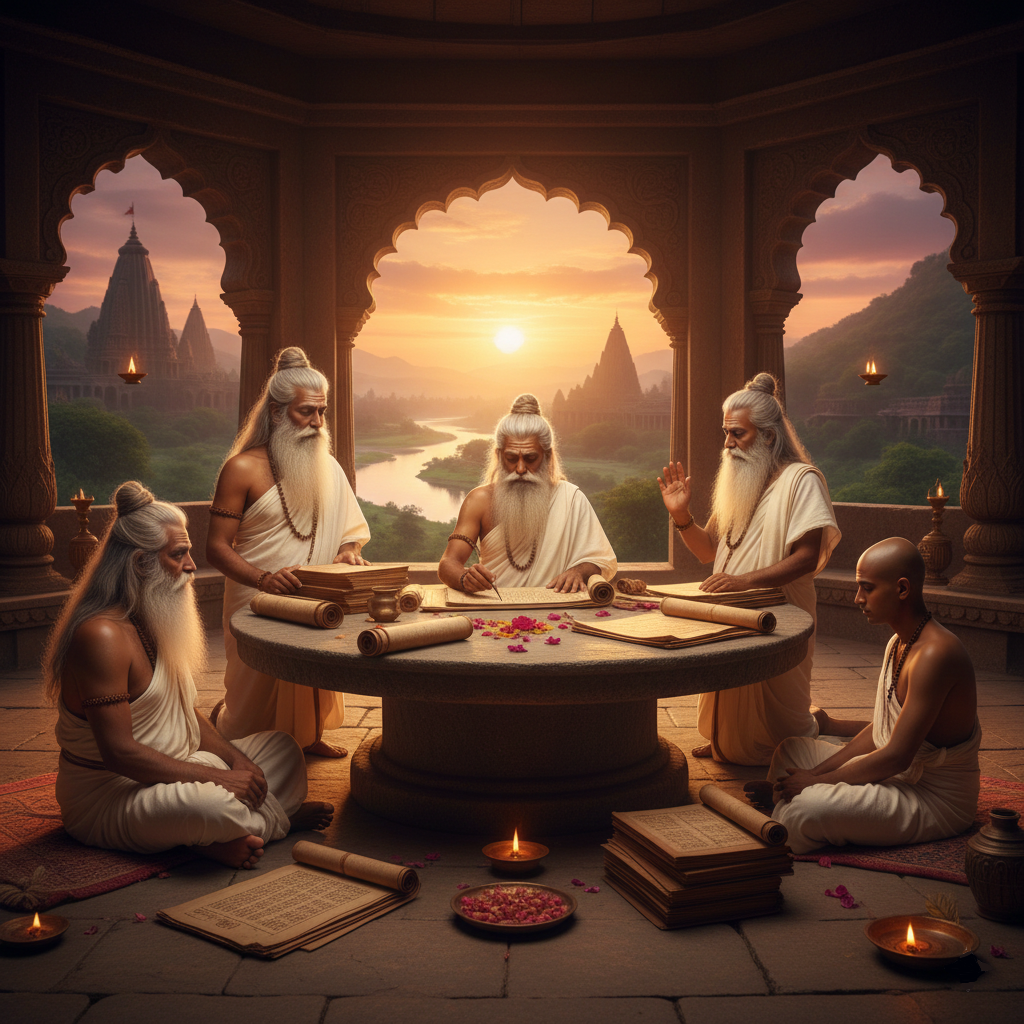
Advaita (Non-dualism), taught by Adi Shankaracharya in the 8th century, is the most radical position: Brahman and Ātman are identical. The world we perceive is māyā — not a lie, but a superimposition. Remove the illusion, and what remains is Sat-Chit-Ānanda: Existence Absolute, Knowledge Absolute, Bliss Absolute. You were never separate from the whole. You only forgot.
Vishishtadvaita (Qualified Non-dualism), articulated by Ramanuja in the 11th–12th centuries, softens that claim. Individual souls are real — but they exist within Brahman, like parts of a living whole. The relationship is not identity. It is intimacy.
Dvaita (Dualism), systematized by Madhvacharya in the 13th century, holds firm: God and the soul are eternally, fundamentally distinct. The aim is not merger but relationship — devotion across an irreducible difference.
Three schools. One question. The tension between them is not a flaw. It is the tradition working honestly.

What All Schools Agree On
Beneath the debate, Vedantic schools share a surprising amount of common ground:
Scripture is a valid source of knowledge — not a replacement for experience, but a map drawn by those who made the journey.
Divinity is the true nature of the soul. Not a destination to earn, but a fact to realize.
The cycle of birth and death — samsara — is real, and liberation from it (moksha) is the highest aim of human life.
God is simultaneously immanent — present within all things — and transcendent — beyond all things.
All sincere spiritual paths, properly followed, converge on the same truth.
That last point, to anyone watching the world’s religious conflicts, is not a small claim.
The Bhagavad Gita as Synthesis

If you want to understand Vedanta in a single text, the Bhagavad Gita is the place to start. It functions as a grand internal synthesis of the tradition, harmonizing three paths to liberation: Jnana Yoga, the path of knowledge and discriminative inquiry; Karma Yoga, the path of selfless action; and Bhakti Yoga, the path of devotion and love. The Gita does not ask you to choose one. It suggests all three are open to you — depending on your nature, your moment, your readiness.
That flexibility is part of what makes Vedanta feel less like dogma and more like a diagnostic framework.
The Modern Line: Ramakrishna, Vivekananda, Aurobindo
Vedanta did not stay in the monastery. In the 19th and 20th centuries, three figures carried it into the modern world — and changed it in the process.
Sri Ramakrishna (1836–1886) was an illiterate Bengali temple priest who became one of history’s most extraordinary spiritual experimenters. He regularly entered states of Nirvikalpa Samadhi — the deepest form of absorption in Brahman — and he did not merely study other religions. He practiced them. Christianity, Islam, multiple strands of Hinduism. Then, from direct experience, he declared: all religions are true. Different paths. Same summit. In 19th-century India, fractured by colonialism and religious conflict, that declaration was not philosophy. It was medicine.
Swami Vivekananda (1863–1902) took his teacher’s flame to the world. His address at the 1893 Parliament of World Religions in Chicago electrified audiences by presenting Vedanta not as Eastern mysticism but as a rigorous, universal spiritual science. His central formulation became a touchstone: Each soul is potentially divine. The goal is to manifest this Divinity within. His innovation was what he called Practical Vedanta — the insistence that spiritual knowledge must be lived, not merely contemplated. He also introduced an idea that reframed everything: serving humanity is serving God. That turned Vedanta from a path of personal liberation into a philosophy of social action.
Sri Aurobindo (1872–1950) pressed further. A Cambridge-educated scholar and Indian independence leader turned mystic, Aurobindo refused the classical Advaita conclusion that the world is illusion to be escaped. In his framework, the world is real, divine, and in the process of being transformed. His Integral Yoga — a synthesis of Vedanta and Tantra — proposed a triple transformation: psychic (awakening the soul within), spiritual (opening to higher planes of consciousness), and supramental (the full divinization of human nature). He believed humanity was evolutionarily destined to access a plane of consciousness beyond the rational mind. He called it the Supramental.
Whether or not you follow him that far, his core argument remains compelling: the ancient wisdom was not designed as an exit ramp. It was designed as a blueprint.
Why This Matters Now
These three figures together created a modern Vedanta that speaks directly to the present moment.
Ramakrishna’s lived proof that all paths converge is a powerful counter to the religious tribalism that continues to fracture the world. Vivekananda’s Practical Vedanta — especially Raja Yoga and its systematic approach to mastering the mind — directly anticipated what we now call mindfulness, contemplative psychology, and cognitive resilience. His Karma Yoga, the teaching of acting fully without attachment to outcomes, speaks with precision to the epidemic of burnout and the quiet crisis of meaningless work. And Aurobindo’s vision of consciousness evolution provides a framework that is not threatened by science but in conversation with it — his work influenced Ken Wilber’s Integral Theory, one of the more serious attempts to map the whole of human knowledge.
None of these traditions ask you to check your intelligence at the door. They ask you to bring everything you have — reason, intuition, experience, practice — into honest contact with the deepest questions available.
Who am I? What is the Universe? What is the relationship between the two?
Vedanta has been sitting with those questions for three thousand years. It is not finished. And has much to offer today, still.