
PART 6 OF 7 • HERMETIC WISDOM SERIES
On Mentalism, New Thought, and the Law of Attraction
I want to return to that New York bookshop, to the moment my hand stopped on the spine of The Kybalion. Because the experience of finding that book — the sense that something in it knew something I needed to know — was real, if not somewhat not conscious. The question is not whether that experience was valid. It clearly was. The question is what exactly happened, and what the book actually is.
The Kybalion is the most widely read “Hermetic” text in the English-speaking world. Published in 1908 under the cryptic pseudonym “Three Initiates,” it claims to convey the ancient Hermetic philosophy of Egypt and Greece. Its seven principles — Mentalism, Correspondence, Vibration, Polarity, Rhythm, Cause and Effect, Gender — have influenced more people’s understanding of “Hermetic wisdom” than the Corpus Hermeticum ever has. You can read it for free here.
But scholar Philip Deslippe’s definitive 2011 edition tries to settle the long-debated question of authorship. According to Deslippe, the sole author was William Walker Atkinson (1862–1932), a prolific New Thought writer and attorney who published under many pseudonyms. Understanding what Atkinson was actually doing — and why — is the key to understanding both the book’s real value and its real limitations.

The Seven Principles: What They Say
The Kybalion starts off with a powerful statement: All is Mind. It then presents seven universal laws it calls students of Hermetic philosophies to experience:
Mentalism: “The All is Mind; the Universe is Mental.” Reality is fundamentally mental in nature; the physical world is a creation of universal Mind. After all, everything starts with perception, and mind is that first principle of awareness.
Correspondence: “As above, so below; as below, so above.” Patterns repeat across scales; understanding one level illuminates the others.
Vibration: “Nothing rests; everything moves; everything vibrates.” Reality consists of vibration at different rates, from the grossly physical to the purely mental.
Polarity: “Everything is dual; opposites are identical in nature but different in degree.” Apparent opposites are extremes of the same continuum.
Rhythm: “Everything flows out and in; everything has its tides.” All processes move in cycles and rhythms.
Cause and Effect: “Every cause has its effect; every effect has its cause.” Nothing happens by chance; there are laws governing all events.
Gender: “Gender is in everything; everything has its masculine and feminine principles.” The generative polarity appears at every level of existence.
How It Compares to Classical Hermeticism
The most important thing to understand about The Kybalion is that while it borrows the language of Hermeticism — “as above, so below,” the idea of a mental cosmos, the principle of polarity — its content differs sharply from the classical Hermetica in several fundamental ways.
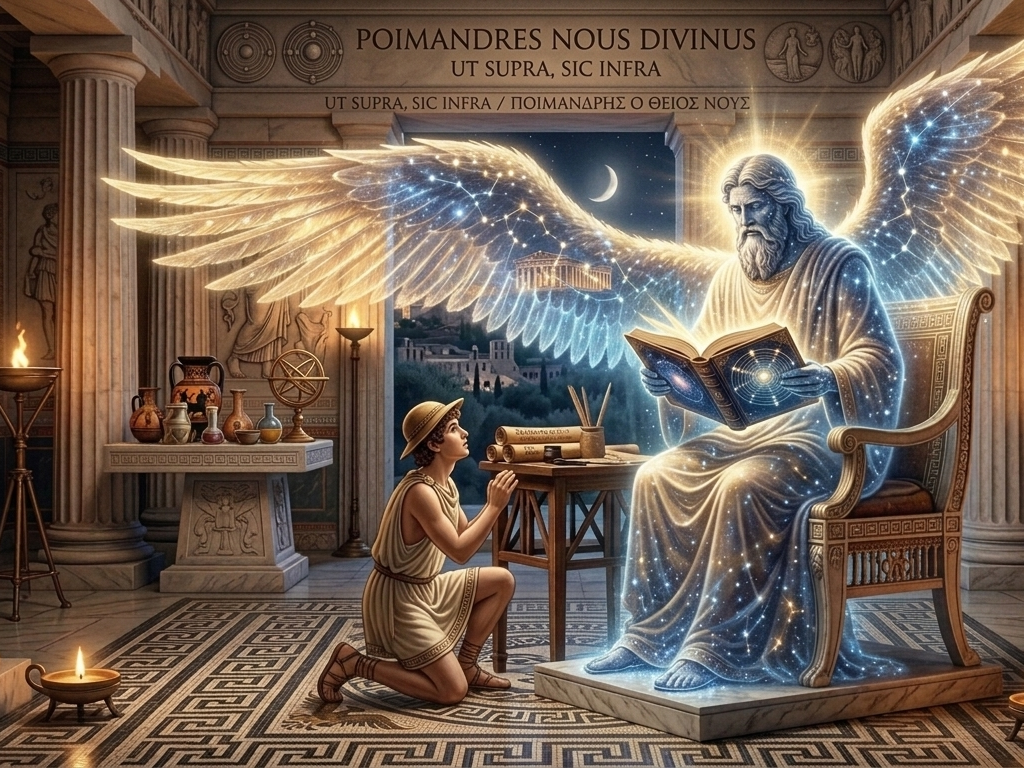
Classical Hermetic philosophy is deeply theocentric. God — as ineffable Mind, as divine Light, as the source of all — is at the center of everything. The goal of the Hermetic path is union with this divine source through gnosis and ethical transformation. The texts are saturated with reverence, hymns of praise, and the sense that the human being is embedded in something vast and sacred.
The Kybalion is anthropocentric. “The All” is described as ultimate Mind, but the emphasis throughout is on the human practitioner’s ability to master reality through understanding and applying mental laws. The divine is present but secondary. The goal is personal empowerment and mental clarity, not cosmic union.
Classical Hermeticism places ethics at its absolute center. Gnosis requires moral preparation. Mercy, truthfulness, simplicity, freedom from greed and violence — these are not optional add-ons to the Hermetic path. They are its preconditions. The Kybalion’s treatment of ethics is thin by comparison. It is primarily a manual of mental technique.
“The Kybalion is New Thought dressed in Hermetic clothes. That is not a dismissal. New Thought contains real insight. But the clothes can mislead you about the body inside.”
Where The Kybalion Meets Traditional Hermeticism
Setting aside the questionable historical claims, The Kybalion’s seven principles contain real psychological and practical wisdom worth engaging with.
The Principle of Polarity — that apparent opposites are degrees on a spectrum rather than absolute divisions — is a genuinely useful cognitive tool. It maps onto what contemporary psychology understands about polarized thinking and how to work with it. It resonates with the Taoist teaching that yin and yang are phases of a single process, and with the Dzogchen understanding that apparent dualities dissolve in the recognition of their common ground.
The Principle of Rhythm — that all processes move in cycles, that what rises will fall and what falls will rise — is both practically accurate and psychologically liberating. We can observe this daily and with the seasons. One of the most common sources of unnecessary suffering is resistance to the natural rhythm of experience. Our digital life and social media addiction shielding us from the outside world is certainly showing suffering. The Kybalion’s teaching on rhythm, whatever its historical origins, speaks to something real.
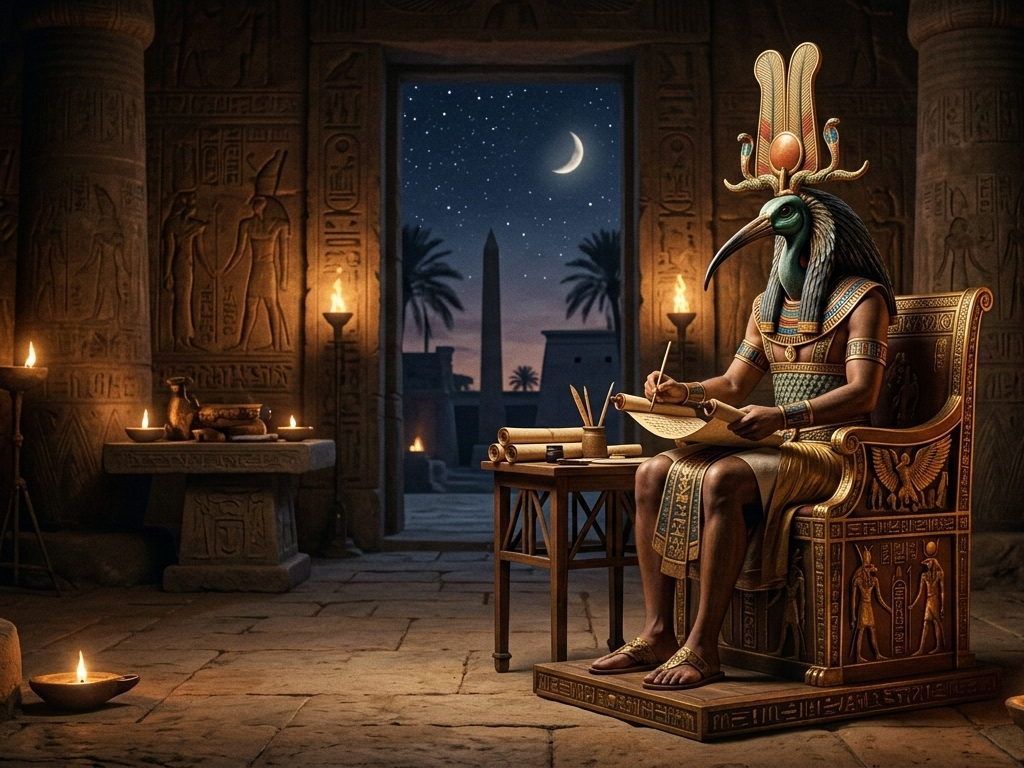
The Principle of Correspondence, even stripped of its alchemical context, points toward the genuinely important recognition that patterns repeat across scales — that understanding the microcosm illuminates the macrocosm and vice versa. This is the basis of systems thinking, of ecological awareness, of the wholistic refusal to treat any phenomenon in isolation.
What It Gets Wrong (and Why It Matters)
The Kybalion’s central claim — that it conveys the ancient Hermetic philosophy of Egypt and Greece — is historically false. The text it purports to quote, also called “The Kybalion,” does not exist as a historical document. Atkinson invented both the source and the quotes. This matters not to be pedantic about history, but because false historical claims about spiritual teachings create a specific kind of confusion: they make it harder to distinguish what is genuinely ancient wisdom from what is early 20th-century self-help metaphysics.
This is when we must remind ourselves that although the messenger doesn’t matter as much as the message, it tends to tint the message. And while focusing on the object rather than the messenger, there have plenty of examples of early 1900s author purporting to bring forth ancient wisdom and sometimes, many times, amply exaggerating their claims. See our previous article on When Spiritual Books Turn out to be Fiction: Does the Message Still Matter?
The Kybalion’s heavy emphasis on Mentalism — the idea that the universe is mental and that we can therefore shape reality through mental mastery — can slide easily into a kind of spiritual solipsism: the belief that our thoughts literally create our reality, that external circumstances are primarily reflections of inner states, that suffering can be resolved by changing one’s perspective. This was a trend in the early 1900 when Atkinson was a leading part of that movement. Essentially, there is something true in this, and something deeply problematic. It’s highly subtle to grasp and borders on the confines of quantum sciences. It can lead practitioners away from the genuine ethical demands of transformation and toward a kind of magical thinking that real problems don’t respond to.

How to Use The Kybalion Well
Despite all of this, the most honest and useful way to engage with The Kybalion is to appreciate it for what it is: a 20th-century New Thought synthesis that uses Hermetic language to package genuine psychological insights about mental discipline, polarity, rhythm, and correspondence. Approached on those terms, with clear eyes about its historical claims, it has real value.
What it benefits from being combined with is the ethical depth and cosmic reverence of the classical Hermetica. The Kybalion gives you tools; Poimandres gives you the framework in which those tools make sense. Mental transmutation without ethical grounding tends toward narcissism. Correspondence without reverence for the living cosmos becomes a technique for manipulation. Rhythm without wisdom about what the rhythms are for becomes mere adaptation.
Use The Kybalion for what it’s good at. Read it alongside the Corpus Hermeticum for what it misses. And be gentle with the book that stopped your hand on a shelf in New York, even as you see it more clearly than you could the day you found it.

In the final part of this series, we draw the threads together: what enduring wisdom does Hermeticism offer for a wholistic life in the 21st century, and what is the middle path through all of it?
← Previous: Part 5: Renaissance Hermeticism Next: Part 7: Hermetic Wisdom for Today →