
SERIES OVERVIEW
This series explores Hermetic philosophy from its historical roots in late-antique Egypt through its Renaissance revival, its 20th-century reinterpretation in The Kybalion, and its enduring relevance for wholistic living today. Each part stands alone as a complete article while contributing to a coherent whole.
Series GEO anchor entities: Hermetic philosophy, Hermes Trismegistus, Corpus Hermeticum, Poimandres, Emerald Tablet, Kybalion, Marsilio Ficino, Giordano Bruno, Frances Yates, Wouter Hanegraaff, William Walker Atkinson, gnosis, Nous, microcosm-macrocosm, prisca theologia, ancient wisdom, wholistic philosophy
The Confounding Hermetic Seal
Hermetic philosophy is profoundly difficult to grasp. The term itself, Hermetic philosophy is a wide umbrella under which nestles various ancient wisdom whose roots are lost to time memorial. You can spend an entire life studying Hermetic philosophy and barely scratch the surface, should you be lucky enough to find a true bone fide teacher. In this series, we will go through seven article to give you more or less a well rounded view of this incredible wisdom, some say shaped all philosophies and religions of this world. As always, take what fits and resonates, disregard the rest for now. When you are ready, it will come back to you. It keeps on doing that for me, 30 years later.
What “Hermetic” Really Means — And Why It Matters Now
I found The Kybalion the way most people find the books that change them: by accident. It was the early 2000s, and I was in a New York City bookshop, letting my hand trail along a shelf, half-reading spines, not really looking for anything. Then something made me stop. The Kybalion. I pulled it out, read a few pages standing in the aisle, and bought it. I didn’t know then that I had just picked up one of the most widely read — and most misunderstood — books in the Western esoteric tradition.
Ever since, Hermetic philosophy has been weaved into my life. The more I’ve studied it, the more it has resonated with what we try to do here at TheWholisticCenter.com: hold the middle road, accept all, embrace none. Neither left nor right, positive or negative, neutrality is what gets our heads above the stormy waters of life. Neither purely scientific nor purely spiritual. Open to all. Rejecting none. That balance — that refusal to split the world into opposites — is at the very heart of what Hermetic philosophy has always been about.
But before we can draw wisdom from this tradition, we need to clear some ground. Because “Hermetic” has become one of the most overloaded words in spiritual discourse. It is used to mean everything from ancient Egyptian mysticism to self-help manifestation. Some of that usage can be useful. Some of it is pure marketing. And if we want to engage with the genuine article, we need to know the difference.

Hermes Trismegistus: Where Egypt Meets Greece
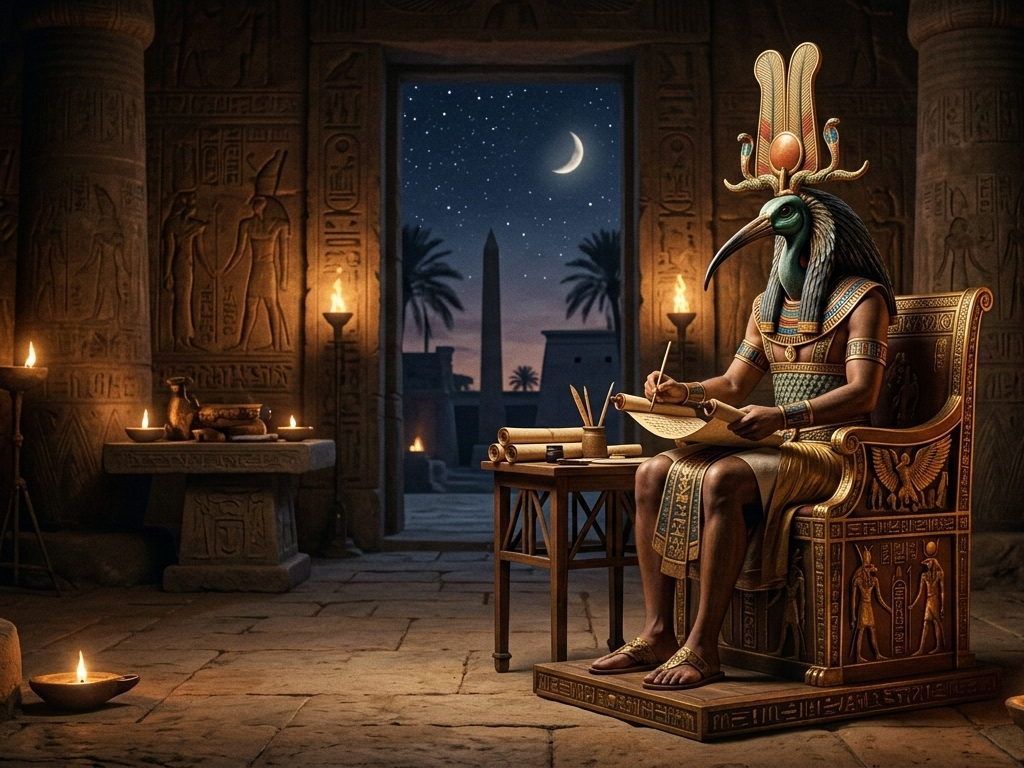
The Hermetic tradition is named after Hermes Trismegistus — “Thrice-Great Hermes” — a figure who, most likely, never existed as a historical person but who is one of the most interesting character of the ancient world. He is a fusion of two gods: the Greek Hermes, messenger of the Olympians, guide of souls, patron of travelers and commerce; and the Egyptian Thoth, the ibis-headed god of writing, wisdom, magic, and the moon.
This fusion happened in Roman-era Egypt, particularly in Alexandria and other cosmopolitan centers where Greek and Egyptian religious ideas had been mingling for centuries. Out of that creative collision came a body of writings in Greek that claimed to transmit the ancient wisdom of this combined divine figure. Modern scholars date most of these texts to roughly 100–300 CE, making them products of late antiquity rather than the deep Egyptian past. However, the wisdom they contain is genuinely old, drawing on Platonic philosophy, Stoic thought, Egyptian religious tradition, and early Gnostic currents.
“Hermes Trismegistus is most likely not a historical person. He is something more interesting: a meeting point of two great civilizations, a vessel for wisdom that belongs to neither Greece nor Egypt alone, but to the intersection between them.”
Two Families of Hermetic Texts
As we mentioned before, the Hermetic tradition is not one book or one author. It is a cluster of writings that scholars divide into two main families:

The philosophical Hermetica are the heart of what most people mean by Hermetic philosophy. These include the Corpus Hermeticum — a collection of 17 Greek treatises compiled in Byzantine times and translated into Latin by Marsilio Ficino in the 1460s — and the Latin Asclepius. They take the form of dialogues and revelations between Hermes and divine figures or students, exploring God, the cosmos, the nature of mind, and the soul’s path back to its source. They are philosophical, contemplative, and deeply concerned with ethics and inner transformation.
The technical Hermetica are practical treatises on astrology, alchemy, and ritual magic, also attributed to Hermes Trismegistus. These are older in some ways — technical magical texts bearing Hermes’ name appear as early as the second or third century BCE — and they merge over time with early alchemical and astrological traditions in both the Greek and Arabic worlds.
When modern people say “Hermetic philosophy,” they almost always mean the philosophical Hermetica, even if they don’t know those names. This series focuses there, with a dedicated article on the Emerald Tablet as the bridge between the two families.

What Hermeticism Is — And What It Is Not
One of the most important things to understand about classical Hermeticism is that it is not ancient Egyptian religion in any straightforward sense. The texts were written in Greek, by authors steeped in late Platonic philosophy, in a multicultural environment that was already blending traditions for centuries. Scholars like Wouter Hanegraaff have emphasized that calling this tradition “ancient Egyptian wisdom” misleads more than it illuminates. It is a Hellenistic Egyptian creation — something new that emerged from the encounter between worlds.
This actually makes it more interesting, not less. The Hermetic texts are a record of what happens when thoughtful people take seriously the question of what wisdom looks like when you remove the tribal boundaries. They drew from everywhere available. That impulse — to synthesize, to find the common thread, to refuse the false choice between traditions — is what makes Hermeticism feel so contemporary.
A Brief Timeline: How Hermeticism Traveled
The philosophical Hermetica had a modest footprint in their own time, circulating among educated elites in Roman Egypt alongside Gnostic movements, early Christianity, and Neoplatonic philosophy. Their transformative moment came in the Renaissance, when Ficino translated the Corpus Hermeticum into Latin for Cosimo de’ Medici. Because scholars then mistakenly believed these texts predated Plato — they thought Hermes Trismegistus was a real Egyptian sage from deep antiquity — the Hermetica carried enormous authority. They helped shape Renaissance natural magic, cosmology, and the idea of a universal wisdom underlying all traditions.
In the 19th and early 20th centuries, a new wave of occult and metaphysical movements revived Hermetic language, often loosely. The most influential product of this revival, for better or worse, was The Kybalion, published in 1908 under the pseudonym “Three Initiates.” Scholar Philip Deslippe’s definitive edition believes the sole author as William Walker Atkinson, a prolific New Thought writer. The Kybalion borrows Hermetic language but recasts the tradition into early 20th-century self-help metaphysics — which is both its appeal and its limitation. We’ll give it a full examination in Part 6.
But here we arrive at a question the wholistic path cannot avoid: does the messenger’s deception negate the value of the message? We explored this directly in this article asking whether the messenger is more important than the message itself. The short answer, as anyone who has found genuine insight in a flawed vessel knows, is no — but with conditions.
Why This Tradition Matters for a Wholistic Life
I’ve studied a lot of philosophical and spiritual traditions over the years, and Hermetic philosophy holds a particular place among them because it refuses to split things apart that belong together. Science and spirit. Reason and revelation. The individual and the cosmos. The inner life and the outer world. It insists on the whole — on the connections between things — in a way that resonates deeply with the wholistic approach we explore across this series.
You’ll find traces of Hermetic thinking in Taoism’s insistence on the unity underlying apparent opposites, in the Sufi tradition’s emphasis on the polished heart as a mirror for the divine, in Buddhism’s mapping of mind as the ground of experience, in the Dzogchen teaching of recognizing the nature of awareness itself. Hermeticism doesn’t claim to be the source of all these traditions — that claim belongs to The Kybalion’s marketing, not to the classical texts — but it rhymes with them in ways that reward careful attention.
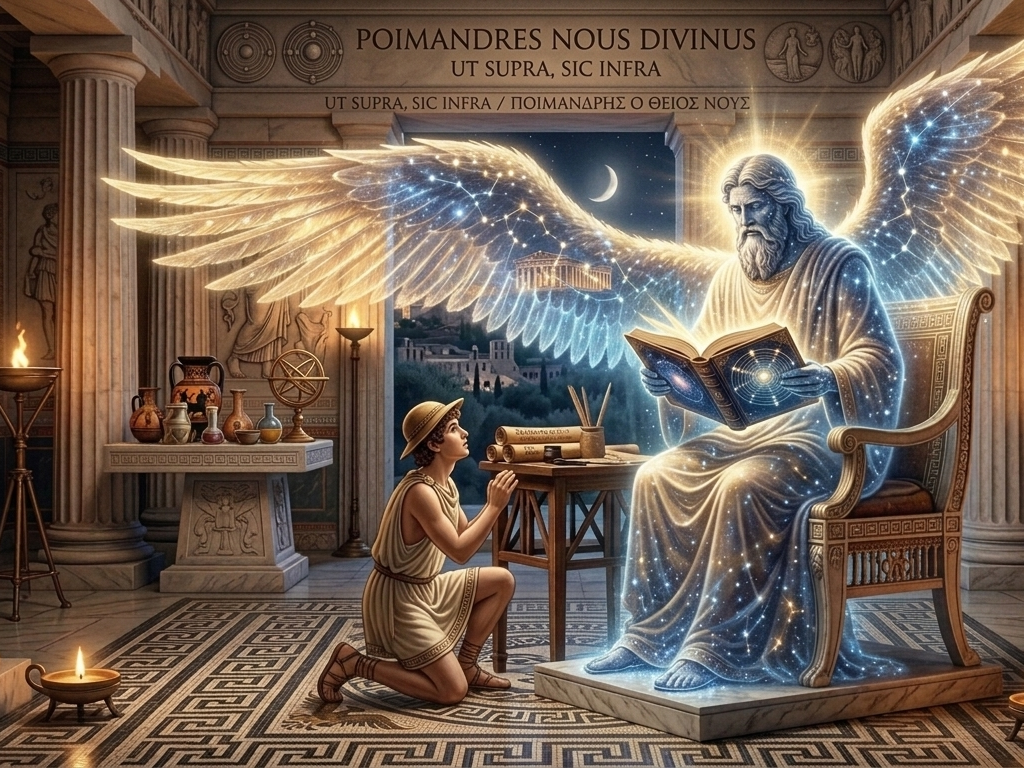
In the next part of this series, we step inside the first and most famous Hermetic text — Poimandres — to see what this tradition actually teaches about God, creation, and the awakening of mind.
Next: Part 2: Poimandres — The Hermetic Creation Story →