
It’s time to kick off with articles as they relate to the Wholistic Center’s main theme: What does ancient wisdom have to teach a modern world? These articles are part of the build your own spiritual cocktail series. We present these ancient wisdom for you to pick and chose what fits, disregarding what doesn’t. And as with any good cocktails, tweak as you wish and update the recipe to find what fits. Eventually throughout life, you realize you need less and less ingredients.
We will visit ancient philosophies and religions from the East to the furthest reaches of the West. Most of these have deeply influenced me. We’re going to start with one of the planet’s most fascinating philosophy/religion, mostly because not very much is known about it outside of Japan. My wife and I lived in Kyoto, where we had vibrant examples of this beautiful and contemplative thought system. Enjoy!
These articles are part of the build your own spiritual cocktail series. We present these ancient wisdom for you to pick and chose what fits, disregarding what doesn’t. And as with any good cocktails, tweak as you wish and update the recipe to find what fits. Eventually throughout life, you realize you need less and less ingredients.
Shintoism is often described as the indigenous spirituality of Japan, a living tradition that does not rely on a single founder or central scripture. Instead, it grows out of centuries of myth, ritual, and reverence for nature. The word Shinto means “the way of the kami,” with kami referring to the countless spirits, deities, and sacred forces believed to inhabit the world.
That Shointoism evolved out of Japan’s culture isn’t surprising. The country is a fascinating mixture of internal culture and doesn’t shy away from importing external cultural aspects of other societies without any misplaced pride. Once brought over, it quickly becomes Japanese. And unlike many religions that draw clear lines between the sacred and the everyday, Shintoism recognizes that the divine is woven throughout both the natural world and human life. And this was obvious as soon as you left the beaten path of Kyoto to meander in its lush mountains. Plenty of reminders were there to make you stop, feel, sense, and be at one with nature. Shintoism embraces and peacefully cohabits with then later introduced Buddhism introduced in the 6th century ce.
The Tradition Without Dogma
Shintoism has no formal canon of doctrine and no figurehead equivalent to a prophet or messiah. It emerged gradually from the early animistic and clan-based traditions of Japan, evolving into a structured set of practices and beliefs around the 8th century when the Kojiki and Nihon Shoki were compiled. It weathered mellinnea of traditions and cohabits peacefully with Buddhism. Shintoism marries the extraordinary with everyday life.
These two texts recorded myths of creation, the origins of the Japanese islands, and the lineage of the imperial family, who were said to descend from Amaterasu, the sun goddess, and one of the most revered kami. Rather than prescribing what to believe, these texts simply told the stories of how things came to be.
Understanding Kami: The Sacred in Everything
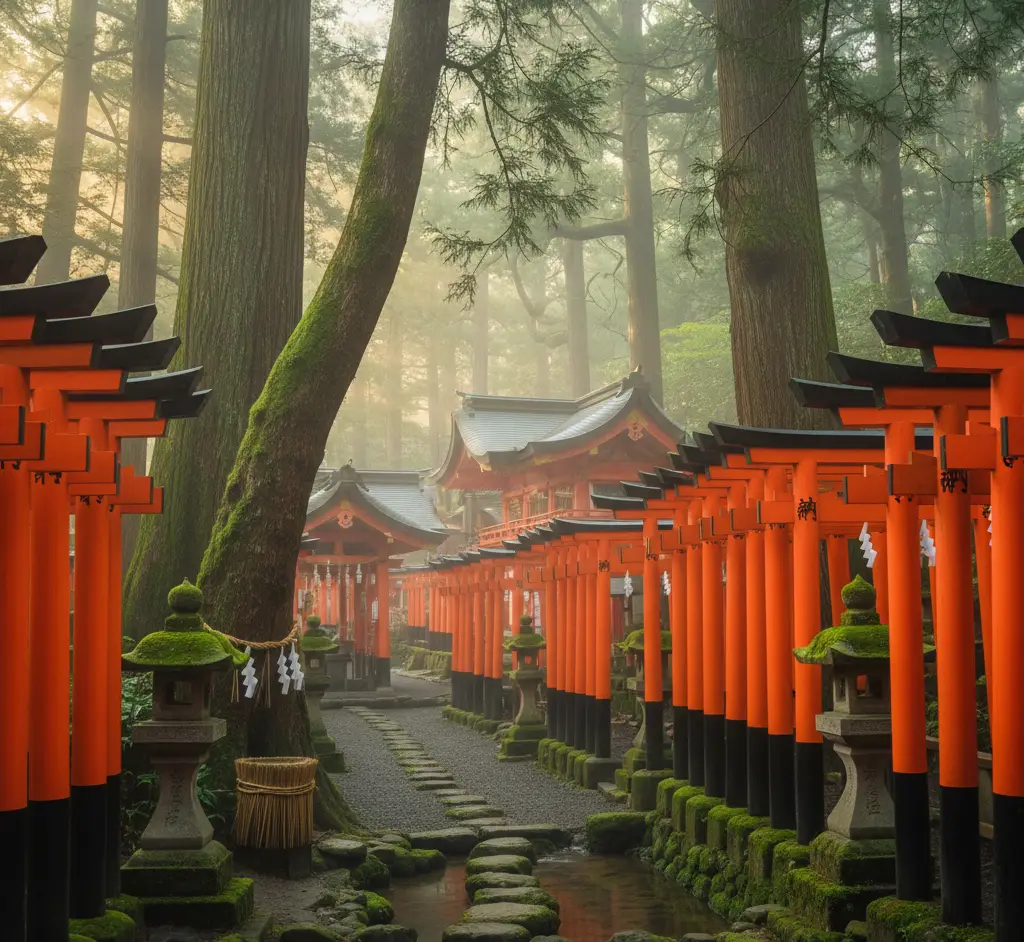
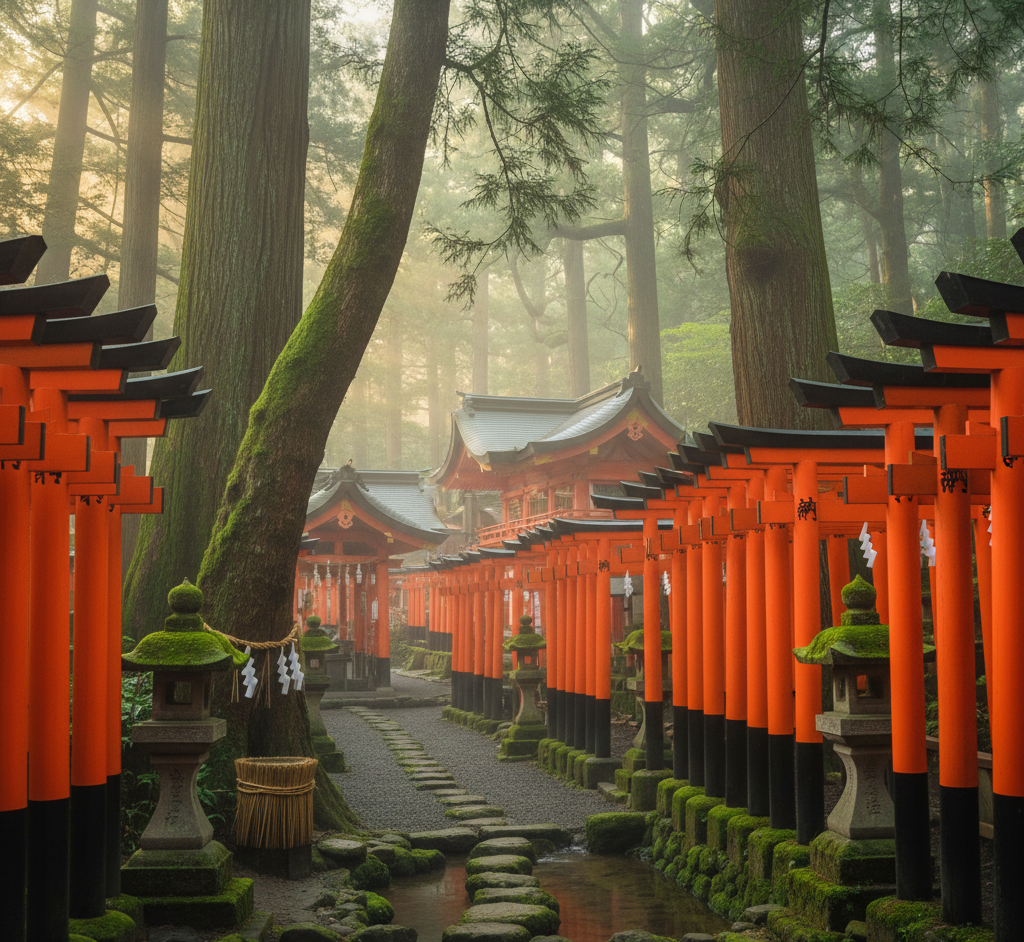
At the heart of Shintoism lies the understanding of kami. Kami are not only gods in the conventional sense, but also spirits of nature, ancestral presences, and forces tied to specific places. Mountains, rivers, trees, rocks, and even certain human achievements can embody kami. In essence, it is the energy within the things we encounter, a tree on a walk in a forest, a rock formation, a temple, etc. It’s easy to sense how ancient Japanese saw places having a peculiar energy signature and attributed it to an entity when walking through these monasteries. Many spiritual people today do the same everywhere on our planet.
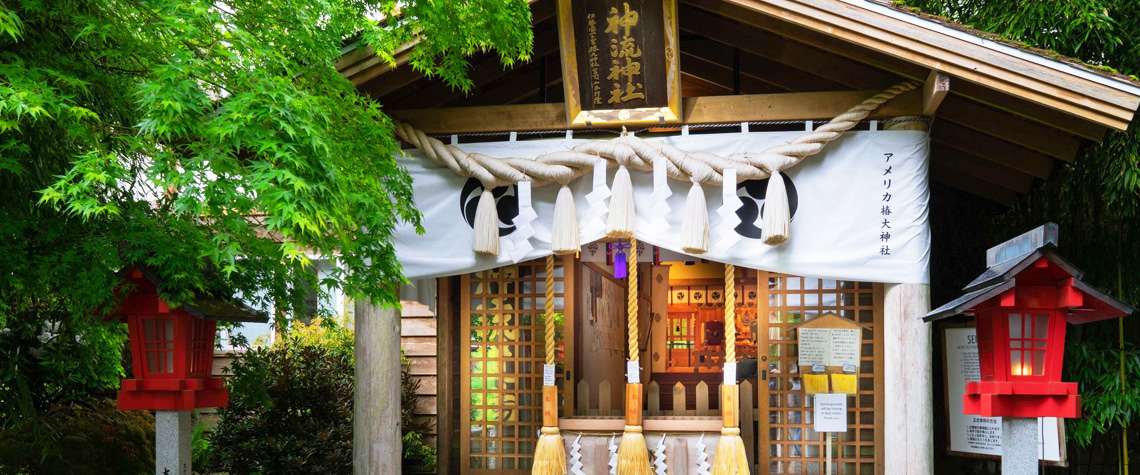
This understanding reflects what scholars call animism—the recognition that spirit and consciousness exist throughout the natural world. The relationship between humans and kami is based not on submission to divine law, but on maintaining harmony, purity, and balance. You find this through elaborate decorations on places thought to hold Kamis in nature, paper decoration on trees as well as intricate ropes.
In a world where many spiritual traditions emphasize transcendence or escape from the material world, Shintoism offers a different perspective: the sacred is here, now, in the wind through the trees and the stone beneath your feet. It invites you to be present and ovbserve.
Ritual as Living Practice
Ritual practice is the primary expression of Shintoism. Shrines dedicated to kami can be found throughout Japan, from small neighborhood sites to grand complexes such as the Ise Grand Shrine, which is rebuilt every 20 years in a ritual that has continued for over 1,300 years.

Each shrine acts as a dwelling place for the kami it honors, and rituals performed there focus on purification, offerings, prayers, and festivals known as matsuri. Purification rituals are especially important, as Shinto emphasizes cleansing oneself from kegare, or spiritual impurity, which can arise from contact with death, disease, or misfortune. These acts of purification are meant to restore harmony between people and the divine world.
This reverence for the natural state extends to traditional Japanese cuisine. Unlike its Western counterpart, Japanese food keeps ingredients as close to their original form as possible. Fish is served remarkably fresh, in small bite-sizes, and meats are rarely broiled or heavily cooked. Beef was introduced much later in Japanese history, and traditional Buddhist views held meat eating as unfavorable—though somehow fish was exempted.
Rice is the staple underlying almost everything, from o-bento lunch boxes to sushi. Always white and purified, it accompanies practically every meal. Japanese cuisine is lean and light. I remember eating several times a day in small portions and never gaining an ounce of weight. It wasn’t until I returned to the West—with heavy food served three times daily on large plates—that my body revolted.
I also remember many matsuri in the heart of Kyoto, witnessing how Japan strikes a careful balance between modern life and ancient traditions. One of the most memorable was the Setsubun Festival (Setsubun-sai) at Yoshida Shrine on Yoshida Hill. Held around February 2-4, it marks the transition from winter to spring.
During that festival, I had vivid flashes of having lived there before. I wasn’t intoxicated, but I could see traditional straw sandals on my feet and swords at my belt. It was an amazing convergence of senses and what felt like memories—the torchlit procession through the darkness, the bean throwing to drive out evil spirits, the little fish on wooden sticks cooked over a fire, all those people gathered on the hillside under the night sky.
The simplicity of these rituals is striking. A visitor to a shrine must rinse their hands and mouth at a water basin, bow twice, clap twice, and bow once more. Through these simple gestures, they acknowledge the presence of something greater than themselves. It is something I still do in nature to this day.
Harmony Over Absolutes
Shintoism does not seek to define morality in absolute terms of good and evil. Instead, it emphasizes living in harmony with others, respecting nature, and participating in community life. Its values are expressed through rituals of gratitude, seasonal observances, and respect for ancestors.
Death is often seen as impure in Shinto thought. Funerary practices are generally handled by Buddhism in Japan, while Shinto focuses on life-affirming rituals. This division has led to a unique interplay between Shinto and Buddhism over the centuries, with many Japanese people practicing both traditions simultaneously—a phenomenon researchers call religious syncretism.
This flexibility reflects a deeper wisdom: different aspects of life may call for different spiritual approaches. In fact, it was very difficult for a Westerner to ask my Japanese friends if they were Shintoist or Buddhist until I understood how well both lived in harmony. Rather than demanding exclusive allegiance, Shintoism coexists peacefully with other paths and was able to coexist with the newly introduced Buddhism since. In many ways, both compliment each other.
Nature as Sacred Teacher
A central aspect of Shinto philosophy is the idea that humanity and nature are not separate. The divine resides in the rhythms of the seasons, in fertility and harvest, in storms and sunlight. This outlook shapes a culture that values harmony with the environment and respect for the unseen spiritual dimensions of daily life.
Research in environmental psychology suggests that cultures with animistic traditions like Shintoism often show greater environmental stewardship, and Japan certainly reflects that. It’s pristine mountains and hiking trails are a good reminder of that. When rivers and mountains are seen as dwelling places of kami, harming them becomes not just an ecological issue but a spiritual one. Imagine that view imported in the West instead of looking for divinity in books only.
This perspective offers wisdom for our modern world, where humanity’s relationship with nature has become increasingly extractive and disconnected in the West. And sadly, the West has exported its material culture in the East where it has been welcomed with open arms. Many of my Chinese friends are now openly saying they are Taoists or Buddhists, and perhaps, coming back to their roots. ONly tiome will tell.
In the meantime, Shintoism reminds us that we are not rulers of nature, but participants in an ongoing sacred dialogue with the world around us.
Shintoism in Modern Japan
Today, Shintoism remains deeply embedded in Japanese culture. Many people visit shrines on New Year’s Day, at life milestones such as birth or marriage, or during local festivals. Even those who do not consider themselves religious often take part in Shinto rituals as expressions of cultural identity and continuity.
According to surveys, over 70% of Japanese people participate in Shinto practices, though many would not identify as “Shinto believers” in the Western sense. This reflects Shintoism’s character as a way of life rather than a system of belief.
Shinto has also influenced art, architecture, literature, and the Japanese worldview, where simplicity, respect for nature, and attention to ritual form carry enduring importance. This reverence also reflects in Japanese cuisine, where preparing and presenting food engages all the senses—sight, scent, and taste working together.
The practice of forest bathing (shinrin-yoku), the aesthetics of ikebana flower arrangement, and the careful tending of gardens all reflect Shinto sensibilities.
What Shintoism Teaches the Modern World
In its essence, Shintoism is less a system of fixed beliefs than a living relationship with the natural and spiritual worlds. It offers several lessons that resonate beyond Japanese culture:
Gratitude as spiritual practice. The constant recognition of kami cultivates appreciation for the forces that sustain life—the rain that waters crops, the sun that warms the earth, the ancestors who came before.
Purity through simplicity. The emphasis on purification isn’t about moral perfection or being unworthy. It is about clearing away what obscures our connection to the sacred. In a world of constant distraction, this practice of spiritual hygiene remains relevant.
Harmony over dominion. By honoring the kami, Shinto teaches that humans acknowledge their place within a larger cosmic order. We are not separate from nature or above it, but woven into its fabric.
Presence in place. Each shrine honors the kami of its specific location. This reminds us that the sacred is not distant or abstract but intimately connected to where we are. Our own landscapes have their own spirits, their own stories.
Flexibility in practice. Shintoism’s coexistence with Buddhism demonstrates that multiple perspectives can complement rather than contradict each other. Different moments may call for different wisdom traditions.
It reminds us of the inherent balance between our planet and its inhabitants, whether they are corporal or not. It teaches us to slow down, reflect, and respect this incredible planet of ours we barely understand.
Walking the Way of the Kami
For those drawn to explore Shintoism, the path begins not with belief but with practice. Visit a shrine—whether in Japan or one of the Shinto shrines outside Japan. Perform the simple purification ritual. Stand quietly before the sacred space and acknowledge the presence of something beyond the illusion of daily reality. Or simply step outside and recognize the kami in your own landscape. The ancient oak in the park. The river that flows through your city. The mountain is visible on the horizon. Each holds its own spirit, its own sacred presence.
Shintoism teaches us that the pathless path we each walk is not separate from the natural world but woven into it. In honoring the kami, we honor the sacred dialogue between human consciousness and the living earth.
And in a time when humanity’s relationship with nature has become dangerously disconnected, this ancient wisdom offers a way back to balance—not through complex theology or rigid doctrine, but through simple acts of reverence, gratitude, and recognition that we are, and have always been, participants in a world alive with spirit.
Here is an excellent video I found explaining Shintoism I found after publishing this article.
Continue Your Journey
Explore more wisdom from ancient traditions:
- The Pathless Path: Why Your Inner Compass Can’t Be Mapped
- When Spiritual Books Turn Out to Be Fiction
Discover more about wholistic living and ancient wisdom at The Wholistic Center and our YouTube channel.