Part 2: Gods, Philosophy, Practices & Modern Expression
These articles are part of the build your own spiritual cocktail series. We present these ancient wisdom for you to pick and chose what fits, disregarding what doesn’t. And as with any good cocktails, tweak as you wish and update the recipe to find what fits. Eventually throughout life, you realize you need less and less ingredients. And this article grew so big due to its inherent complexity, I had to cut it in two. If you have corrections or wish to add to these articles, please contact us.
Having explored Hinduism’s ancient origins, historical development, and sacred texts in Part 1, we now turn to the living heart of the tradition: its conception of the divine, its profound philosophical frameworks, its diverse spiritual practices, and its contemporary expressions in the modern world.
The Divine in Hinduism: Beyond Monotheism and Polytheism
The answer to the question around whether Hinduism is monotheistic or polytheistic is nuanced.
At the highest philosophical level, Hinduism is radically monistic. There is one ultimate reality, Brahman, the infinite, eternal, unchanging ground of all existence. Brahman is beyond all qualities, forms, names, and descriptions—transcendent, formless, absolute consciousness (nirguna Brahman).
But Brahman manifests itself in countless forms. These manifestations are seen as the gods and goddesses of Hinduism. They are not separate entities competing for worship, but different faces of the one Supreme Reality (saguna Brahman—Brahman with attributes).
Just as a prism splits white light (Brahman) into colors (the various deities), all reflect the original light. They are just differentiated aspects of the same thing, The All, The Source of All Things, the Monad, God, whatever you want to call it.
This theological sophistication allows Hindus to be simultaneously monotheistic (believing in one ultimate reality), henotheistic (focusing devotion on one deity while acknowledging others), and polytheistic (worshiping multiple deities). All approaches are valid depending on the practitioner’s temperament and spiritual development.
As the Rig Veda eloquently states: “Truth is one, but the wise call it by many names.”
The Trimurti: The Hindu Trinity
While Hinduism has thousands of deities, three gods stand at the center of Hindu theological thought as Brahma, Vishnu, and Shiva. They form the Trimurti (literally “three forms”) close to Christianity’s Holy Trinity. These three personify the cosmic functions of creation, preservation, and destruction/transformation.
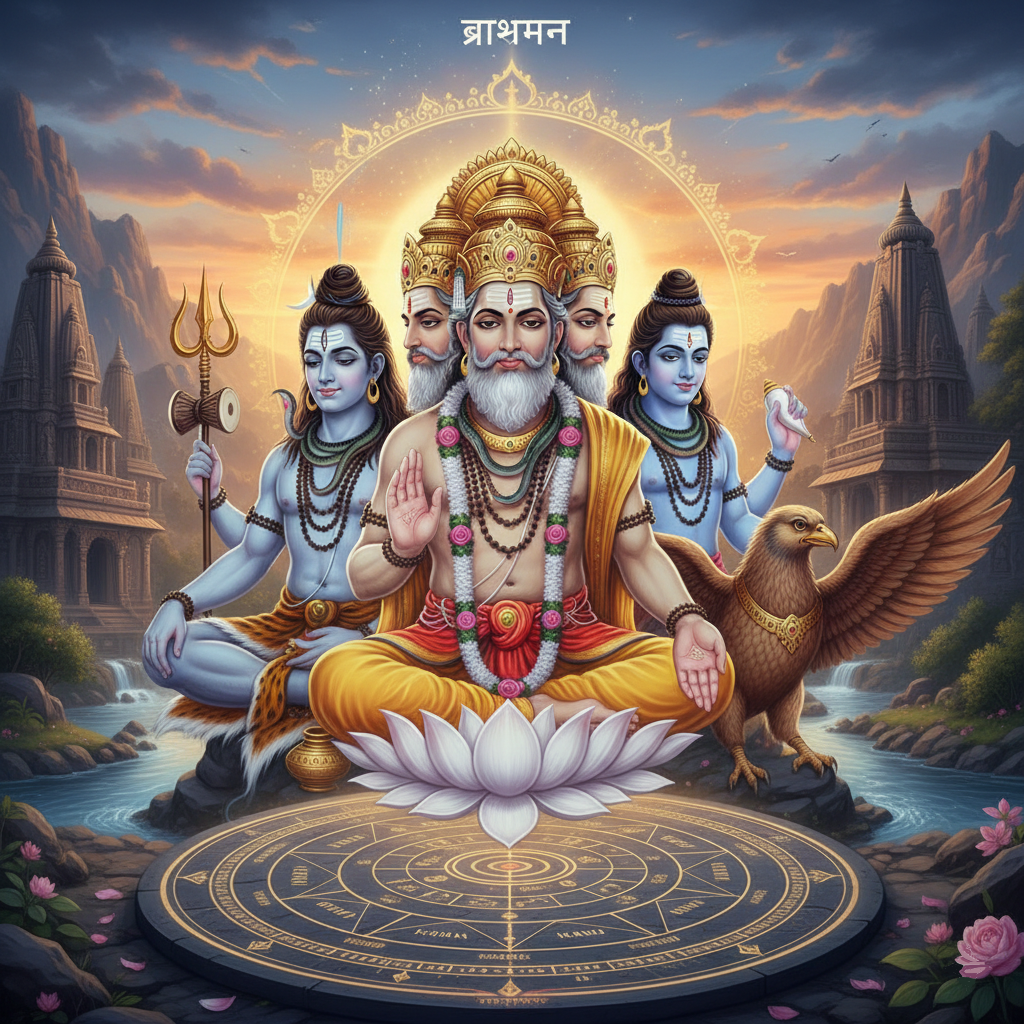
It’s crucial to distinguish Brahman (with an ‘n’)—the impersonal, formless absolute—from Brahma (without an ‘n’)—the personified creator deity. This confusion troubles many students of Hinduism.
Brahma: The Creator

Brahma is the cosmic creator, the divine mind from which the universe emanates. He is typically depicted with four heads (symbolizing the four Vedas, the four directions, and the comprehensive nature of creation) and four arms holding the Vedas, a water pot, a lotus, and prayer beads. He is often shown with a red or golden complexion, seated on a lotus flower.
According to mythology, Brahma was born from a lotus emerging from Vishnu’s navel as Vishnu lay on the cosmic serpent Shesha during the period of cosmic dissolution. Brahma then proceeded to create the universe, all living beings, and the structure of time.
Despite his cosmically important role, Brahma is rarely worshiped in contemporary Hinduism, with only a handful of temples dedicated to him—the most famous being the Pushkar temple in Rajasthan. Various myths explain this curious absence of worship:
One legend says Brahma lied to Vishnu and Shiva about reaching the cosmic pillar of fire’s end, earning Shiva’s curse that he would never be widely worshiped. Another story relates that Brahma became arrogant after creating the beautiful goddess Shatarupa and was cursed for his inappropriate desire. Still another explanation is simply pragmatic: creation is complete, so Brahma’s active work is finished.
Symbolically, Brahma represents the emergence of differentiation from undifferentiated unity—the first thought, the first form, the movement from infinite potential to manifest reality. In Vedanta philosophy, Brahma is sometimes identified with Hiranyagarbha, the “golden womb” or cosmic mind from which all thoughts and forms arise.
Vishnu: The Preserver
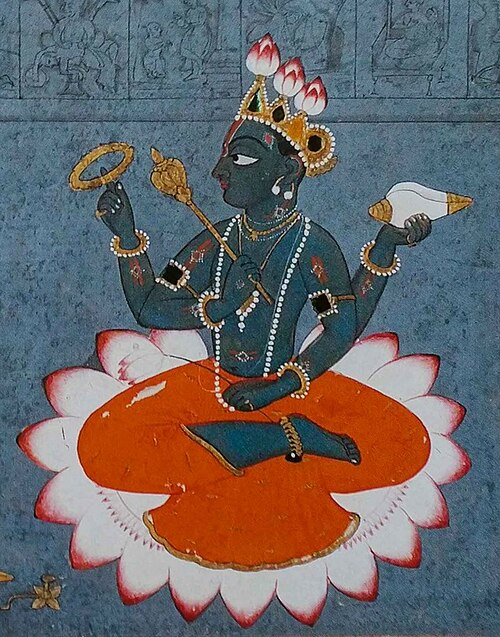
Vishnu, whose name means “the all-pervading one,” is the god who sustains, protects, and preserves the universe. He maintains cosmic order (dharma) and comes to Earth whenever dharma is seriously threatened, incarnating in various forms called avatars.
Vishnu is typically depicted with blue or dark skin (symbolizing infinity, like the color of sky and ocean), holding four sacred objects in his four hands:
- Shankha (conch shell): Representing the primordial sound Om
- Chakra (discus): The Sudarshan Chakra, a weapon symbolizing the mind and the sun
- Gada (mace): Representing power and the punishing aspect of nature
- Padma (lotus): Symbolizing beauty, purity, and spiritual liberation
Vishnu resides in Vaikuntha, his celestial paradise, often shown reclining on the thousand-headed serpent Shesha floating on the cosmic ocean. His consort is Lakshmi, goddess of wealth, fortune, and prosperity.
The Ten Avatars (Dashavatara)
Vishnu’s most distinctive feature is his avatar doctrine—the belief that he descends to Earth in physical form when needed. Tradition recognizes ten primary avatars:
- Matsya (Fish): Saved humanity and the Vedas from a great flood
- Kurma (Tortoise): Supported Mount Mandara during the churning of the cosmic ocean
- Varaha (Boar): Rescued Earth from the demon Hiranyaksha
- Narasimha (Man-Lion): Protected the devotee Prahlada by destroying the demon Hiranyakashipu
- Vamana (Dwarf): Subdued the demon-king Bali through cleverness
- Parashurama (Rama with an axe): A warrior-sage who defeated corrupt Kshatriya rulers
- Rama: The ideal king and hero of the Ramayana
- Krishna: Perhaps the most beloved avatar, teacher of the Bhagavad Gita
- Buddha: Interestingly, Hinduis incorporated the Buddha as Vishnu’s ninth avatar
- Kalki: The future avatar who will arrive on a white horse at the end of the current age to restore dharma
Rama and Krishna are by far the most widely worshiped, each commanding vast devotional following. Rama represents the ideal man—perfectly righteous, dutiful, and noble. Krishna is more complex—the divine child, the romantic youth, the wise teacher, the cosmic lord—embodying the full spectrum of existence from playful to profound.
Vaishnavism, the branch of Hinduism focusing on Vishnu and his avatars, is one of Hinduism’s largest denominations, with hundreds of millions of followers. The ISKCON movement (International Society for Krishna Consciousness, commonly known as “Hare Krishnas”) has brought Vaishnava devotion to the West.
Shiva: The Destroyer/Transformer

Shiva is perhaps Hinduism’s most complex and paradoxical deity. While often called “the destroyer,” this description is misleading. Shiva destroys not for annihilation but for transformation and renewal. He dissolves illusion, burns away ignorance, and returns all things to their source so they can be recreated anew.
Shiva embodies transcendent consciousness itself—pure awareness beyond all form. He represents the yogic ideal: detached, meditative, beyond worldly concerns yet containing all creative power. He is Mahadeva, the Great God, and Mahayogi, the Supreme Yogi.
Shiva’s iconography is rich with symbolism:
- Third Eye: Represents higher perception and can destroy with its gaze what needs to be dissolved
- Blue Throat (Neelakantha): During the churning of the cosmic ocean, poison emerged that would have destroyed creation. Shiva drank it, holding it in his throat without swallowing, turning his throat blue—a symbol of his self-sacrifice for the cosmos
- Crescent Moon: Worn in his matted hair, symbolizing the cyclical nature of time
- River Ganga: Flowing from his hair, representing the descent of divine grace
- Serpent: Coiled around his neck, representing kundalini energy and mastery over death
- Trident (Trishula): Representing the three gunas (qualities of nature), the three aspects of time (past, present, future), or the Trimurti itself
- Damaru (drum): The cosmic sound that initiates creation
- Ashes: Smeared on his body, representing detachment and the impermanence of physical form
- Tiger Skin: Symbol of his mastery over desire and power
Shiva’s Forms
Shiva manifests in many forms:

Nataraja (Lord of Dance): Perhaps Shiva’s most famous depiction, showing him dancing the cosmic dance (Tandava) within a circle of flames. This image represents the rhythm of creation and destruction, the eternal flow of energy in the universe. One foot crushes the demon of ignorance while the other is raised in blessing. The Chidambaram temple in Tamil Nadu houses a famous Nataraja sculpture.
Linga: Shiva is often worshiped in aniconic form as the Shiva Linga—a cylindrical stone form representing his formless, infinite nature and the creative principle. Far from being merely phallic symbolism (though that aspect exists), the linga represents the cosmic pillar, the axis mundi, the unmanifest becoming manifest.
Ardhanarishvara: Shiva as half-male, half-female, united with his consort Parvati in one body, representing the union of consciousness and energy, the masculine and feminine principles.
Dakshinamurti: Shiva as the supreme teacher, facing south, teaching through silence.
Shiva’s family includes:
- Parvati: His consort, the Divine Mother, who takes many forms including gentle Uma and fierce Kali
- Ganesha: The elephant-headed god of wisdom and remover of obstacles, beloved throughout India
- Kartikeya (Murugan): The god of war, especially popular in South India
Shaivism, devotion to Shiva, is another major branch of Hinduism with hundreds of millions of followers. The Kashmir Shaivism tradition developed sophisticated non-dual philosophy centered on Shiva as supreme consciousness.
The Unity of the Trimurti
While Vaishnavas often view Vishnu as supreme and Shaivites view Shiva as ultimate, the Trimurti concept emphasizes their underlying unity. They are three faces of one reality, three functions of one cosmic process.

The yogic deity Dattatreya is depicted with three heads representing Brahma, Vishnu, and Shiva, symbolizing their non-dual nature. The sacred syllable Om is said to contain all three: A (Brahma/creation), U (Vishnu/preservation), M (Shiva/dissolution).
The Goddess: Shakti and the Divine Feminine

Beyond the male trinity stands the supreme power of the universe in feminine form—Shakti, the Divine Mother, Devi, the Goddess. In Shaktism (goddess-centered Hinduism), She is not subordinate to male deities but is the ultimate reality itself.
Shakti means “power” or “energy”—the dynamic force that creates, sustains, and transforms. While Shiva represents pure consciousness, Shakti represents the active creative energy. Together they form an inseparable unity; consciousness without energy is inert, and energy without consciousness is chaotic.
The Goddess manifests in innumerable forms, from gentle and nurturing to fierce and terrifying:
Saraswati: Goddess of knowledge, wisdom, arts, and learning; consort of Brahma Lakshmi: Goddess of wealth, prosperity, and fortune; consort of Vishnu
Parvati: Gentle aspect of Shiva’s consort, representing devotion and family Durga: Warrior goddess who defeated the buffalo demon Mahishasura, riding a lion or tiger Kali: Fierce, dark goddess of time, change, and destruction of ego, often depicted with a garland of skulls Radha: Krishna’s eternal consort, representing the soul’s love for God
The Devi Mahatmya (Glory of the Goddess), composed around the 6th century CE, narrates how the Goddess, as supreme power, defeats demons the male gods cannot vanquish, establishing her as Mahadevi, the Great Goddess, supreme over all.
Tantra traditions, which emerged around the 5th-8th centuries CE, place the Goddess at the center of spiritual practice, viewing her as the kundalini energy coiled at the base of the spine, which through yogic practices rises through the chakras to unite with Shiva in the crown, bringing enlightenment.
The worship of the Divine Mother remains vibrantly alive in India, particularly in Bengal, Assam, Kerala, and Tamil Nadu. The Navaratri festival, celebrating the Goddess over nine nights, is one of Hinduism’s most popular celebrations.
Karma, Dharma, Samsara, and Moksha: The Philosophical Core
Having explored a small part of Hinduism’s pantheon, we can now turn to its central philosophical concepts. These profound concepts have influenced Buddhism, Jainism, Sikhism, and increasingly, Western thought.
Karma: The Law of Action and Consequence
Karma (from the Sanskrit root kri, meaning “to do” or “to act”) is perhaps Hinduism’s most widely known concept, though often misunderstood. At its simplest, karma is the law of cause and effect applied to moral and spiritual life: every action produces consequences.
But karma is far more subtle than simple reward and punishment. It operates on several levels:
Physical Actions: What we do with our bodies Speech: What we say Thoughts: Our mental intentions and attitudes Attitudes: The spirit in which we act
Karma isn’t about divine judgment or punishment. It’s an impersonal, natural law—as inevitable as gravity. Hindu texts compare it to seeds: actions are seeds planted, and we will eventually harvest their fruit, whether sweet or bitter. Good intentions and actions create positive karma; selfish, harmful actions create negative karma.
Three types of karma exist:
- Sanchita Karma: The vast accumulated karma from all past lives, stored like seeds in a warehouse
- Prarabdha Karma: The portion of sanchita karma that has “ripened” and is bearing fruit in the current life—determining our birth circumstances, opportunities, and certain life events
- Kriyamana (Agami) Karma: New karma being created by current actions, which will bear fruit in this or future lives
This framework helps explain life’s apparent inequalities and injustices. Why is one person born into privilege while another faces hardship? Why do bad things happen to good people? Karma provides an answer: current circumstances reflect past actions, but present actions shape the future.
Critically, karma is not fatalistic. While prarabdha karma from the past is unalterable (like an arrow already in flight), we continually create new karma through our choices. Through right action, spiritual practice, and the grace of God, negative karma can be mitigated or exhausted.
The Bhagavad Gita revolutionized karma theory by teaching that action performed without attachment to results, as an offering to the divine, doesn’t bind the soul—it becomes karma yoga, a path to liberation rather than bondage.
Samsara: The Cycle of Birth, Death, and Rebirth

Samsara is the endless cycle of reincarnation—the soul’s journey through countless births, deaths, and rebirths across various life forms. This is not a simple belief in returning to life but a complex philosophical understanding of existence.
At death, the physical body perishes, but the atman (soul/self) is eternal and indestructible. The Bhagavad Gita beautifully describes this: “As a person sheds worn-out garments and wears new ones, so at the time of death, the soul casts off its worn-out body and enters a new one.”
What determines the soul’s next incarnation? Karma. The quality of one’s thoughts, words, and deeds throughout life creates karmic impressions (samskaras) that determine the soul’s next form and circumstances. Someone who lived virtuously may be reborn into favorable circumstances—wealthy, healthy, with opportunities for spiritual growth. Someone who lived harmfully may be reborn in difficult circumstances, in poverty, disease, or even in animal or lower forms.
Yet Hindu reincarnation is not linear progress upward. The soul can ascend or descend. Even gods are part of samsara—even they will eventually die and be reborn. Only moksha lies beyond the cycle.
Importantly, current Hindu belief is that human birth is extraordinarily precious and rare—the only form from which moksha is possible. Animals and lower beings cannot perform spiritual practices or gain self-knowledge. Gods, while enjoying great pleasures, are too comfortable to seriously seek liberation. Humans alone, experiencing both pleasure and pain, have the perfect circumstances for spiritual striving.
The recognition that all beings are souls on their journey through samsara cultivates compassion. The ancient enemy might have been your mother in a past life; the animal you encounter might be a soul working through its karmic debt. This perspective underlies ahimsa (non-violence) and vegetarianism among many Hindus.
Dharma: Righteous Living
Dharma is one of Hinduism’s most important yet difficult-to-translate concepts. It can mean:
- Cosmic law: The natural order that governs reality
- Religious duty: One’s obligations to gods and tradition
- Moral righteousness: Ethical conduct
- Social duty: Responsibilities to family, community, and caste
- Individual path: One’s personal calling and nature
At its heart, dharma means living in harmony with the cosmic order, fulfilling one’s duties appropriately to one’s position, stage of life, and individual nature.
Hindu ethics are context-sensitive rather than absolutist. Unlike traditions with universal commandments (like the Ten Commandments), Hinduism recognizes that right action varies depending on who you are and your circumstances.
The dharma of a Brahmin (priest) differs from that of a Kshatriya (warrior). A student’s dharma differs from a householder’s or renunciant’s. This is svadharma—one’s own dharma.
The Bhagavad Gita famously states, “Better is one’s own dharma, though imperfectly performed, than another’s dharma well performed.”
Classical Hindu thought identified four ashramas (life stages), each with appropriate dharmas:
- Brahmach arya (Student): Study, celibacy, discipline under a teacher
- Grihastha (Householder): Marriage, raising family, earning wealth, supporting society
- Vanaprastha (Forest Dweller): Gradual withdrawal from worldly life, increased spiritual focus
- Nyasa (Renunciant): Complete renunciation, wandering homeless, focused entirely on moksha
This system attempted to harmonize worldly life and spiritual aspiration—acknowledging both are legitimate and necessary at different times.
Dharma texts (dharma shastras) detail elaborate codes for different castes and life stages. While these texts contain genuine ethical wisdom, they also codified social inequalities, particularly the caste system and patriarchal structures, which many modern Hindus critique or reject.
Moksha: Liberation

Moksha (also called mukti or kaivalya) is the ultimate goal of Hindu spiritual life: liberation from samsara, freedom from the endless cycle of birth and death, the realization of one’s true nature as Atman/Brahman.
Moksha is not merely a pleasant afterlife or heaven. It’s the dissolution of the illusion of separateness, the experiential realization that the individual self is one with infinite consciousness, the end of all suffering, limitation, and ignorance.
Different philosophical schools understand moksha differently:
Advaita Vedanta (Non-dualism): Moksha is realizing that Atman is identical to Brahman—there is no duality. Liberation comes through knowledge (jnana) that destroys the illusion of separateness. “I am Brahman” is not egotism but the highest truth. This realization can occur while alive (jivanmukti) or after death (videhamukti).
Vishishtadvaita (Qualified Non-dualism): The soul is a part of Brahman (God/Vishnu) but eternally distinct. Moksha is eternal loving communion with God in His divine realm, not absorption into formlessness.
Dvaita (Dualism): God (Vishnu) and individual souls are eternally separate. Moksha is reaching God’s heavenly abode through devotion and grace, maintaining individual existence in blissful proximity to God.
Shaivism: Various schools exist, but generally emphasize recognizing one’s identity as Shiva, pure consciousness.
Can moksha be achieved in this life? Advaita and some other schools say yes—the jivanmukta, one liberated while living, continues to inhabit a body but is inwardly free, acting in the world without attachment or ego-identification.
How is moksha attained? Hindu tradition recognizes multiple paths (margas):
The Paths to Liberation
Jnana Yoga: The Path of Knowledge
Jnana yoga seeks liberation through discriminative knowledge and self-inquiry. Through rigorous philosophical investigation, meditation, and the guidance of a guru, the practitioner dis covers their true nature as Atman/Brahman.
This path involves:
- Study of scriptures (particularly the Upanishads and Brahma Sutras)
- Meditation on mahavakyas (great statements like “I am Brahman”)
- Discrimination between the real (eternal) and unreal (temporary)
- Negation of false identifications (neti neti – “not this, not this”)
Jnana yoga is considered intellectually demanding, requiring sharp intellect and unwavering commitment. It’s often associated with Advaita Vedanta and teachers like Adi Shankara and Ramana Maharshi.
Bhakti Yoga: The Path of Devotion
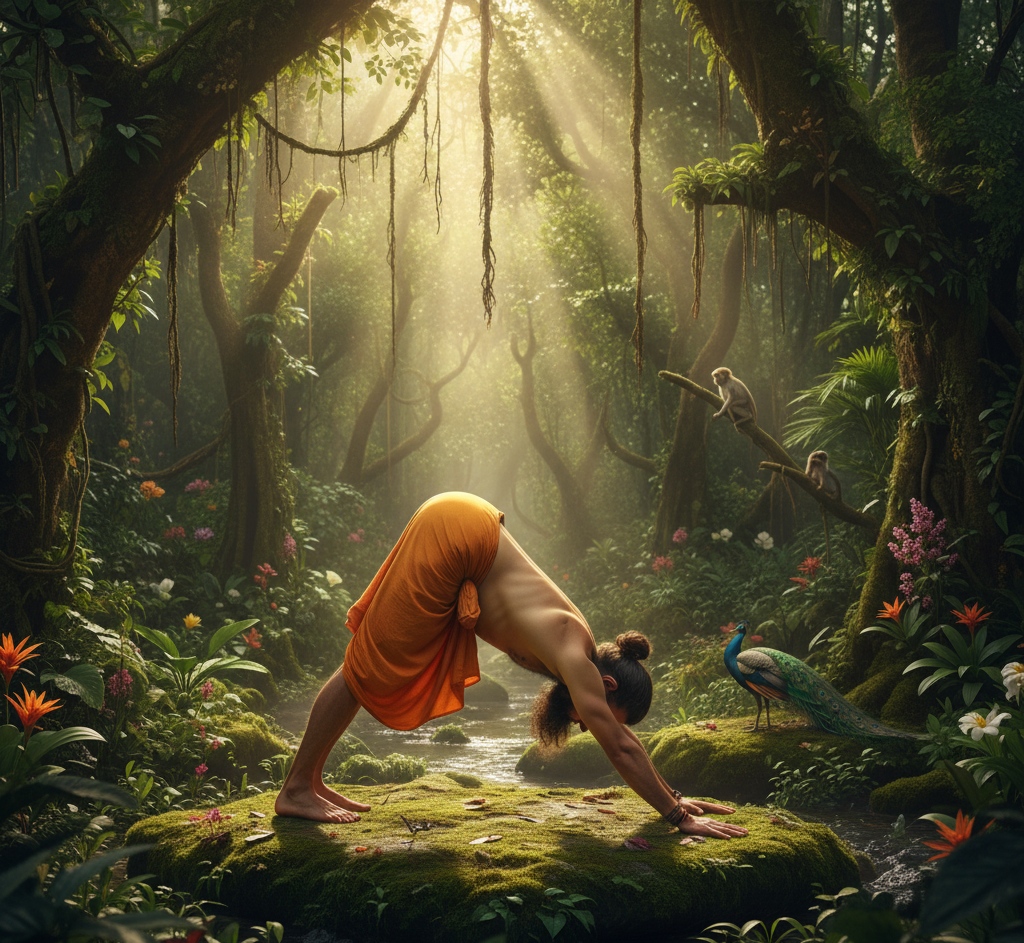
Bhakti yoga is the path of loving devotion to a personal deity. Through worship, prayer, chanting God’s names (kirtan), hearing scriptures, serving God, and cultivating constant remembrance, the devotee’s heart is purified, and divine grace brings liberation.
Bhakti is often considered the most accessible path—requiring no advanced learning, available to all regardless of caste, gender, or social position. What matters is sincerity of heart and depth of love.
The bhakti movement, which flourished from around the 7th-17th centuries CE across India, produced extraordinary poet-saints:
- Mirabai: Rajasthani princess whose devotional songs to Krishna are sung throughout India
- Kabir: Weaver-saint whose poetry transcended Hindu-Muslim divisions
- Tulsidas: Author of the beloved Ramcharitmanas
- Andal: Tamil woman saint whose passionate devotional poetry is recited in temples
- Tukaram: Maharashtra saint whose abhangs (devotional poems) remain popular
- Chaitanya Mahaprabhu: Bengali saint who spread ecstatic Krishna devotion
Bhakti emphasizes that God is not distant or abstract but intimately personal, responding to love with love. The relationship can take many forms (rasas): parent-child, master-servant, friend-friend, or lover-beloved.
Karma Yoga: The Path of Selfless Action
As taught in the Bhagavad Gita, karma yoga is performing one’s duties and actions as an offering to God, without attachment to results. Work itself becomes worship.
The key is the internal attitude: acting without ego-identification, without desire for personal gain, dedicating all actions and their fruits to the divine. This gradually purifies the mind and leads to liberation even while fully engaged in worldly life.
Karma yoga particularly appeals to householders who cannot renounce the world but seek spiritual progress through their daily activities.
Raja Yoga: The Path of Meditation
Raja yoga (royal yoga) is the systematic path of meditation outlined in Patanjali’s Yoga Sutras, which we explored in depth in our article on yoga. Through ethical living, physical postures, breath control, sense withdrawal, concentration, meditation, and finally samadhi (absorption), consciousness is refined and ultimately realizes its true nature.
This path emphasizes direct experiential knowledge through systematic inner work.
The Integration of Paths
While traditionally distinguished, these paths are not mutually exclusive. Most practitioners combine elements: devotion (bhakti), ethical action (karma), knowledge (jnana), and meditation (raja) can all be part of one’s spiritual practice. Indeed, the Bhagavad Gita integrates all approaches.
Hindu Practice: Ritual, Worship, and Festivals
Hinduism’s philosophical depth is matched by its rich devotional and ritual life. While belief is important, Hinduism emphasizes practice—what you do is as important as what you believe.
Puja: Worship
Puja is Hindu ritual worship, performed daily by millions in homes and temples. It involves treating the deity’s image (murti) as an honored guest:
- Awakening the deity
- Bathing and dressing the image
- Offering food (prasad), flowers, incense, and light
- Chanting mantras and prayers
- Receiving darshan (sacred sight of the deity)
- Distributing prasad (sanctified food) to devotees
Puja can be simple (lighting a lamp, offering a flower) or elaborate (multi-hour ceremonies with complex rituals). The physical actions symbolize inner attitudes: the light offered represents dispelling inner darkness, flowers represent the offering of one’s heart, incense represents spreading virtue.
Sacred Practices

Mantra: Sacred syllables, words, or phrases repeated in meditation or prayer. The most sacred is Om (Aum), representing ultimate reality. Other mantras include the Gayatri Mantra (a Vedic prayer to the solar deity Savitri), “Om Namah Shivaya” (salutation to Shiva), and “Hare Krishna” (Vaishnava mantra).
Japa: Repetitive recitation of mantras, often using a mala (prayer beads with 108 beads). The repetition focuses the mind and purifies consciousness.
Sandhya Vandana: Ritual prayers performed at dawn, noon, and dusk, particularly by Brahmins.
Pilgrimage (Tirtha Yatra): Journey to sacred sites. Major pilgrimage sites include the four dhams (Badrinath, Dwarka, Puri, Rameshwaram), the seven sacred cities, the twelve jyotirlingas (sacred Shiva sites), and Varanasi (Kashi), the most sacred city.
Sacred Bathing: Rivers, especially the Ganges, are considered sacred. Ritual bathing purifies karma. The Kumbh Mela, held every twelve years, is the world’s largest religious gathering, attracting millions who bathe at the confluence of sacred rivers.
Yoga and Meditation: As we explored in our yoga article, these practices aim at spiritual realization through physical, mental, and spiritual discipline.
Satsang: Gathering with spiritual seekers or in the presence of a teacher (guru) for discourse, singing, and mutual support.
Hinduism in the Modern World
As we conclude our exploration, we must ask: how has this ancient tradition adapted to modernity?
Reform Movements
The 19th and 20th centuries saw significant Hindu reform movements responding to Western colonialism, Christian missionary critiques, and internal social problems:
Ram Mohan Roy (1772-1833): Founder of Brahmo Samaj, worked to eliminate sati (widow burning), child marriage, and caste discrimination while promoting women’s education and monotheism.
Swami Dayananda Saraswati (1824-1883): Founded Arya Samaj, rejecting idol worship, supporting Vedic authority, promoting social reform.
Sri Ramakrishna (1836-1886): Mystical saint who practiced multiple religious paths and experienced unity in diversity. His disciple Vivekananda brought Hindu philosophy to the West.
Swami Vivekananda (1863-1902): Represented Hinduism at the 1893 Parliament of World Religions in Chicago, presenting Hindu philosophy to Western audiences with unprecedented impact. Founded the Ramakrishna Mission emphasizing service alongside spirituality.
Mahatma Gandhi (1869-1948): Made Hindu concepts like ahimsa (non-violence) and satyagraha (truth-force) the foundation of India’s independence movement, demonstrating their political power.
Sri Aurobindo (1872-1950): Revolutionary-turned-yogi who developed Integral Yoga, synthesizing Eastern and Western thought.
Global Spread
In the late 20th century, Hindu teachers brought various practices and philosophies to the West:
- Transcendental Meditation (Maharishi Mahesh Yogi)
- Hare Krishna Movement/ISKCON (A.C. Bhaktivedanta Swami Prabhupada)
- Yoga and Meditation (countless teachers)
- Vedanta Societies (followers of Vivekananda)
- Self-Realization Fellowship (Paramahansa Yogananda)
Hindu concepts like karma, reincarnation, meditation, and yoga have entered mainstream Western consciousness, though often in simplified or commercialized forms.
Contemporary Challenges

Modern Hinduism faces several challenges:
Caste System: While legally abolished in India, caste discrimination persists in practice. Reform movements and modern Hindus increasingly reject caste hierarchy as contrary to the Vedantic teaching of the divine in all beings.
Gender Equality: Traditional texts often reflect patriarchal values. Modern Hindu women and progressive movements work to reclaim egalitarian elements in ancient texts (like female Vedic sages) while challenging discriminatory practices.
Hindu Nationalism: In India, some political movements use Hinduism for nationalist purposes, sometimes promoting intolerance toward religious minorities. This conflicts with Hinduism’s traditionally pluralistic and tolerant character.
Westernization and Secularization: Urban, educated Indians increasingly identify as culturally Hindu but religiously secular, participating in festivals and rituals without deep spiritual commitment.
Environmental Crisis: Hindu reverence for nature (rivers, mountains, animals as sacred) positions it well to address environmental issues, though practice often lags behind principle.
Authenticity vs. Adaptation: How does Hinduism maintain its essence while adapting to modern scientific worldviews, democratic values, and human rights principles?
Hinduism’s Continuing Relevance
Despite challenges, Hinduism demonstrates remarkable vitality and relevance:
Philosophical Depth: Hindu philosophy’s sophisticated non-dualism, its integration of science and spirituality, and its psychological insights resonate with contemporary seekers.
Pluralism: Hinduism’s acceptance of multiple paths and truths offers an alternative to religious exclusivism and fundamentalism.
Ecological Wisdom: Hindu reverence for nature and interconnectedness speaks to environmental concerns.
Contemplative Practices: Yoga and meditation have proven benefits verified by modern science.
Inclusive Spirituality: Hinduism’s emphasis on direct experience over mere belief, its acceptance of atheists and agnostics within the tradition, and its non-proselytizing nature appeal to modern sensibilities.
Conclusion: The Eternal Way
As we conclude this long two-part exploration, what can we say about Hinduism, this vast, ancient, complex, beautiful tradition?
Hinduism is not easily summarized or categorized. It’s ancient, contains multitudes of priest and renunciant, philosopher and devotee, ascetic and householder, monist and dualist, ritualist and mystic. It embraces opposites: transcendence and immanence, unity and diversity, action and renunciation, form and formlessness.
Certain themes emerge, such as the belief that ultimate reality (Brahman) is one, though it manifests in countless forms; that the true self (Atman) is divine, not separate from that ultimate reality. It points to how we are trapped in samsara (the cycle of rebirth) by our karma and that through various paths of devotion, knowledge, ethical action, meditation, we can attain moksha (liberation). It makes a strong point that dharma (righteousness) should guide our actions and that all spiritual paths, sincerely followed, lead to the same truth.
Hinduism offers not a single path but a rich landscape of spiritual possibilities. It provides frameworks for understanding existence, practices for transformation, stories that inspire, festivals that unite communities, and ultimately, a way to recognize that life is vast, diversified, and doesn’t easily fit in categories. Hinduism reflects The Wholistic Center’s philosophy. Many paths and one source…