
If you’ve been to Dubai, or have been following Saudi Arabia NEOM – The Line project, then Bhutan’s Gelephu Mindfulness City might strike a different bell. Could this mindful city project be the blueprint of the future?
Special Video at the bottom of the article!
The world keeps building megacities that promise utopia and sustainability. Saudi Arabia’s NEOM – The Line proposes to house nine million people in a 170-kilometer mirrored wall is but one of these examples. Dubai created artificial islands. It seems every few other years, a hopeful country announces a futuristic urban project that sounds amazing in promotional videos and hails the city of the future.
And then there is Bhutan. This tiny Himalayan kingdom, smaller than West Virginia, is building what it calls Gelephu Mindfulness City. This 1,000-square-kilometer urban project rethinks what cities should be’t. On December 17, 2023, King Jigme Caesar Namgyel Wangchuck announced plans for what he called the world’s first economic hub built on mindfulness, sustainability, and Gross National Happiness. The more I learn about how Gelephu differs from other megaprojects, the more it becomes clear that Bhutan might actually be onto something here.
What Makes This Different From Other Megaprojects
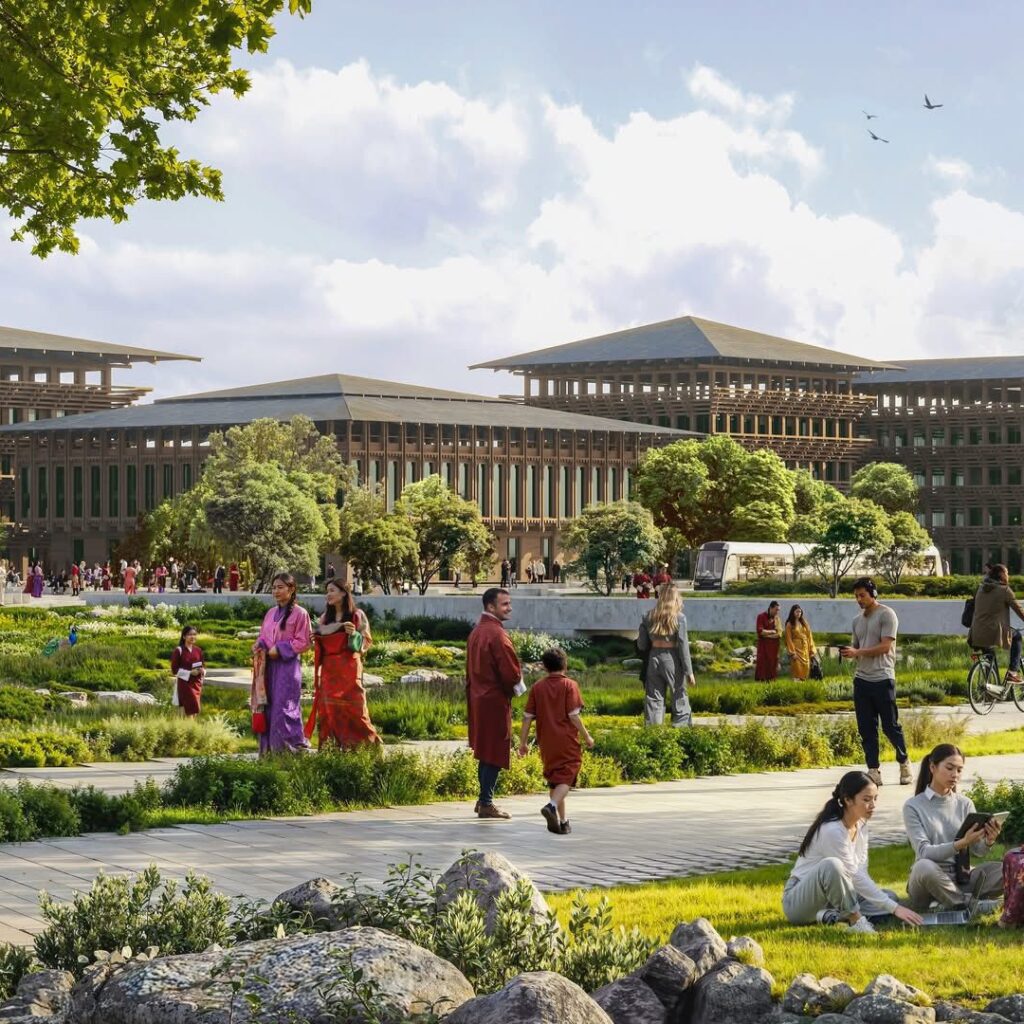
Gelephu Mindfulness City covers an area three times the size of Singapore situated in Bhutan’s southern border with India. The masterplan, designed by Danish architecture firm Bjarke Ingels Group along with sustainability consultants Arup and Cistri, shows a low-to-mid-rise city built around eleven mandala-inspired neighborhoods connected by inhabitable bridges. These bridges play an essential role in the city’s functions connecting the international airport, a university, healthcare facilities combining Eastern and Western medicine, hydroponic greenhouses, spiritual and science research centers, cultural venues, and even a hydroelectric dam with a temple built into it. Be still my heart, the dream!
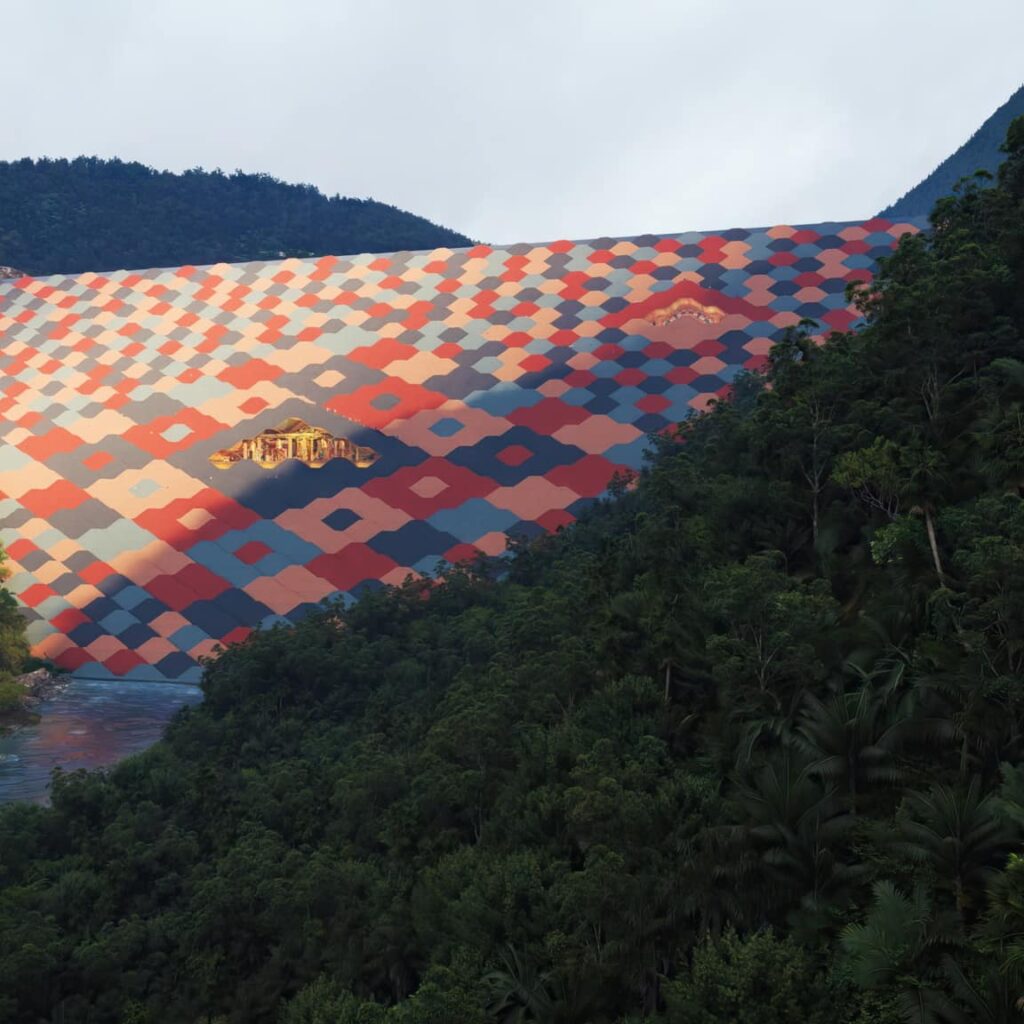
The Sankosh Temple-Dam is perhaps the most striking example of Gelephu’s philosophy. Architect Bjarke Ingels describes it as a 21st-century version of Tiger’s Nest, Bhutan’s most sacred monastery that clings to a cliff face 3,000 feet above a valley. The dam will feature cascading steps and landings where visitors can walk meditatively up and down countless routes to reach a temple nested on the face of the structure. As Ingels explains, the design embeds the city’s values into the landscape, turning engineering into art and the forces of nature into power. In the middle of it lies a temple with a Buddha statue.
Gelephu’s design incorporates all thirty-five rivers and streams that flow through the site creating ribbon-like neighborhoods cascading down the hills to paddy fields. These terraces are pretty and functionable. They act as biodiversity corridors for local plants and animals, leaving migratory routes for elephants and other wildlife completely undisturbed. Flooding protection comes from working with water rather than fighting it. Buildings use local materials like wood, stone, and bamboo instead of imported glass and steel. Cement and steel was deemed too carbon intensive and would require non-sustainable ways of making it, bringing it into the country, and adapting it onto the landscape.
As you would expect, the city will be plastic-free, carbon-negative, and powered by renewable energy including hydropower. The latter already powers close to 90% of the country’s electricity need. Wind, thermal, and solar sources will complement the rest.
Bhutan is already the world’s first carbon-negative country that absorbs more carbon dioxide than it produces. And it’s serious about it. The constitution requires that at least 60 percent of the country remains forested. Currently, 70 percent is forest. These aren’t new commitments made for this project. They’re decade-long existing values now extended into urban development.
And if you think this is just marketing and political talk, the King has already offered his own family to help lay down the foundations of the city, physically.
Bhutan is clear-sighted enough to know it cannot build the city by itself. It needs the help of international firms. And in return, it wants to gain knowledge so that in 50 years, other countries will ask it to help with their sustainable project. Essentially, the project aims to incorporate nature with it, not conquer it.
The Philosophy That Makes It Possible
Only a country like Bhutan could pull off a project like that. Famous for shunning the out-of-breath domestic product (GDP) rating system, it adopted what it calls the Gross National Happiness index in 1972. Bhutan’s king, Jigme Singye Wangchuck, declared then that Gross National Happiness is more important than Gross Domestic Product. This wasn’t just a catchy slogan. It became the governing philosophy of the entire country, enshrined in Bhutan’s 2008 constitution.
The Gross National Happiness Index measures progress across nine domains (PDF): psychological wellbeing, health, time use and balance, education, cultural diversity and resilience, good governance, community vitality, ecological diversity and resilience, and living standards. Notice that economic output is just one of nine equally weighted areas. These nine domains break down into thirty-three specific indicators that track everything from how much sleep citizens get to how connected they feel to their communities.
- Psychological wellbeing (6 indicators)
- Health (7)
- Education (5)
- Time use (3)
- Cultural diversity & resilience (7)
- Good governance (5)
- Community vitality (5)
- Ecological diversity & resilience (9)
- Living standards (6)
Every five years, surveyors travel across Bhutan conducting three-hour questionnaires with randomly selected households. The government then uses this data to shape policy. Unlike GDP, which can grow infinitely, the GNH Index has a maximum value of 1. Once reached, all citizens have achieved sufficiency in at least six of the nine domains. Once people pass the income sufficiency threshold, which Bhutan sets at 1.5 times the national poverty line, additional money doesn’t raise the happiness score. Resources get redirected to other domains instead.
This creates a completely different mindframe and incentive structure than what drives most development in the West. Traditionally, economic zones attract businesses by offering tax breaks, cheap labor, and minimal environmental regulation. Gelephu approaches this fundamentally in a different way. By screening and inviting businesses based on respecting Bhutanese values, such as sustainable development, and the country’s sovereignty, they are allowed in. As King Khesar explained, Gelephu will offer everything other economic hubs provide plus something unprecedented: mindfulness, Buddhist spiritual heritage, and the uniqueness of Bhutanese identity baked into every business decision.
Gross National Happiness 2.0
The government has developed a GNH screening tool that evaluates all proposed policies and projects for their potential effects on happiness and sustainable development. This tool must be used for all public decisions by mandate of the Prime Minister’s office. Before any major development proceeds, officials assess this against negative, uncertain, neutral, or positive impacts using the thirty-three GNH indicators. If a project would harm community vitality or psychological wellbeing even while boosting economic growth, it gets rejected or redesigned.
Prime Minister Tshering Tobgay calls Gelephu “Gross National Happiness 2.0” and frames it clearly: “Happiness and well-being of people must be the purpose of capitalism.” This isn’t naive idealism. It’s very close to the original ideals of capitalism. It’s a sophisticated framework that has already produced measurable results.
Between 2010 and 2022, Bhutan’s GNH Index increased from 0.743 to 0.781, and the percentage of citizens classified as happy rose from 40.9 percent to 48.1 percent, even through the COVID-19 pandemic. The country’s Gini coefficient, which measures income inequality, decreased from 40.9 in 2003 to 37.4 in 2017.
Real Sustainability Versus Marketing Claims
Most green megaprojects announce ambitious environmental goals and then quietly abandon them when budgets tighten. Gelephu’s sustainability promises are more credible. They’re based on what Bhutan already does. Not only does it plan well into the future but it has a reason behind the plan. Bhutan wants to learn, grow, and keep it’s GNH part of its DNA. It can then be a point of reference globally and be sought out to achieve this elsewhere on the planet.
To date, the country provides free healthcare to almost 90 percent of its population within two hours of travel distance. Education is free. Tourism operates under a sustainable development fee system where visitors pay substantial daily fees that fund infrastructure, airport improvements, and social programs. This ensures tourism benefits the economy without compromising the environment or culture. These policies reflect the GNH principle that balances material and spiritual growth.
The design of Gelephu integrates agriculture directly into the urban fabric. Paddy fields along rivers don’t just prevent flooding. They provide food and create green corridors that support biodiversity. Hydroponic and aquaponic greenhouses will put ancient farming practices and modern agricultural science on display for daily commuters. The city’s density gradually increases from small buildings dispersed in the landscape in the north to larger footprints in an urban environment in the south, mimicking natural settlement patterns rather than imposing a rigid grid.
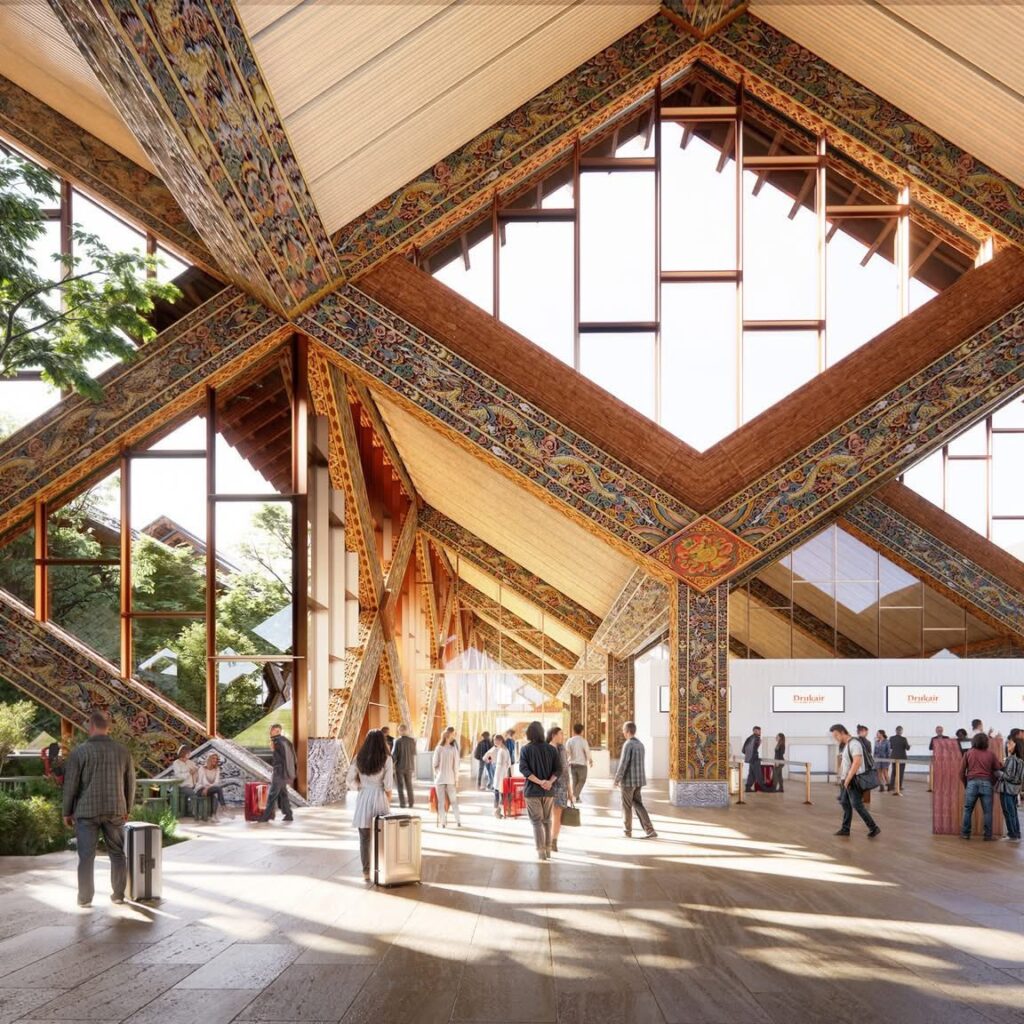
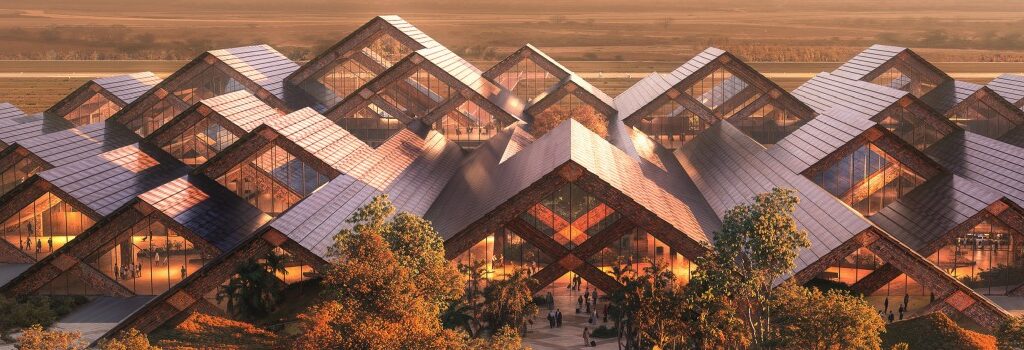
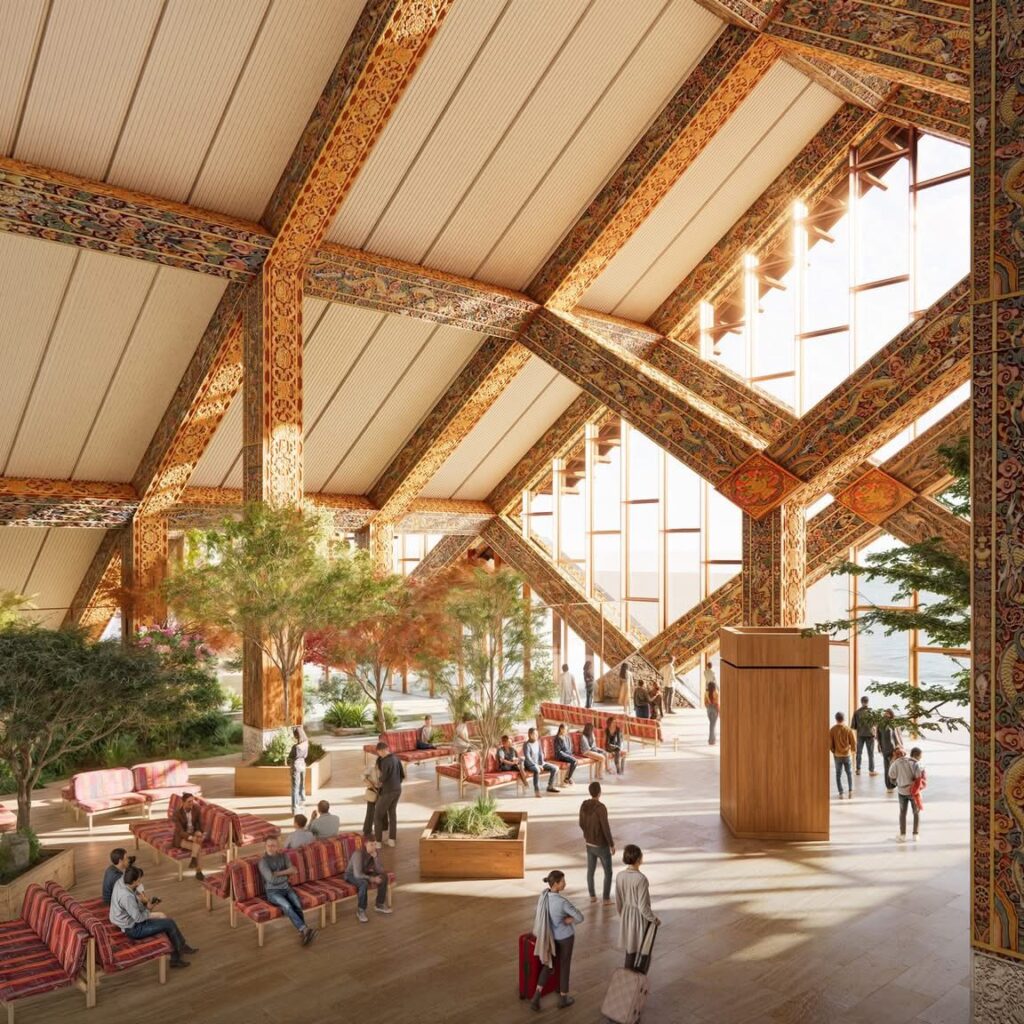
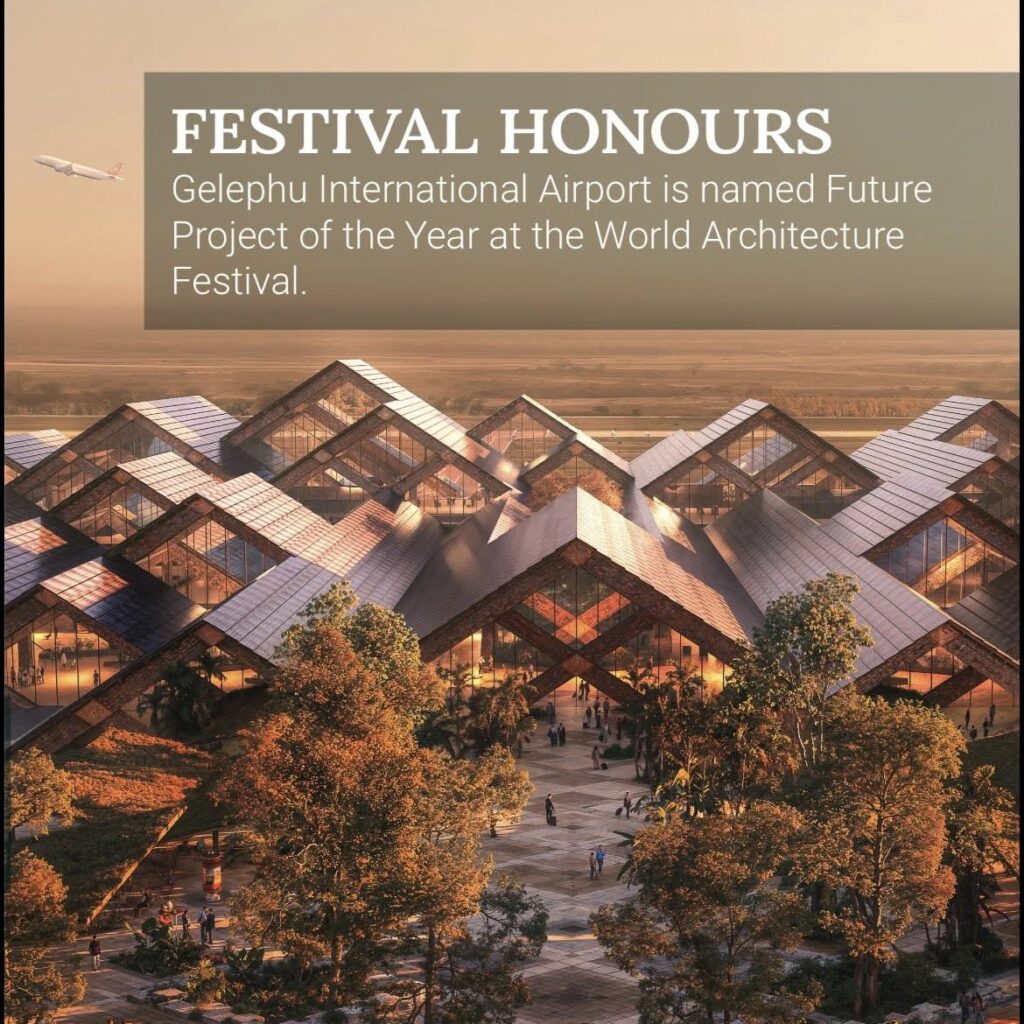
Construction has already begun on the international airport, which will accommodate 1.3 million passengers annually in its first phase with plans to expand to 5.5 million. The airport runway extension and new terminal are funded through Bhutan’s first-ever domestic bond offering in 2025, which saw strong support from local investors. This matters because it demonstrates domestic buy-in rather than dependence on foreign debt that could compromise sovereignty. The design of the airport is of particular interest. Its terminal is modular, meaning it can grow to accommodate traffic while respecting local artistic design, and, of course, sustainability. It will be placed over a river and we are told the fish won’t know airplanes take off and land above them.
Overall, the project focuses on eight core industries: spirituality, health and wellness, education, green energy and technology, finance and digital assets, agri-tech and forestry, aviation and logistics, and tourism. Notice that spirituality leads the list. This is very close to our philosophy here at The Wholistic Center that embraces everything on healthy foundations. Gelephu will include Vajrayana spiritual centers where visitors can observe the daily practices of monks and masters of mindfulness. Healthcare facilities will integrate Eastern and Western medicine as equals, not as alternative versus real medicine.
The People Making It Happen
Another gauge of the seriousness of the project is community involvement coupled by realistic leadership. King Khesar himself has led volunteer programs where he personally hand-clears land for the new airport. This reflects Bhutan’s tradition of zhabtog, community labor where everyone from members of parliament to regular citizens works together on public projects.
The volunteer program has brought together over 7,000 people in multiple waves, installing benches, water points, toilets, and developing public spaces for the city. In October 2025, the king established the pelsung, a new program specifically aimed at youth. As he explained, “Everything we are doing today is for our youth, so that they will be better versions of us, better prepared, smarter, and more hard-working. It falls on us to build that future, and on them to protect it and take it to greater heights.”
The leadership team includes serious global talent. Mun Leong Liew serves as CEO, with former Prime Minister Dasho Dr. Lotay Tshering as GMC’s inaugural Governor. The board includes Joichi “Joi” Ito as chairman of the Gelephu Investment Development Corporation, along with leaders from finance, technology, and development sectors. The project received endorsement at the 2024 Bhutan Innovation Forum from Nobel laureates Joseph Stiglitz and Michael Spence, as well as Snap Inc. CEO Evan Spiegel.
Critically, the king appointed these leaders with a mandate for capacity building and developing Bhutanese talent in preparation for future leadership succession. This isn’t a vanity project run by foreign consultants who will disappear later. It’s being built by and for Bhutanese people with clear succession planning from day one. Clearly, the Bhutanese government is putting its money where its mouth is.
The Economic Strategy Behind The Vision
Gelephu’s project addresses real economic pressures facing Bhutan. The country moved from the UN’s Least Developed Country list to developing country status in December 2023. Existing urban centers like Thimphu and Paro have reached saturation. Young people are migrating to Australia and other countries at unprecedented rates because opportunities at home feel limited.
The city aims to reverse this brain drain by creating economic opportunities that don’t require abandoning Bhutanese values. Trade between neighboring regions grew ninefold from 2000 to 2018, from thirty-eight billion to 349 billion dollars according to the World Bank. The high-speed rail connections to India and the international airport will position Gelephu to capture some of that trade. GMC will further that trend.
In a pioneering financial move, Gelephu incorporated cryptocurrencies like Bitcoin and Ether into its strategic reserves in January 2025. In December 2025, Bhutan launched a gold-backed digital token called TER on the Solana blockchain platform, designed to bridge traditional gold value with blockchain-based finance. King Khesar also announced a “Bitcoin Development Pledge” committing up to 10,000 Bitcoin, approximately one billion dollars from national reserves, to fund city infrastructure. These calculated strategies attract global investment while maintaining sovereignty.
The Innovate for GMC program has already attracted over 1,700 applicants, offering stipends to 500 youth for idea incubation. The special administrative region will have its own distinct laws and business-friendly regulations separate from the rest of Bhutan, making it easier to attract foreign investment without compromising the values that govern the broader country.
Why This Might Actually Work
Healthy skepticism about megaprojects is understandable. Gelephu has several advantages that other projects lacked.
First, it’s being built by a country with a proven track record of prioritizing values over short-term profit. Bhutan turned down opportunities to monetize its considerable lumber, coal, and mineral resources because doing so would harm the environment. The country limited tourism for decades even though opening the floodgates would have generated immediate revenue. These weren’t one-time decisions but consistent choices over fifty years.
Second, the project has realistic timelines and budgets. The full vision is set for a 21-year development period with initial phases already underway. The first airport terminal opens by the end of 2029. It’s designed for gradual organic growth that can adapt as circumstances change. This last part certainly has won a lot of critics who point of overzealous projects that falter.
Third, transparency and accountability are built into the governance structure. The GNH screening tool isn’t optional or advisory. It’s mandatory for all major decisions. Every five years, the population gets surveyed and results inform policy adjustments. This creates a feedback loop that can correct course before problems become catastrophic.
Fourth, the king leads by example. When the leader of your country shows up to physically clear land alongside citizens, it sends a message about shared sacrifice and collective effort. This is the opposite of megaprojects where powerful people make grand announcements and then hire others to deal with messy implementation details.
Finally, Gelephu addresses real needs rather than manufactured desires. Bhutan needs economic diversification. It needs to create opportunities for young people in order to offer them a future and keep its brain share happy at home. It needs infrastructure to connect with neighboring countries. These are genuine problems requiring serious solutions, not fantasies about that don’t always solve real human needs.
What The Rest Of Us Can Learn
The Gelephu project offers lessons for how we think about future cities. In a world filled with many questions and little answers, many realize how happiness and wellbeing must be legitimate policy goals. Gelephu feels like a prototype for the future of the human race.
When a government measures success by the GNH Index instead of GDP alone, it changes everything. Infrastructure projects get evaluated for their impact on community vitality and psychological wellbeing, not just potential economic return on investment. Businesses get invited or rejected based on whether they enhance or diminish cultural resilience. Time use and work-life balance become metrics that matter as much as productivity.
GDP in Bhutan is one tool used, not the central piece. The approach also demonstrates that sustainability doesn’t have to mean sacrifice. The city incorporates modern elements to serve human and environmental flourishing rather than dominating them. And finally, Gelephu makes a point about not displacing communities or destroying nature to succeed.

The Challenges Ahead
None of this guarantees success. Gelephu faces serious obstacles. The hundred-billion-dollar projected cost is thirty times Bhutan’s national GDP.
Balancing legislative independence with national unity will require careful governance. The trick will be to screen businesses for values alignment that sound better in theory than in practice.
Our modern world begs to answer these challenges with something genuinely new approaches rather than copying failed models.
A Different Kind Of Future
Bhutan isn’t trying to preserve its past. It’s attempting something harder: global evolutionary development that honors our past. King Khesar expressed it clearly when he said the country “is not trapped by legacy and can innovate swiftly to implement plans that other countries might hesitate to pursue.”
Other countries hesitate because they’re stuck in frameworks where economic growth trumps everything else, where nature is a resource to exploit rather than a partner to work with, and where happiness is a luxury that comes after you get rich. Bhutan wants to flip that model by starting with the most important aspect, the human being.

The greatest contribution Gelephu Mindfulness City could make isn’t becoming the perfect city. It’s demonstrating that prioritizing wellbeing over wealth, sustainability over speed, and community over consumption is possible at scale. That alone would make it worth building.
Internal Links
- The Healer’s Paradox: Empower People, Don’t Choose for Them
- Stillness: The Accessible Temple Within
- Tibetan Buddhism: The Unique Flavors of Tibetan Buddhism, part 1
External Links
- Gelephu Mindfulness City Official Website
- CNBC: Bhutan’s Gelephu Mindfulness City Plans
- Wikipedia: Gelephu Mindfulness City
- TIME Magazine: Bhutan’s Plan to Boost Economy with Mindful Capitalism
- OECD: Bhutan’s Gross National Happiness Index
- Oxford Poverty & Human Development Initiative: Gross National Happiness
- Asian Development Bank: What is Bhutan’s GNH Index?
- Bjarke Ingels Group: Gelephu Mindfulness City Masterplan