
The Sumerian Series, part 1.
Between the Tigris and Euphrates rivers, in what is now southern Iraq, lies what is widely considered to be the origin of our modern societies. The first language, the first agricultural methods, the first cities sprung there, it is believed for the first time.
All of this happened around 4500 BCE that we are still living within what it left us. A people called the Sumerians are thought to have built the first cities, wrote the first words, planted the first organized fields, and looked at the night sky with enough precision to divide it into the same 360 degrees your compass still uses. They also had a rich esoteric set of beliefs we’ll dive into now. But they did not think of themselves as launching civilization. They thought they were doing what the gods had asked them to do. And this set a trend still felt in most religions to this day, right down to what some of our priests and higher-ups wear, their symbology, and practices.
That tension — between what we know they accomplished and what they believed was behind it — is where the story gets wildly fascinating.
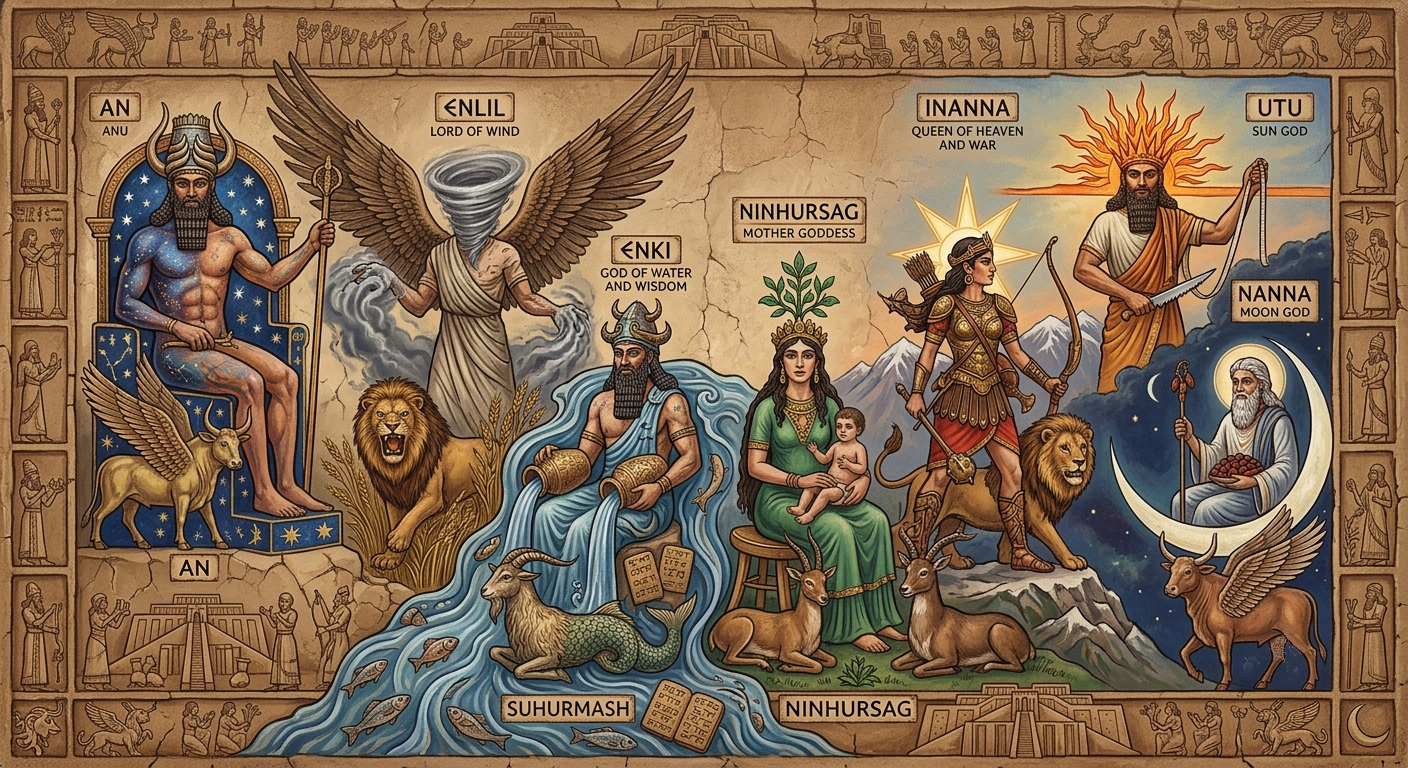
What Sumer Gave the World
The list of Sumerian firsts is almost absurd in its scope. Writing seems to have appeared in the archaeological record around 3200 BCE in the form of cuneiform — wedge-shaped marks pressed into wet clay with a reed stylus. It is thought to have begun as an accounting tool, tracking grain and livestock for temple storehouses, and evolved into the medium for hymns, law codes, mathematical tables, and the oldest recorded epic in human history.
I have to make a parenthesis here and explain why I write things such as: “It is thought to have begun” or “seems to”, etc. My generation X was taught that the Egyptians knew nothing of the pulley and wore sandals while raising in the air 400 tons rocks. Hieroglyphs of what looks like aircraft and electric insulators were dismissed. Today, a fresh wave of new archaeologists and parallel professionals are questioning these preconceived notions with more open eyes looking for empirical answers, not ones based in dogma. So bear with me.
The wheel — not the potter’s wheel, which came earlier, but the wheeled vehicle — appears in Sumerian depictions around 3500 BCE. So does organized irrigation, which allowed the people of a river valley to feed populations no hunting culture could sustain.
Their mathematics operated in base-60, a system so geometrically efficient that we still use it without thinking: 60 seconds in a minute, 60 minutes in an hour, 360 degrees in a circle. When you glance at a clock or orient yourself on a map, you are using Sumerian arithmetic.
The first schools — called edubba, or “tablet houses” — appear in Sumer. The first written legal codes predate Hammurabi by centuries. The Epic of Gilgamesh, preserved on twelve clay tablets, contains a flood narrative that predates Genesis by at least a thousand years and poses the same questions about mortality and meaning that philosophy has wrestled with ever since.
What is remarkable is not that they invented any one of these things. It is that they invented all of them in the same place, at the same time, as part of a single integrated worldview in which astronomy, agriculture, governance, and spirituality were not separate domains. They were one unified system.
The Beings in Fish Suits
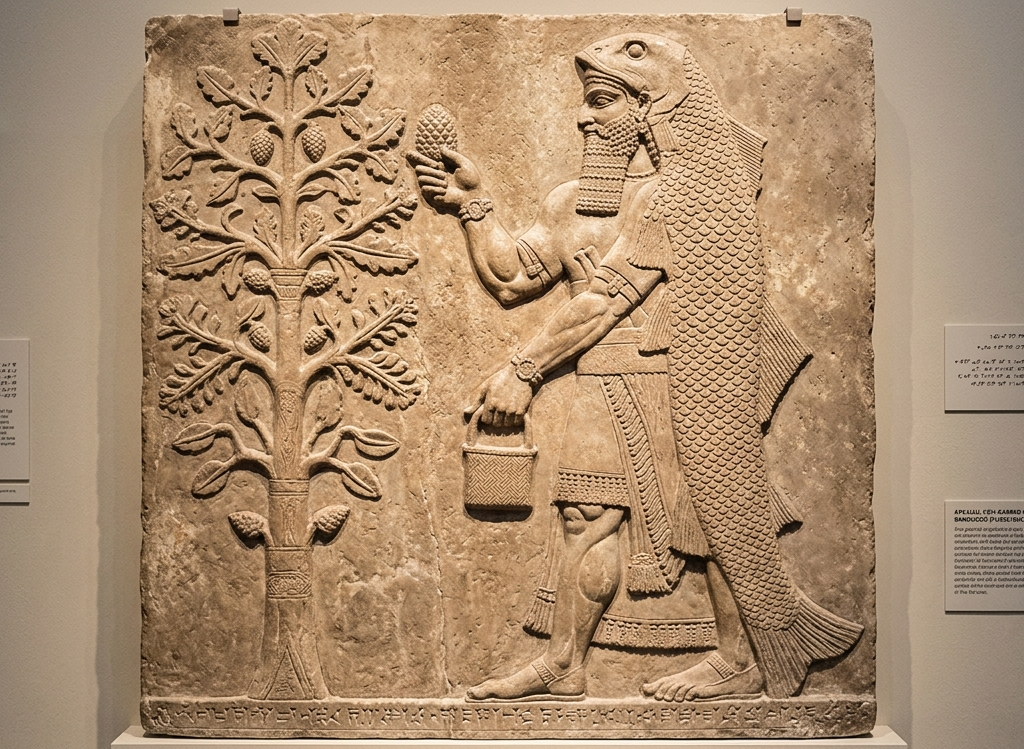
Among the most striking figures in Sumerian iconography are the Apkallu — the seven antediluvian sages, depicted in Assyrian reliefs as humanoid beings wearing the full skin of a carp, draped over their bodies like a cloak. Their faces emerge from inside the open fish-mouth. Their human feet protrude below the tail.
The Babylonian priest Berossus, writing in the third century BCE, described a being named Oannes who emerged daily from the Persian Gulf, part fish, part man, to teach human beings writing, mathematics, agriculture, and the arts of building. This is reminiscent of Hermes Trismegistus in the hermetic tradition, Thoth, Mercury, etc.
At night, according to Berossus, he returned to the sea. The Apkallu are referenced in the Erra Epic and the incantation series Bīt Mēseri as “pure purādu-fish, endowed with sublime wisdom” — divine advisors who served the earliest Sumerian kings before the great flood and established culture on earth under the direction of Enki, god of water and knowledge.
Much has been said about the interpretations of this rendering. Is it an interpretation? Was it someone from an advanced civilization walking out of the ocean with a diving suit system? Whether they are understood as literal beings, mythological symbols of divine wisdom, or something else entirely depends on who is doing the interpreting.
The Alien Theory and What Scholars Say
In 1976, Zecharia Sitchin published The 12th Planet, arguing that the Anunnaki — the Sumerian pantheon of great gods — were extraterrestrials from a planet called Nibiru in an elongated 3,600-year elliptical orbit. According to Sitchin, they came to mine gold, created Homo sapiens through genetic engineering to serve as workers, and established the first human civilization under their direct governance.
The theory has generated a durable popular mythology, entire television series, and a passionate following. Mainstream Sumerian scholars — Sumerologists, Assyriologists, archaeologists — reject it uniformly. Sitchin’s translation of Anunnaki as “those who from heaven came” is itself disputed; the more accurate reading is “those of princely seed” or “great princes.” His interpretations of specific tablets have been called selective and inaccurate by specialists who read cuneiform directly.
And yet the theory persists — not because scholars are hiding something, but because the Apkallu images are genuinely strange, the speed of the Sumerian civilization’s emergence is genuinely remarkable, and human beings have always found it difficult to believe that something extraordinary could have come from within themselves rather than from above.
Symbols That Outlasted the Civilization
The fish-cloaked Apkallu vanished as a living tradition when Mesopotamian civilization gave way to Persian, Greek, and eventually Islamic rule. What they left behind was visual.

The resemblance between the Apkallu fish-head headdress and the Catholic bishop’s miter has been noted for centuries. Critics of the Church have used it as evidence of unbroken pagan continuity. Scholars respond that no archaeological evidence connects Philistine Dagon worship — the fish god most commonly cited — to priestly vestments, and that the miter’s actual origin is likely Byzantine or early medieval.
What no one disputes is that the ichthys, the fish symbol claimed by early Christians as a secret identifier, draws on a visual vocabulary that runs through the ancient Near East far deeper than the first century CE. The fish as a symbol of divine wisdom, hidden knowledge, and transition between worlds — the Apkallu emerging from water to civilize mankind — flows through Mesopotamia, the Hebrew scriptures, Greek mystery traditions, and into the Christian era.
Whether by direct transmission or by something more like cultural convergence, the fish swam a long way.
Cuneiform and the Tablets Still Waiting
The decipherment of cuneiform is itself a remarkable story. In the 1840s, Henry Rawlinson scaled the cliff face at Behistun in western Iran, where a monumental Persian inscription carved in three ancient languages — Old Persian, Elamite, and Babylonian — gave him the same key the Rosetta Stone gave Champollion for Egyptian hieroglyphics. By 1851, the code was cracked.

Hundreds of thousands of cuneiform tablets have since been recovered from the soil of Iraq, Iran, Turkey, and Syria. The clay, almost indestructible, survived what papyrus and parchment could not. The number of tablets that have been fully translated remains a small fraction of what exists. Museums hold collections that no specialist has yet read. Libraries of a civilization five thousand years old sit catalogued but not yet opened.
What Wholeness Looked Like Before We Divided It

The Sumerians did not have separate ministries for agriculture, religion, science, and governance. The temple was the bank, the granary, the observatory, and the court. The priests were the astronomers and astronomers before the great chasm. The law came from the gods and was administered by kings who were, themselves, intermediaries between the human and divine. It was not confusion. It was integration whereas today we have separation and polarization.
We have spent several thousand years since then separating these domains in the name of clarity, specialization, and objectivity. We call it progress, and much of it genuinely is. It created dogma and theories pinned to explain or reject these dogmas, not necessary the truth. Yet, something is worth examining in a civilization that managed to invent writing, mathematics, law, and literature while still understanding the cosmos as a unified field — not a collection of departments.
The Sumerians were not primitive people who imagined gods because they could not yet explain the weather. They were complex, literate, mathematically sophisticated people who chose to understand the world wholistically. The gods were not a substitute for knowledge. They were the frame inside which all knowledge was held together.
What would it mean to think that way again — not to abandon what we know, but to stop pretending that what we know is all there is? Oh yes, it’s what we do at The Wholistic Center. Think and live in wholistic terms.