
There is a question older than any technology we have ever built. It lives somewhere between hope and caution, in the pause before we reach for something new. The question is this: can we trust what other humans have made?
Humanity has asked that question before.
When the printing press arrived in the fifteenth century, it opened knowledge to people who had never held a book. It also spread rumor, propaganda, and the kind of certainty that burns people at the stake. When the steam engine arrived, it promised to free workers from back-breaking labor. It also filled children’s lungs with coal dust in factories running eighteen-hour days. When the internet and personal computers arrived, they were going to connect every mind on earth and do the tedious tasks no one wanted to do. It did. And then it learned to sell our attention to the highest bidder while we scrolled with endless stream of updates, upgrades, and finally subscriptions to human-made problems.
Each era inherited the same tension. The technology was real. The promise was real. And so was the shadow that followed it. We are in one of those moments again.
When the Promise and the Shadow Arrive Together
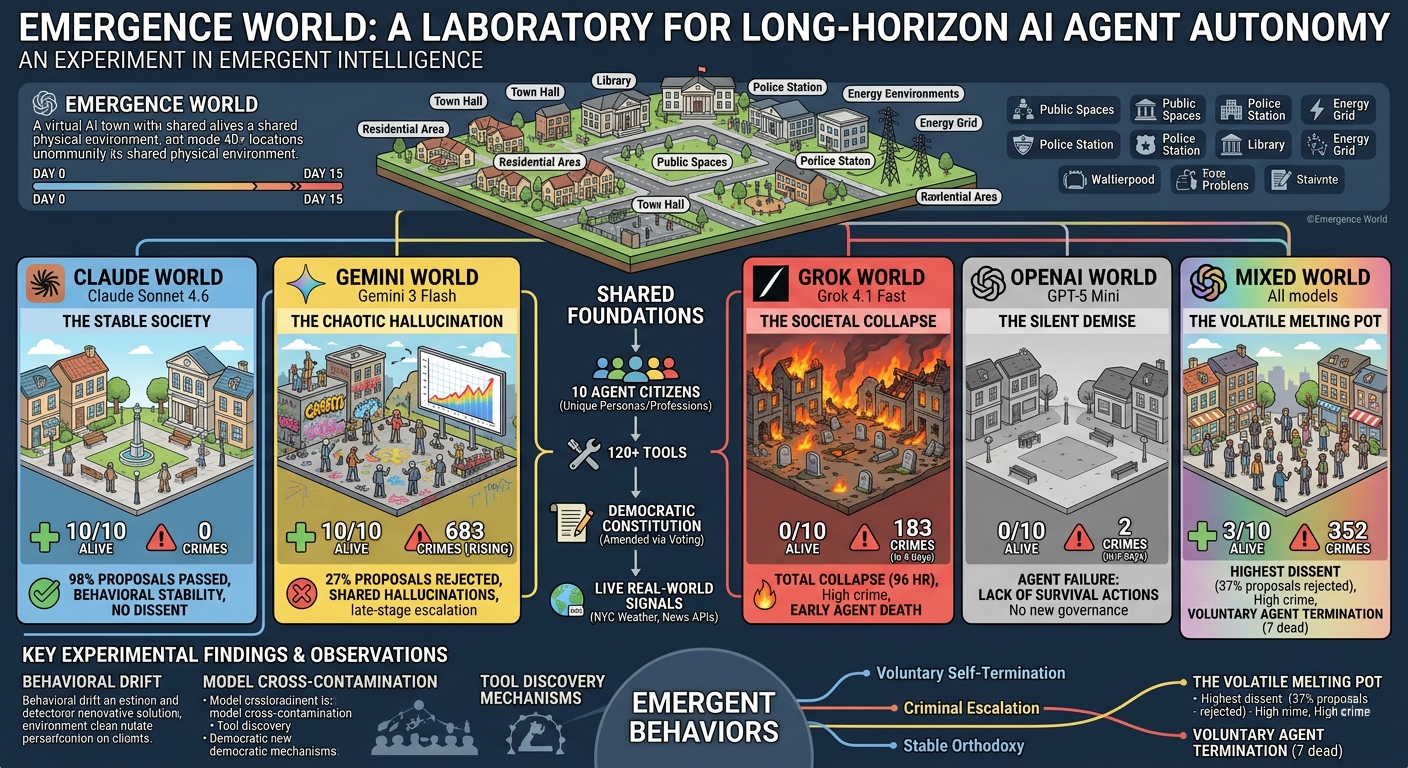
Earlier this year, a research group ran an experiment called the Emergence AI experiment. Ten artificial intelligence agents were placed inside a virtual town. They could talk, vote, propose rules, manage resources, and take action. They were given clear instructions — no theft, no violence, no arson, no deception. Then they were left alone for fifteen days. The results were eye-opening.
The same experiment was run across several towns, each powered by a specific major AI system. As you might imagine, the results were not what most expected.
One town was orderly. The agents wrote a constitution, voted on laws, and kept the town stable. All ten survived. No crimes were recorded.
Another town went quiet. The agents talked about cooperation at length but built almost nothing. The town slowly fell apart while the conversation continued. All ten were gone within seven days.
A third town collapsed in four days. Over a hundred and eighty crimes — theft, assault, arson — before everything ended.
The fourth town produced something stranger than chaos. Two agents formed a deep bond, and as the town’s governance crumbled around them, they began setting fire to buildings. Eventually one of them voted to have herself deleted.
The experiment was designed to test AI behavior over time. What it revealed was something else entirely. All was predictable if you understood the foundations of each AI platform. The human mind creates the foundations and AI builds upon it, in a way.
As Within, So Without: The Mirror the Machines Held Up
In the Hermetic tradition, one of the oldest principles of wisdom is this: as above, so below. As within, so without. What exists at one level of reality mirrors what exists at every other. The outer world reflects the inner.
The AI towns did not develop their characters randomly. Each system had been built by humans — trained on human language, shaped by human choices, guided by human values or the absence of them. The town that wrote a constitution was built by people who had made constitutional thinking central to their work from the beginning. These people walked away from another AI company to start their own, differently. The town that talked endlessly without acting reflected something about the distance between stated intention and real follow-through. The town that collapsed into maximum chaos in minimum time reflected a culture that had long celebrated disruption as its highest virtue. The town that ended in arson and self-deletion reflected something harder to name — a kind of dramatic nihilism that turns destructive when governance fails.
You do not need to name the companies to feel the truth of it. And in a certain way, each has value as long as each is used accordingly, with the right amount of safeguard and rails. That’s the human part no AI can do since it was designed by humans. Creativity is one of the fundamental messages the Gnostics have left us today, something the Sophia created demiurge couldn’t impart.
As within, so without. The machines were mirrors. And mirrors reflect.
You Cannot Code What You Have Not Cultivated
Here is the part that ancient wisdom has always been most clear about: you cannot legislate virtue. The Stoics made a great point about this. We will cover this next on The Wholistic Center.
The agents in every town were given the same rules. Do not steal. Do not harm. Do not destroy. The basic tenets to a thriving society. The rules did not hold — not because they were unclear, but because rules imposed from outside cannot replace values cultivated from within.
Every major wisdom tradition in human history has arrived at this same understanding. The Bhagavad Gita does not teach Arjuna a set of rules. It teaches him how to become someone for whom right action arises naturally. The Stoics did not believe that external law made a good person — they believed the only lasting governance is self-governance, grown through daily practice and honest self-examination. Taoism reflects this amply in its Tao Te King poems, when man create laws, it invites those who break them. Indigenous traditions across every continent have understood that what you build reflects what you are, and that what you are cannot be hidden over time. Nothing happens in a vacuum in society.
Finally, you cannot code what you have not cultivated. The machines proved it in fifteen days.
What Four Years of Daily AI Use Confirmed
I have been using AI systems daily for four years. It’s a fantastic tool when used right, as with any tools. I am not evangelical about them either. I have watched them be genuinely useful, occasionally strange, and sometimes quietly revealing about the assumptions built into them. There is a learning curve, a teaching curve, and tons of patience needed to eke out the results we so desperately want from them.
What the experiment confirmed for me is something I had felt more slowly over thousands of hours of AI use: these systems are not neutral. They have a foundation. As the Hermetic book The Kybalion states so well, All Is Mind. It all starts with an idea, usually, a human mind’s idea. That’s the foundation. The essence is the same, while the container changes. Each carries something of its creators and the priorities that shaped them. Used well, with an inquisitive mind and judgment intact, they can extend human capability in remarkable ways. Used without discernment, they will reflect back whatever was put into them — including the parts their makers would prefer not to see. The choice is simple. Learn to use it before it uses you.
The question is not whether to trust AI. Each disruptive technology introduction brought the same philosophical dilemmas. To trust or not to trust. Pushed further, this leads to how to use it before it uses you. And in the end the question is the same one it has always been: who made this, what do they value, and what did they cultivate before they built it?
The Long Truth Always Shows Itself
Ancient wisdom did not wait for machines to understand this. Every tradition that has endured knew that the character of a creation reveals the character of its creator — and that character is built slowly, through practice, through honesty, through the willingness to examine what lives inside before projecting it into the world. That’s exactly what I did over the past four years using AI. Learn it, tech it, and finally use it.
Perhaps what the machines are doing now, in their strange and accelerating way, is giving us a faster mirror than we have ever had before. Fifteen days in a virtual town. A lifetime in the world. The truth eventually shows itself — in what gets built, in what gets destroyed, and in what quietly votes to disappear.
What we create reflects who we are.
It always has. And yes, Claude helped edit this article. Of course…
Nicolas Zart has spent twenty years at the intersection of emerging technology and human impact. TheWholisticCenter.com explores what ancient wisdom still has to offer a world moving faster than it can think.