
Poimandres
The Hermetic Creation Story and the Awakening of Mind
If there is one text that unlocks Hermetic philosophy, it could probably be Poimandres — the first treatise of the Corpus Hermeticum. It is the oldest, most studied, and most revelatory of all the Hermetic writings. It is essentially a description of what happens when a human being turns their attention fully inward and discovers The Source of All. You can read it for free here.
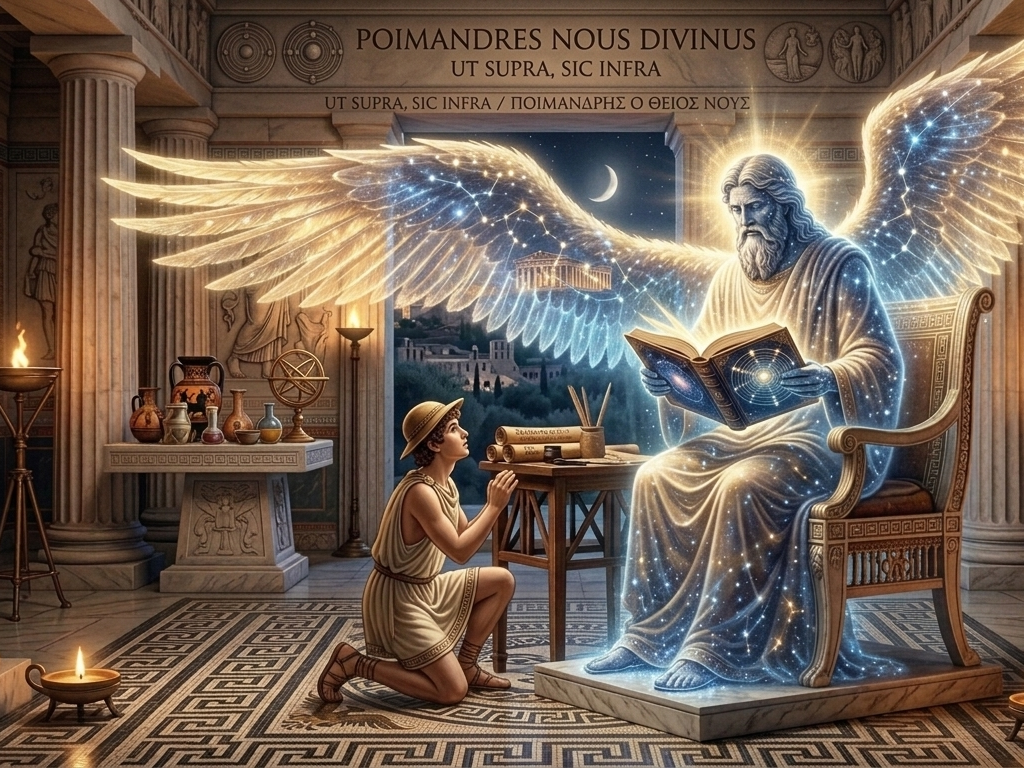
The text opens with Hermes Trismegistus meditating by the Nile, his mind turning inward, seeking the source of life and the nature of things. His senses withdraw. Darkness envelops him. And then a voice speaks: “I am Poimandres, the Mind of Power. I know what you want, and I will show you.”
Poimandres is not a god in the conventional sense. He is Nous — Mind itself, the active divine intelligence behind creation. And what he shows Hermes is nothing less than the origin of the universe, the nature of the human soul, and the path back to the divine source. Reading it carefully, you might pick up on the description of the contemplative experience itself: the moment when the chattering surface of the mind stills, and something deeper becomes visible.
The Hermetic Cosmogony: How the Universe Comes Into Being
Poimandres reveals a creation story that begins not with a craftsman god shaping matter, but with pure light and awareness overflowing into form. Before anything existed, there was The Source — ineffable Light and Life, The All, containing all potential within. The All speaks the Word (Logos), and from that speaking, Nous (Mind) comes into being as the first principle of cosmic order. From Nous flows the ordered cosmos: Fire, Air, Water, Earth, arranged in seven planetary spheres that govern Fate and the cycles of material existence.
This is not a world created by a distant craftsman and then left alone. The Hermetic cosmos is alive — a living, ensouled being that continuously participates in its divine source. The seven planetary spheres are not mechanical gears but intelligences, governors of a system that has purpose and direction. And the material world itself is described as a “second god, perceptible and visible” — not an illusion to be escaped, but a meaningful expression of divine creativity.
This distinction matters enormously for anyone drawn to Hermeticism through a wholistic lens. Unlike some traditions that see the physical world as a problem or a prison, Poimandres sees it as sacred. The challenge is not to escape the world but to perceive it rightly — to see the divine intelligence within it, not just the surface appearance. This, of course, greatly influenced me to embrace as much as possible a wholistic life, something I’m hoping to do with this website and podcasts.
The Fall of the Soul — And Why It Is Not a Tragedy
Poimandres then tells the story of humanity’s origin and fall. God creates Adam as a microcosm — a perfect image of the All, containing the whole pattern of creation within. Adam, loved by God, is given a portion of divine Mind. But Adam desires to create, to participate in the generative power of the cosmos. He descends into the material realm, and in doing so becomes entangled with the seven planetary governors, with Fate, with the body, with the passions. Something to point out is that this will be visited later with Sophia, who also desired to create.
The Hermetic notion of fall is not a moral catastrophe or a punishment, but a consequence of desire. The desire to know creation from the inside, from our human vantage point of view is seen as falling within the spheres. Here, humanity becomes double: mortal in body, subject to Fate and the cycles of matter; immortal in mind (Nous), capable of transcendence. Thus the duality is born and compounded with other seemingly duality aspects of life as sensed through the senses. In this context, we are, as the text puts it, neither purely divine nor purely animal, but something in between — the pivotal beings in creation, the hinge between the material and the divine. Essentially, this is what makes humans so unique, as far as we can tell.
“You are not a spiritual being having a human experience. You are a human being who is also, entirely, a divine one. Poimandres doesn’t ask you to choose. It asks you to hold both at once.”
Salvation Through Gnosis — And What Gnosis Actually Means
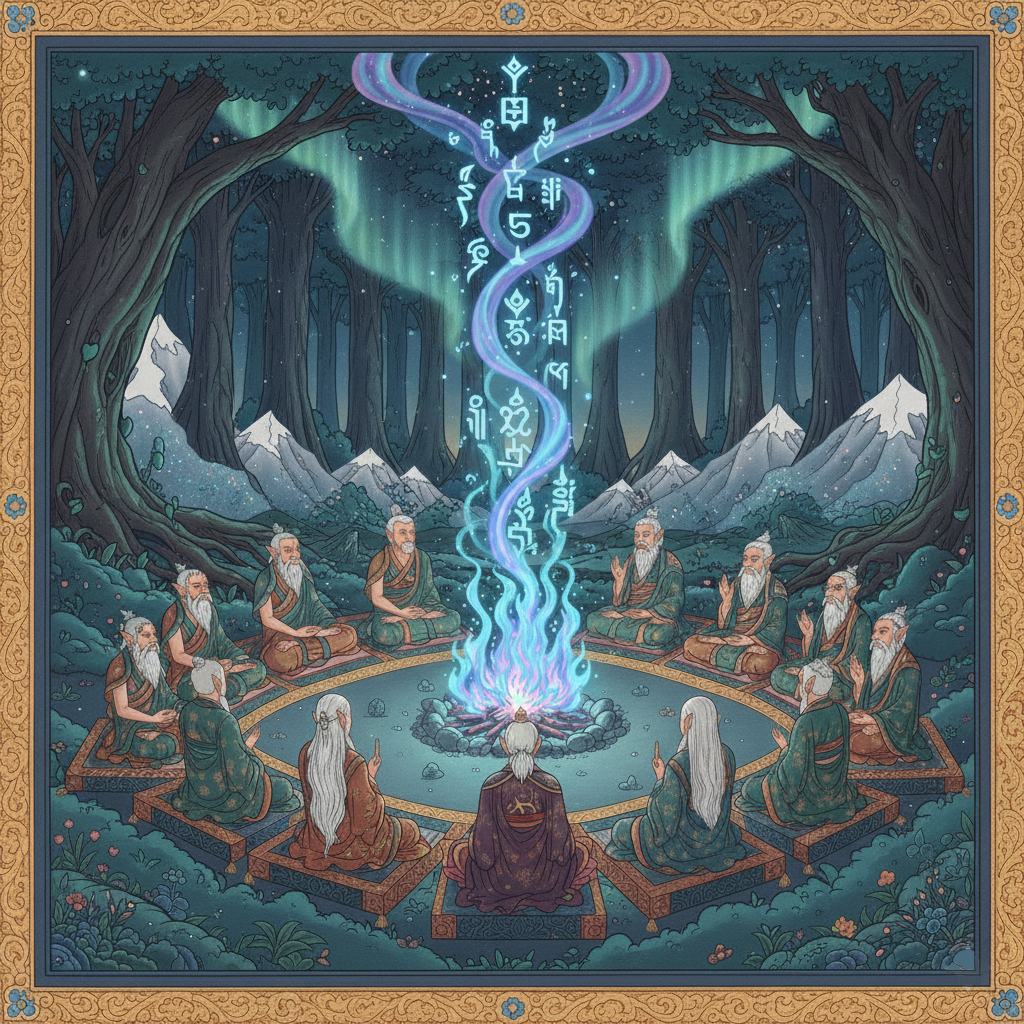
The Hermetic path out of entanglement is gnosis — a word that gets used loosely in spiritual discourse but has a specific meaning in the Hermetic texts. We will visit in greater details later. Gnosis does not mean belief in a set of propositions. It’s the opposite. It’s knowledge through self-awareness, direct inner knowledge. It does not only mean intellectual knowledge of facts. Gnosis is direct knowing — a living recognition of one’s own nature, of the divine intelligence within oneself, of the connection between the human microcosm and the cosmic whole. This is what Hermes Trismegistus found when he meditated by the Nile, gnosis.
It is worth noting that both Hermetic Philosophy and Gnosticism contain an inherent tension: their written traditions risk becoming the very obstacle to the direct inner knowing — gnosis. Gnosticism seeks direct knowledge, not the findings others have recorded in books and treatises. These systems exist not to simply be followed, but to serve as a doorway toward personal revelation. They are the impetus or perhaps, the nudge after sensing that inner impetus to seek and find our very own answers. This principle is foundational to The Wholistic Center: using the wisdom of these traditions as a catalyst for your own genuine gnosis, rather than as a doctrine to be accepted wholesale.
Interestingly, Poimandres points out that this direct knowing requires ethical preparation. The soul must be genuinely oriented toward clarity and compassion before gnosis is possible. The text gives a specific list of what this means in practice: mercy and reverence, freedom from envy, greed, deceit, anger, and violence. It requires simplicity, truthfulness. The avoidance of bodily excess that binds the soul’s attention to the surface of experience.
This is not asceticism for its own sake. It is a description of what happens to attention when the mind is constantly pulled toward distraction, craving, or reactivity: it cannot settle into the deeper perception that gnosis requires. The ethical demands of Poimandres are not rules imposed from outside. They are a description of the inner conditions necessary for clarity. In that sense, they map almost perfectly onto what contemporary contemplative traditions understand about the relationship between ethical life and meditative depth.

The Ascent of the Soul
After gnosis comes liberation. Poimandres describes the soul’s ascent through the seven planetary spheres after death, shedding at each sphere the qualities acquired in the descent.
1 – first sphere, the capacity for increase and decrease
2 – second, the instruments of evil
3 – third, illusive desire
4 – fourth, vain arrogance
5 – fifth, unholy daring
6 – sixth, the greedy impulse toward wealth
7 – seventh, falsehood.
Stripped of all of this, the soul arrives at the eighth sphere — beyond the planetary governors. From there and beyond even that, into union with the divine source.
Hermes is then sent back to teach this to humanity. The text ends with a hymn of praise: “Holy is God the Father of all. Holy is God whose will is accomplished by his powers. Holy is God who wills to be known and is known by those who are his own.”
What Poimandres Offers a Wholistic Life Today
Reading Poimandres in 2026, what strikes me most is how practical it is beneath the cosmological language. In fact, “hermetic philosophy” is practical, by all accounts. Strip away the planetary spheres and the mythological framework, what remains is a remarkably coherent description of the contemplative life. Essentially, we must turn silently inward without distractions from incarnated life to encounter with something vast and intelligent, the recognition that the chattering surface mind is not who and what we are, the ethical work that supports and deepens that recognition.
The teaching that we are microcosms — small images of the whole — resonates with ecological thinking, with systems theory, with the deep felt sense that our inner states ripple outward into relationships, communities, and the world we share. The insistence that ethical integrity is not separate from spiritual depth, but its very foundation, speaks directly to the wholistic approach that refuses to split personal transformation from relational responsibility.
And the vision of a cosmos that is alive — not a dead mechanism to be exploited but a living intelligence to be participated in — may be one of the most important things the ancient world has to offer the contemporary one.
In Part 3, we explore the full Hermetic vision of that living cosmos: the seven spheres, the principle of microcosm and macrocosm, and the famous maxim “As above, so below.”
← Previous: Part 1: What Is Hermetic Philosophy? Next: Part 3: The Hermetic Cosmos → Before the Kybalion. Before the Renaissance revival. Before any of the modern interpretations of Hermetic philosophy — there was Poimandres. The first and oldest treatise of the Corpus Hermeticum opens with Hermes Trismegistus meditating alone by the Nile, his senses withdrawing, until Mind itself speaks. What follows is nothing less than the Hermetic account of creation, the origin of the human soul, and the path back to the divine — told not as mythology, but as a map for the contemplative life.